
Test
Chapter 1
Este test tiene tipos de pregunta que se abren en el reproductor de siempre.
Preguntas del test (19)
1The [blank_start]phagocytic[blank_end] cells of the innate immune system include, monocytes and
neutrophils in the blood, & macrophages in the tissues. Collectively, the cells
and proteins activated by an infection provide the physiological basis for the
[blank_start]inflammatory[blank_end] response.- Aphagocytic
- Binflammatory
2The goal of
inflammation is to isolate and remove the irritant and repair the damaged
tissue- AVerdadero
- BFalso
3[blank_start]Sensor[blank_end] cells express PRRs that provide initial discrimination between self and nonself
- ASensor
4The inflammatory response involves three stages: 1) [blank_start]dilation[blank_end] of capillaries to
increase blood flow, which causes redness and heat; 2) [blank_start]blood vessel[blank_end] dilation
with entrance of plasma and proteins from the bloodstream, which causes
swelling; and 3rd), [blank_start]leukocyte[blank_end] transmigration from the blood stream through
[blank_start]endothelium[blank_end] and accumulation of cells at the site of injury, which causes
swelling and pain due to nerve cell stimulation.- Adilation
- Bleukocyte
- Cendothelium
- Dblood vessel
5The inflammatory response involves recruitment of leukocytes or white blood
cells to the site. This is accomplished by the leukocyte adhesion cascade
which includes five steps: leukocyte [blank_start]rolling[blank_end] adhesion, [blank_start]firm[blank_end] adhesion,
extravasation ([blank_start]transmigration[blank_end]), [blank_start]chemotaxis[blank_end], and [blank_start]phagocytosis[blank_end].- Arolling
- Bfirm
- Cchemotaxis
- Dphagocytosis
- Etransmigration
6All white blood cells are [blank_start]nucleated[blank_end], which distinguishes them from the
anucleated [blank_start]red[blank_end] blood cells and platelets.
Granulocytes are distinguished from agranulocytes by their [blank_start]nucleus[blank_end] shape
(lobed versus round, that is, polymorphonuclear versus mononuclear) and by
their cytoplasm [blank_start]granules[blank_end].- Anucleated
- Bred
- Cnucleus
- Dgranules
7Label the white blood cell types.
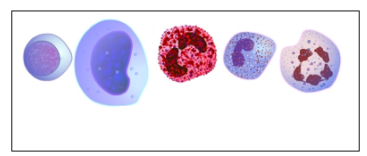
- Alymphocyte
- Bmonocyte
- Ceosinophil
- Dbasophil
- Eneutrophil
8Label image.
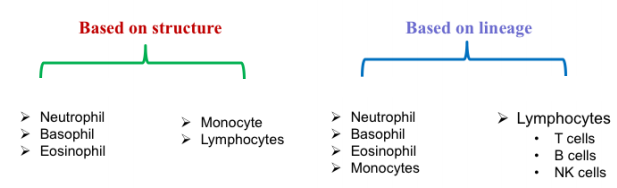
- AGranulocytes
- BAgranulocytes
- CMyleoid cells
- DLymphoid cells
9The components of the [blank_start]adaptive[blank_end] immune system include [blank_start]humoral[blank_end] immunity
and cell mediated immunity.- Aadaptive
- Bhumoral
10Cell mediated immunity destroys [blank_start]intracellular[blank_end] pathogens while humoral immunity removes [blank_start]extracellular[blank_end] pathogens.
- Aintracellular
- Bextracellular
11B lymphocytes from the adaptive immune system are derived from the
lymphoid precursor in the [blank_start]bone marrow[blank_end]. The Initial stages of B cell maturation
occurs in the bone marrow, where the antibody genes undergo rearrangement
resulting in membrane expression of [blank_start]IgM[blank_end]/[blank_start]IgD[blank_end], which are the antigen receptors
on naïve B lymphocytes.- Abone marrow
- BIgM
- CIgD
12Mature naïve B cells leave the bone marrow and reside in the secondary
[blank_start]lymphoid[blank_end] tissues, where they respond to antigen that enters via the [blank_start]lymph[blank_end]
fluid. CD19-21 are common CD markers expressed on B cells and are often
used to enumerate cells by flow cytometry analysis. MHC, Complement
receptors, Fc receptors, and B7 are cell membrane proteins expressed
following B cells activation.- Alymphoid
- Blymph
13[blank_start]Memory T cells[blank_end] develop from lymphocytes
following infection, and provide life long immunity to reinfection and are the
basis for immune protection following vaccination.- AMemory T cells
14For example, antibody binds to
a microbial toxin and prevents it from binding to its receptor on a host cell. This
is known as [blank_start]neutralization[blank_end]. Antibody [blank_start]opsinization[blank_end] refers to antibody binding to a
microbial surface, which enhances phagocytosis by macrophages. In addition,
antibody can cooperate with the [blank_start]complement[blank_end] system proteins to direct the
deposition of complement proteins that mediate microbial cell lysis.- Aneutralization
- Bopsinization
- Ccomplement
15All white blood cells are [blank_start]nucleated[blank_end], which distinguishes them from the
[blank_start]anucleated[blank_end] red blood cells and platelets.
Granulocytes are distinguished from agranulocytes by their [blank_start]nucleus[blank_end] shape
(lobed versus round, that is, polymorphonuclear versus mononuclear) and by
their cytoplasm [blank_start]granules[blank_end].- Anucleated
- Banucleated
- Cnucleus
- Dgranules
16NK cells are directly cytotoxic cells that recognize and lyse virus infected cells
or tumor cells. NK cells recognize abnormal cells by detecting changes in the
level of [blank_start]MHC[blank_end] I & II expression on somatic cells. NK cells detect changes in
MHC expression by Killer activating receptors (KIR) and Killer inhibitory
receptors (KIR). Unlike lymphocytes, NK cells do not exhibit [blank_start]specificity[blank_end],
however, specific NK sub-populations may have limited immunological memory
functions. The CD markers commonly used to identify and enumerate NK cells
by flow cytometry are CD16 and CD56. Also, the differential expression of
these two markers can identify killer and cytokine secreting NK subpopulation.- AMHC
- Bspecificity
17The role of antigen presenting cells is to internalize antigens and re-express them complexed with MHC molecules on the cell surface.
- AVerdadero
- BFalso
18[blank_start]B lymphocytes[blank_end] have both antigen presenting functions and antibody producing
ability.- AB lymphocytes
19[blank_start]Dendritic[blank_end] cells are the sentinels of the immune system by detecting activation
of the [blank_start]innate[blank_end] system, and function as the bridge to the adaptive immune
response by guiding the type of adaptive immune response induced.- ADendritic
- Binnate
Información
- Descripción
- GRE Immunology Test sobre Chapter 1, creado por Brooks Johnson el 28/01/2021.
- Autor
- Brooks Johnson
- Idioma
- English
- Visitas
- 0
- Etiquetas
- Valoración
- Aún sin valoraciones Valora este test