
Fichas
Chemistry
Fichas del conjunto (21)
- 1What is the relative mass of an electron?1/1840
- 2What is relative atomic mass?The weighted mean mass of an atom of an element 1/12 of the mass of an atom of carbon-12
Not normally a whole number as it is an average of relative isotopic masses - 3How can you calculate relative atomic mass?mass no x abundance + mass no x abundance ...
______________________
total abundance - 4What is relative isotopic mass?-The mass of an atom of an isotope 1/12 of the mass of an atom of carbon-12
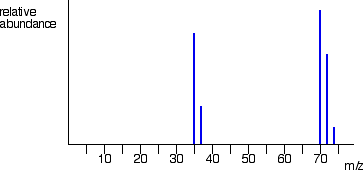
-It isn't always a whole number as the mass of protons and neutrons are miniscually different - 5Explain the following peaks on a Mass Spectra for Chlorine:-The two peaks around 35 and 37 are two different isotopes of chlorine
-The peaks around 70 are chlorine molecules as chlorine is diatomic. There are three peaks as there are three combinations of the two chlorine isotopes - 6Explain the following peaks on a Mass Spectra for Water:-The peak at 1 is hydrogen atoms that have separated from the H2O
-The peak at 16 is oxygen atoms that have separated from the H2O
-The peak at 17 is oxygen and hydrogen atoms that haven't completely separated
-The peak at 18 is the MOLECULAR ION PEAK of water molecules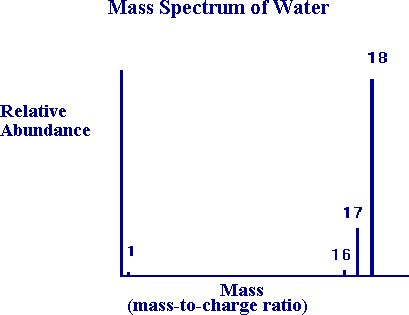
- 7What is the M+1 peak?It's a small peak behind the molecular ion peak which is due to the presence of isotopes, normally carbon 13
- 8How does the energy in quantum shells and sub shells differ-The further away quantum shell is from the nucleus the more energy it has (electrons less bound by the nucleus so more free to move about)
-Electrons in the same quantum shell have similar energy, electrons in the same sub shell have the same energy - 9How many orbitals does each sub shell have, and what is it's shape?-s sub shell is shaped like a sphere and has one orbital (max 2 electrons)
-p sub shell is shaped like three identical dumb-bell-shaped orbitals at right angels at each other. It has 3 orbitals (max 6 electrons)
-d sub shell has 5 orbitals (max 10 electrons) - 10How do you write the electron configuration of sodium and magnesium?-Sodium 1s2 2s2 2p6 3s1
-Magnesium 1s2 2s2 2p6 3s2
-The big number is the quantum shell
-The letter is the sub shell
-The small number is the number of electrons in the orbital - 11How do you write the electron configuration of sodium and magnesium (box and arrow)?
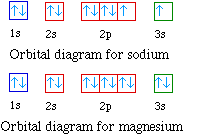
- 12What are electron orbitals?Areas where there is a probability of finding an electron, it's like a cloud
- 13What is the Aufbau principle?The sub shells with the lowest energy get filled first
-This is why the 4s sub shell gets filled before the 3d sub shell - 14What is Pauli's exclusion principle?Two electrons can't occupy the same orbital unless they are spinning in opposite directions
-This is why in the box and arrow notation the two arrows are pointing in opposite directions - 15What is Hund's rule?Electrons will first fill all orbitals in a sub shell singly before they pair up
- 16How can the periodic table be split according to the sub shells?
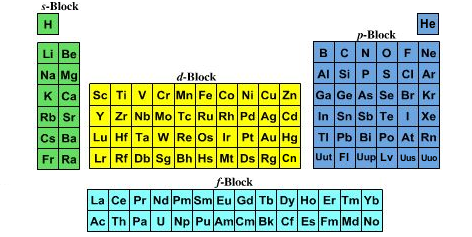
- 17What are the two exceptions to this pattern of electron configuration-Chromium
-Copper - 18Why do these exceptions exist?-The element is more stable if the outer sub shell is half full of completely full
-So in both cases an electron from the 4s sub shell moves to the 3d sub shell, so that in the case of chromium the 3d sub shell is half full and for copper the 3d sub shell is full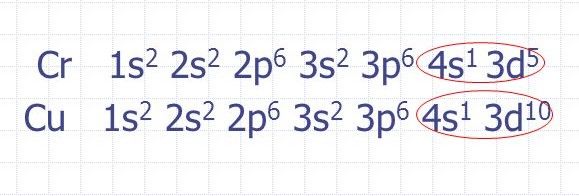
- 19How do you write the electron configuration of ions?-Use the same notation
-However, once the 4s sub shell is full, it has more energy than the 3d sub shell, so in an ion the electrons are first lost from the 4s sub shell - 20What is the shorthand method of writing electron configuration?Write the last noble gas in square brackets first and then continue from there
- 21What is ionisation energy?The amount of energy required for an atom to lose an electron
Información
- Descripción
- A level Chemistry Fichas sobre Chemistry, creado por Natalia Cliff el 17/09/2017.
- Creado por
- Natalia Cliff
- Visitas
- 0
- Valoración