
Fichas
Causes of genetic mutations
Fichas del conjunto (51)
- 1What is the difference in heritability of somatic and genetic mutations?Somatic mutations are passed on to daughter cells while germ mutations are passed onto the next generation
- 2Give an example of a positive evolutionary traitDuplication - if one copy of a gene fails then there is back up
- 3What are the three types of mutation?1) Point mutations
2) Frameshift mutations
3) Chromosomal mutations - 4What is triplet for the start codon?AUG - methionine
- 5What mutation causes sickle cell disease? What does this result in?1) A non-conservative change (T to A) which results in a non-conservative mutation of glutamine (neutral) to valine (hydrophobic).
2) This causes the misfolding/malformation of the haemoglobin molecule which carries oxygen. The change from a neutral to hydrophobic amino acid results in the formation of fibres which can cause the blood cells to sickle. - 6Give an example of a disease caused by a frameshift mutationTay-Sachs disease
- 7Where do the mutations in Tay-Sachs disease occur? What are the different types of mutations?1) Mutations in B-hexosaminisade A (Hex-A)
2) Point mutations (65/78), 8 frameshift mutations (6 deletions, 2 insertions). - 8What is the most common mutation in Tay-Sachs?A 4 base pair insertion in exon 11, observed in 80% of Tay-Sachs disease in Ashkenazi Jewish population
- 9What is B-hexosaminidase A (Hex-A)?A protein in the CNS which is important in the production of myelin
- 10What are the four kinds of chromosomal mutations?1) Deletions - part of the chromosome is left out
2) Duplication (insertion) - part of a chromosome breaks off and attaches to the sister chromatid
3) Inversion - Part of the chromosome breaks off and reinserts itself backwards
4) Translocations - Part of a chromosome breaks off and attaches to a different chromosome - 11What tends to be the result of an inversion?Often silent as all the genes and promoters are still present - DNA is read in opposite direction but still effective
- 12When can translocations be beneficial?Can lead to variation which can result in an evolutionary advantage
- 13What is Cri du chat? What do the mutations tend to be?1) Partial deletion of the short arm of the chromosome 5 (5p)
2) 90% are sporadic and de novo deletions - 14What is Di George syndrome? What are the majority of cases?1) Deletion of a region of long arm of chromosome 22 (22q11.2) (microdeletion)
2) Majority of cases are de novo. - 15What are the genes in the 5p important for?Chromosomal regulation of development - deletion results in neurons not wiring correctly
- 16When do most de novo mutations occur?During meiosis
- 17What is Charcot Marie Tooth disease (CMT1A)? What causes the majority of cases?1) Demyelination of the peripheral nerves
2) 70-80% of cases are due to duplication of a large region of the short arm of chromosome 17 (17p11.2) - this region contains the gene for peripheral myelin protein (PMP22). There are two copies of PMP22 gene, this increases the amount of PMP22. Myelin which has too much PMP22 results in the incorrect ratio of other proteins. This leads to poor quality myelin and demyelination. - 18What is XX male syndrome? How is it inherited?1) The SRY translocates from the Y chromosome to the X chromosome in the sperm. Consequently an individual with two X chromosomes may be male
2) Paternally inherited - 19What is non-disjunctionChromosomes fail to separate properly
- 20Why do bananas require clonal propagation?Bananas are triploid and therefore sterile.
- 21What happens to human triploid babies?Human triploid babies will miscarry or die within their first year of life.
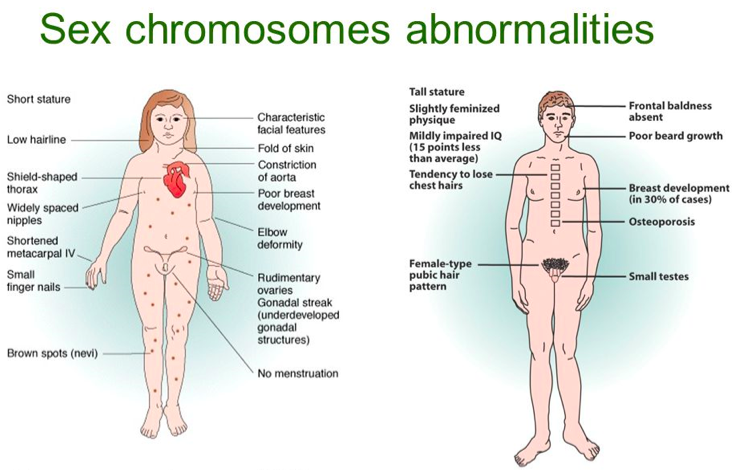
- 22—On the LHS is Turner syndrome (XO) on the RHS is Klinefelter syndrome (XXY)
- 23What are the four causes of non-heritable mutations?1) Spontaneous mutations (mistakes which happen during replication)
Induced:
1) Radiation
2) Chemicals
3) Infectious agents - 24Give four examples of chemicals which may cause mutations1) cigarette smoke
2) nitrate and nitrate preservatives
3) barbecuing
4) benzoyl peroxide - 25Give two examples of infectious agents which may cause mutations1) Human papillomavirus - viral DNA is incorporated into host and can disable normal DNA damage repair process
2) Helicobacter pylori - infection can cause stomach cancer and induce reactive oxygen species. - 26Describe the mutation rate associated with H. pylori.1) Up to four weeks following infection there is a mutation burst of around 2.2-8.4X10^-4 changes per site per year (acute infection triggers mutation burst)
2) Beyond 4 weeks (chronic infection) the mutation rate dramatically decreases to 0.5-2.5X10^-5 (equilibrates with host) - 27Describe the two hit theoryCancer requires two hits - usually there is a spontaneous mutation early on (or inherited) and then a second later hit (which can be environmental or spontaneous). 5% are inherited, 29% are from the environment and the rest are spontaneous.
- 28How many spontaneous mutations happen everyday in the body?10 to 100,000 - are successfully repaired
- 29What are the stages at which spontaneous mutations can occur?During the S, G1 and G2 phases of the cell cycle or movement of transposons (jumping genes).
- 30In eukaryotes what is the spontaneous mutation rate?10^-4-10^-6 per gene per generation - RNA polymerase has a natural error rate.
- 31What is a mutagen?An agent which causes a genetic mutation
- 32What effect do mutagens have on the number of mistakes made per gene?Increases it from 1,000 to 100,000 per replicated gene
- 33What are the three classes of mutagens? Give examples.1) Physical (UV rays, radiation and extreme heat)
2) Chemical (nicotine, pesticides and methane)
3) Biological (bacteria, viruses) - 34What are the three ways by which spontaneous mutations can occur?1) Depurination (most common, loss of a purine base - A or G)
2) Deamination
3) Tautomeric shift - 35What is depurination?A loss of a purine base (A or G)
- 36What is deamination? What are the two forms?1) Change from a normal base to an atypical base
2) Repairable - C to U; irreparable such as deamination of 5-methylcytosine and hypoxanthine - 37What is a tautomeric shift?A base is changed by a repositioning of hydrogen
- 38What three things contribute to replication errors?1) DNA polymerases
2) Endogenous mutagens which leads to
3) Mutagenic nucleotides - 39What are the repair systems in place to protect against the processes on the previous card?1) Sanitisation of the mutagenic nucleotide
If replication errors do occur then before next replication there should be
2) Proofreading
3) Mismatch repair - 40What contributes to spontaneous DNA damage? What in turn does spontaneous DNA damage contribute to?1) Endogenous mutagens
2) Replication errors - 41How can spontaneous DNA damage be corrected? How can spontaneous DNA damage lead to mutations?1) Error free repair
2) Error-prone repair results in the mutation being carried through - 42What is sanitisation usually?Apoptosis
- 43When is repair most effective?During the replication phase of the cell cycle - double stranded loss of a purine is repairable as there is still an existing template. Single stranded is harder because the RNA is 'not aware' of the damage.
- 44What type of action does radiation have?Direct and indirect
- 45Describe the direct action of radiationa- or B-particles or x-rays create ions which physically break the sugar phosphate backbone, connection between base pairs, or chemically alter bases.
- 46What happens to adjacent pyrimidines if the backbone is broken? What does this result in?They interact via hydrogen bonds which distorts the DNA. The 'kinked' section is then either excised or ignored when the DNA is read - either way this results in a loss of a base.
- 47Describe the indirect action of radiationCreation of free radicals, where the presence of unpaired electrons damages bases or breaks backbone - radiation causes the loss of an electron from water causing the production of a substance such as superoxide.
- 48How many deaths are estimated to occur due to smoking related cancer and other neoplasms?1,000,000 (30% of all cancer deaths in developed countries)
- 49How many carcinogens are there in a cigarette?More than 60
- 50What do the carcinogens in a cigarette cause?Double strand breaks, base pair trans-versions
- 51List some of the toxins in a cigaretteHexamine, arsenic, carbon monoxide, ammonia, methanol, nicotine, acetic acid, butane, methane, hexamine, cadmium, stearic acid, toluene.
Información
- Descripción
- Dr. L Robson 06.10.17
- Creado por
- Anna Hogarth · oct 2017
- Actualizado
- 24 oct 2017
- Visitas
- 416
- Valoración