
Fichas
Lecture 33 - The urea cycle
Fichas del conjunto (21)
- 1GOALS->Understand that ammonia is toxic and is excreted from animals as urea
->Know the important amino acids in nitrogen metabolism, including those for transport of nitrogen in the blood and in the urea cycle
->Understand the roles of glutaminase, transaminases, glutamate dehydrogenase and carbamoyl phosphate synthetase I in nitrogen metabolism in the level
->Describe the steps (and location of reactions) of the urea cycle
->Understand regulatory mechanisms of the urea cycle - 2TUTORIAL SLIDES Amino acid catabolism: nitrogen metabolism l. Remove the amino group 2. Dispose of nitrogen via ___ 3. Degrade carbon to metabolic products Amino group is removed by transamination or oxidative deamination. Must transport to the liver to make urea. Amino group is transported via blood as ___ or ____. In the liver, alanine and glutamine are converted into ____. Glutamate is converted to ___ and ______ by glutamate dehydrogenase. ___ is used to make urea. The carbon skeletons of the amino acids are degraded either to acetyl-CoA or to pyruvate or citric acid cycle intermediates.urea
alanine or glutamine
glutamate
NH4(+) & α-ketoglutarate
NH4(+) - 3Production of urea In liver mitochondria, NH4+ reacts with HC03- & ATP to make ___ _____. (Catalyzed by ____ ____ synthetase I) Carbamoyl phosphate combines with ornithine to make ____, which is transported to the cytoplasm. ____ provides the second nitrogen that will become urea. ____ is the penultimate product. ___ cleaves arginine to generate ___ and ornithine. Ornithine is recycled through the path. Urea is ____ Urea 1 nitrogen is from ____, incorporated from carbamoyl phosphate The carbon is from ____, incorporated from carbamoyl phosphate 1 nitrogen is from ____carbamoyl phosphate
carbamoyl phosphate
citrulline
Aspartate
Arginine
Arginase
urea
excreted
ammonia
bicarbonate
aspartate - 4Amino acid catabolism Amino acid catabolism produces ___ skeletons that are metabolized Defects in carbon skeleton metabolism underlie some ____ Amino acid catabolism releases ____ Ammonia accumulation is ___, therefore management of nitrogen waste is critical Nitrogen from amino acid catabolism is eliminated via the ___ ___carbon
diseases
nitrogen
toxic
urea cycle - 5Nitrogen-containing waste products Two major nitrogen-containing waste products that are excreted 1) ___ — produced in the liver from ammonia 2) __ ___ produced during purine catabolismUrea
Uric acid - 6Amino GROUP metabolism most amino acids degraded in ____ excess ammonia from other tissues is transported as amino acids (___ or ___) to the liver in liver excess ammonia is converted to ____ 4 amino acids are key for nitrogen metabolism — ___, ___, ____, & ___liver
glutamine or alanine
urea
glutamate, glutamine, alanine, and aspartate - 7Recall - Removal of nitrogen For amino acids catabolized in the liver: Amino group from amino acid is removed via a ____ reaction Generally, keto acid acceptor is _____: produces glutamate, which is transported into the mitochondria In mitochondria, glutamate is oxidized to a-ketoglutarate and ___ Enzyme is glutamate ____ — seen before — rxn runs in reverse here ___ is produced, which is used for ETC and production of ATPtransamination
α-ketoglutarate
NH4(+)
dehydrogenase
NADH - 8Transporting nitrogen to the liver In MUSCLE: α-ketoglutarate + amino acid ⇌ glutamate + α-keto acid, Then: pyruvate + glutamate ⇌ alanine + α-ketoglutarate ____ is transported in blood to liver In OTHER tissues, NH4(+) is released from glutamate by ___ deamination. Then: NH4(+) + glutamate + ATP ⇌ glutamine + ADP + Pi Catalyzed by ____ _____ Glutamine is transported in blood to liver.Alanine
oxidative
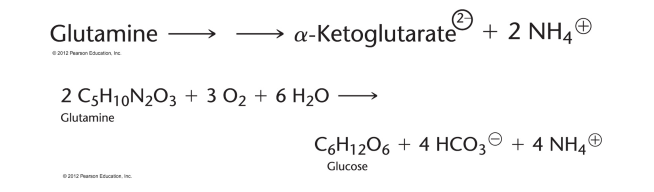
glutamine synthetase - 9In the liver Alanine from ___ — transamination reaction to transfer amino group to α-ketoglutarate generating ____ in the liver Glutamine from other tissues - is converted to glutamate and NH4(+) by ____ (in mitochondria) Glutamate is then converted to NH4(+) and α-ketoglutarate by ___ _____ NH4(+) is used to synthesize ___muscle
glutamate
glutaminase
glutamate dehydrogenase
urea - 10Urea less toxic than ____ uncharged ___-soluble transported via the blood to ___ for excretion "___" of urineammonia
water
kidney
salt - 11Overview of urea cycle Ornithine plays an important role Nitrogen in urea comes from 2 sources: l) ____ ____ and 2) _____ Arginine is cleaved by ____ to regenerate ___ and produce ureacarbamoyl phosphate and aspartate
arginase
ornithine - 12Synthesis of carbamoyl phosphate ' recall — citric acid cycle generates CO2 recall — carbonic ___ catalyzes the formation of carbonic acid from C02 and H2O dissociates into bicarbonate and H+ a mitochondrial carbonic anhydrase produces ____ bicarbonate reacts with ___ and ATP to produce carbamoyl phosphate catalyzed by __ ___ ___ __ in a reaction requiring 2 ATPsanhydrase
bicarbonate
ammonia
carbamoyl phosphate synthetase I - 13Urea cycle - detail carbamoyl group from carbamoyl phosphate is transferred to ornithine to produce ____ (mitochondria) citrulline condenses with aspartate to generate ____ (cytoplasm) arginosuccinate is cleaved to produce ___ & ____ (cytoplasm) arginine is hydrolyzed by ___ to produce ___ & ___ (cytoplasm)citrulline
arginosuccinate
arginine and fumarate
arginase
ornithine and urea - 14Urea cycle - detail Carbamoyl phosphate and citrulline made in _____ subsequent steps in ____ Citrulline transported via the ___-____ ___ glutamate-aspartate ____ also importantmitochondria
cytoplasm
citrulline-ornithine exchanger (citrulline in and ornithine out)
translocase - 15Urea cycle ornithine in the urea cycle is analogous to ____ in the citric acid cycle modified at each step of the cycle and ____ at the end of the cycle Fumarate (made in cytoplasm) is hydrated to form ___— enters mitochondria via malate-α-ketoglutarate exchanger and into citric acid cycle Enzymes in urea cycle are clustered — products are channeled to next enzyme without being ____oxaloacetate
regenerated
malate
released - 16Relationship of urea and citric acid cycles ____ is produced in the urea cycle and enters the citric acid cycle Oxaloacetate in the citric acid cycle can be converted to ____ to be used in the urea cycle Connection reduces the energy ___ of urea synthesisFumarate
aspartate
cost - 17Balance of urea cycle by flux reactions catalyzed by glutamate dehydrogenase and the transaminase are ____ _____ aspartate and carbamoyl phosphate levels for urea production (so urea can always be made) note how reactions proceed differently, depending on the molecule in ____ If ___ in excess, the urea cycle is favored If ____ in excess, the citric acid cycle is favoredreversible
balances
excess
NH3
Aspartate - 18Control of Urea Cycle Short term regulation: carbamoyl phosphate synthetase I is allosterically ___ by N-acetylglutamate — produced when glutamate, acetyl CoA and arginine are ___ arginine activates N-acetylglutamate ___ which produces N-acetylglutamate from ___ & ___ ___ Long term regulation: Expression of carbamoyl phosphate synthetase I and all enzymes in urea cycle is regulated by __ & ___activated
High
synthase
glutamate and acetyl CoA
diet and hormones - 19Glutamine metabolism in the kidney produces ___ to buffer the blood Ammonia is excreted in urine and ___ enters blood to replenishbicarbonate
bicarbonate - 20Recap I excess ammonia transported to liver as ___ or ___ glutaminase (glutamine) or transamination (alanine) produces ____ glutamate dehydrogenase releases ____ in mitochondria carbamoyl synthetase I produces ___ ___ from bicarbonate, ammonia and ATP carbamoyl group is transferred to ornithine to produce ___ aspartate condenses with citrulline and the product is cleaved to produce ____ and ____ (to citric acid cycle — via malate) arginine is cleaved by ____ to produce ornithine and ureaglutamine or alanine
glutamate
ammonia
carbamoyl phosphate
citrulline
arginine and fumarate
arginase - 21Recap II some reactions of the urea cycle in mitochondria and some in the cytoplasm short term regulation by ___ mechanism, long term regulation by altering ___ levels of enzymesallosteric
expression