
Fichas
Unit 1.1 Cells
Fichas del conjunto (206)
- 1What does the Cell Theory state-All living things consist of cells
- New cells are only formed by division of pre-existing cells
- Cells contain info that acts as instructions for growth ( info can be passed on to new cells) - 2What types of microscopes have been developed to help scientists study cells- Electron
- Light - 3Magnification isDegree to which an image is enlarged from actual size
- 4ResolutionDegree to which we can distinguish between two points that are close together
- 5How do light microscopes workUses number of lenses to produce image that can be directly viewed at eyepieces
Light - Bulb under stage - Through condenser lens - Through specimen - Light beam focused through objective lens - Through eyepiece lens - Image magnified - 6Light microscope advantages- Can view a wide range of specimens
- Less expensive
- Easier preparation methods
- Used widely in labs
- Can view living specimens - 7Light microscope disadvantages- Low magnification ( x 1500 ) & resolution
- Don't produce detailed or 3D images of organelles within cells
- Can't reveal contours and cellular/ tissue arrangements like SEM - 8Staining- Colored stains are chemicals that bind to chemicals on or in a specimen
- Allows stains to be seen
- Some stains bind to specific cell structures - 9Sectioning- Specimens embedded in wax
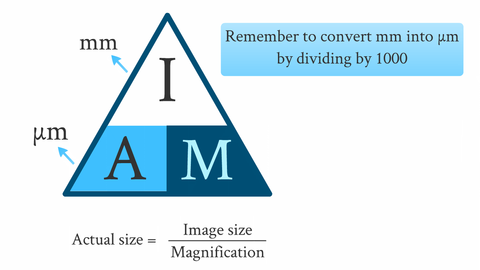
and thin sections are then cut without distorting structure - 10Equations for magnifiction
- 11Electron microscopes key points- Generate a beam of electrons that has a shorter wavelength than light
- Can distinguish between objects 0.2nm apart
- Use magnets instead of light
- Electrons not visible to human eye - 12Transmission electron microscope (TEM)Electron beam passes through thin prepared sample, produces 2D image and has a mag of around x 500 000
- 13Scanning electron microscopeElectorn beam directed onto sample, electrons bounce off sample, 3D image produced and has a mag of about x 100 000
- 14Resolution of light and electron microscopesLight - 200nm
Electron - 0.2nm - 15Advantages of electron microscopes- Higher resolution
- Can produced detailed images of organelles
- SEM produces 3D images revealing contours and tissue/ cellular arrangements - 16Disadvantages of electron microscopes- Samples have to be placed in a vacuum a electron beams are deflected by air molecules
- Expensive
- Requires high degree of skill and training - 17How is a thin section of liver tissue preparedFix specimen in ghlutaraldehye to make tissue firm - dehydrate to replace water with ethanol - embed dehydrated tissue in solid resin - cut thin slices using diamond knife- stain using lead salts- electrons scatter differently (contrast) - mount on copper grid - place specimen in vacuum in microscope
- 18What are colored electron micrographsElectron micrographs are colored using specialized computer software ( false-color )
- 1922
- 20What are the seven characteristics of all living thingsMovement
Respiration
Sensitivity
Growth
Reproduction
Excretion
Nutrition - 21What type of microscope can be used to identify organelles in cellsElectron
- 22What does the term 'Ultra structure' refer toThe detail of the inside of cells
- 23What does the term 'Division of labour' refer toSpecific organelles having specific roles within a cell
- 24What is the CytoskeletonNetwork of protein fibers within cells
- 25What is the role of the Cytoskeleton- Fibres keep cells shape stable
- Move some organelles around the cell
- Cause movement seen in some white blood cells - 26Types of protein fibres- Actin filaments
- Microtubles - 27What protein are Microtubules made ofTubulin
- 28What are the functions of microtubles- Move microorganisms through liquid/ or waft liquid past cell
- Move organelles and other cell contents along fibres (e.g. chromosomes during mitosis) = 'Microtubule Motors' - 29What are Cilia and FlagellaHair- like extensions that stick out from cell surface
- Made up of a cylinder (containing nine microtubles in a circle, with two in the middle) - 30What is the difference between Flagella and CiliaFlagella is longer and usually has a tail for eased movement
- 31How frequent are they on CellsFlagella - ones or twos
Cilia - Numerous ( in large numbers ) - 32Which is found on BacteriaFlagella
- 33What are vesicles and their roleMembrane bound sacs
Carry many different substances around cells - 34How do Vacuoles maintain cell stability in plantsThey are filled with water making them turgid so it pushes cytoplasm against cell wall
- 35Where are plant cell walls found and what are they made ofPlants have cellulose cell walls found on outside of plasma membrane
- 36Structure of NucleusLargest organelle
Has nuclear envelope, pores and a nucleolus - 37Function of NucleusHouses cells genetic material
Chromatin consists of DNA and proteins
Has instructions for making proteins - 38Structure of Endoplasmic Recticulum (ER)Series of flattened membrane bound sacks
- 39Types of ER and Functions1) Rough ER - Transports ans synthesis' proteins ( Studded with ribosomes )
2) Smooth ER - Synthesis' lipids - 40Structure of Golgi ApparatusStack of membrane bound flattened sacks
- 41Function of Golgi ApparatusModifies and packages proteins
- 42Structure of MitochondriaSpherical/ sausage-shaped
Double membrane, central matrix and cristae in inner membrane - 43Function of MitochondriaProduce ATP, during respiration
- 44Structure of Chloroplast
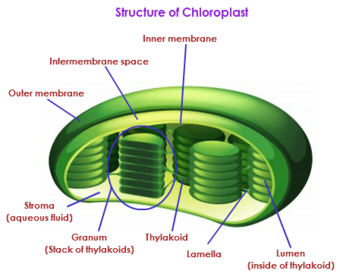
- 45Function of ChloroplastsSite of photosynthesis in plant cells
- 46Structure of LysosomesSpherical sacs surronded by single membrane
- 47Structure of RibosomesTiny organelles
Free floating in cytoplasm or attached to Rough ER - 48Function of RibosomesSite of protein synthesis
- 49Structure of CentriolesSmall tubes of protein fibres ( microtubules )
- 50Function of CentriolesForm spindle during cell division
- 51How do organelles work together in Protein synthesis1) Nucleus copies instructions onto mRNA molecule
2) Molecule leaves through nuclear pore
3)Attaches to a ribosome, instructions read and protein assembles
4) Pinched off in vesicle
5)Transported to Golgi Apparatus
6) Modified and then packaged into vesicles
7) Moved to CSM then secreted - 52Features of EukaryotesHave a true nucleus
Each organelle performs specific role
Larger
Have mitochondria - 53Features of ProkaryotesNo true nucleus
Bacteria
Smaller
No membrane bound organelles
Single loop of DNA in cytoplasm
Have flagella
Peptidoglycan cell wall - 54Examples of useful Prokaryotes ( Bacteria )- Food industry ( yogurt, cheese )
- On skin to prevent harmful microorganisms getting into body
- Digest/ respire dead or waste material ( useful for sewage treatment and natural recycling ) - 55Why are some bacterial cells well knownDue to the diseases they cause
- 56What can some bacterial strains become resistant toAntibiotics
- 5733
- 58What are the major roles of membranes- Separate cell contents from outside environment or cytoplasm
- Cell recognition and signaling
- Regulate material transportation into/ out of cells
- Hold components of some metabolic pathways in place - 59The phosphate head isHydrophilic
- 60The fatty acid tails of a phospholipid areHydrophobic
- 61Why are the tails hydrophobic and heads hydrophilicDue to the distribution of charges across the molecule
- 62Why can't oil and water mixAs their molecules have charges that are distributed evenly across them (oil), repel water molecules
- 63What happens when phospholipids are mixed with waterForm a layer on water surface
- Heads stick into water
- Tails stick up out of water - 64When can a bilayer formWhen phospholipid molecules are completely surrounded by water
- 65What does bilayer look likeinsert
- 66Phospholipids aren't bonded together, how is the bilayer kept stableHyrophilic heads cant easily pass through hydrophobic region in middle of bilayer
- 67All biological membranes haveA phospholipid bilayer
- 68Why is the hydrophobic layer necessaryCreates a barrier to many molecules
Separates cell contents from outside world - 69What type of microscope can be used to see membranesElectron
- 70Examples of differentiation in cell membranes1) Plasma membrane - contain receptors to detect molecules that regulate growth
2) Muscle cells - large number of channels, allow rapid glucose uptake (energy for contractions) - 71Why are all membranes permeable to waterWater molecules can diffuse through lipid bilayer
- 72Why are membranes with aquaporins more permeableThey are protein channels that allow water through them
- 73What are partially permeable membranesMembranes that allow water and some solutes through
- 74What does the term Fluid mosaic refer toMolecular arrangement in membranes
- 75Features of Fluid mosaic model- Phospholipid bilayer (basic structure)
- Protein molecules (floating in bilayer, free floating or bound to components)
- Extrinsic proteins (partially embedded in bilayer)
- Intrinsic proteins (completely span bilayer) - 76Phospholipid molecule + Carbohydrate partGlycolipid
- 77Protein molecule + Carbohydrate partGlycoprotein
- 78Role of cholestrol in membranes- Mechanical stability
Found between fatty acid tails to complete barrier - 79Role of channel proteins- Allow movement of some substances across membrane
(e.g. large hydrophilicmolecules/ions - go directly through cell using channel) - 80Role of carrier proteinsActively move substances across membrane
- 81Receptor sites...- Allow specific (matching) hormones to bind with cells to carry out responses
(e.g. allow drugs to bind, affecting cell metabolism) - 82How are glycoproteins and glycolipids involved in cell signalling- Allow recognition by immune system
- Components of some hormones - 83Advantage of enzymes/coenzymes on membranesSpeed up metabolic reactions
- 84Temperature effect on membrane =Increased Kinetic energy, move faster
- 85Disadvantage of increased membrane movement, as a result of increasing temperatureMembranes become leaky
Allows substances that wouldn't normally, enter or leave cell - 86How could an animal living in hot conditions become adapted to maintain membrane stabilityIncrease cholesterol content
- 87What are receptorsSurface sensors, receive signals
Usually protein molecules - 88Communication in multicellular organism cells are often mediated by...Hormones
- 89What are hormonesChemical messengers
within organism
Produced by specific tissues - 90What is a target cellAny cell with receptor for hormone molecule
- 91Why do hormone molecules and receptors on target csm bindComplementary shapes
- 92Binding results in a ...Particular response
- 93Outline Insulin receptors and their function- Hormone receptor
- Released from beta-cells in Pancreas
- Response to incresed blood suger levels
- Muscle/liver cells
- Insulin + its receptor = internal response in muscles, more glucose channels, more uptake so less glucose in blood - 94How are medicinal drugs able to interfere with receptors and why- Complementary shape
- Block certain receptors
(e.g. beta blocker prevent heart muscle from increasing heart rate in individuals where it would be harmful) - 95How can viruses enter cellsHijack receptors
Bind with receptors on CSM that normally bind to hosts signalling molecules (e.g.HIV) - 9644
- 97Why do cells need a supply of O2 and other nutrient moleculesTo survive
O2 for aerobic respiration - 98What is the name given to reactions in living cellsMetabolism
- 99What does metabolism generateWaste products that must be removed from cell across a membrane
- 100What are the passive transport processesDiffusion
Faciliated diffusion
Osmosis - 101What are the active transport processesActive transport
Endocytosis
Exocytosis - 102What is diffusionThe net movement of substances from a region of higher concentration to lower concentration, down concentration gradient
- 103What type of energy is used in diffusion for movementKinetic energy
- 104What is equilibriumA state in which there is no overall movement of molecules in one direction (no net movement)
- 105Factors that affect rate of diffusionTemperature (increasing means more kinetic energy)
Molecules size (smaller molecules diffuse quicker)
Distance (shorter diffusion distance necessary, thick membranes slow down diffusion)
Concentration gradient (more molecules on one side- increased diffusion) - 106Why can steroid hormones able to diffuse through cell membranesThey are lipid based
- 107Why can h20, co2 and o2 molecules pass through the bilayerMolecules are small
- 108Type of diffusion in which large or charged molecules can pass through bilayerFacilitated diffusion
- 109Channel proteinsForm pores in membrane
Only allow one type of ion through
Gated
(sodium, calcium ions) - 110Carrier proteinsShaped
Allow specific molecule to fit into them at membrane surface
Changes shape to allow molecule through to other side
(e.g. glucose, amino acids) - 111How do membranes have some control over types of substances that pass in or outDifferent membranes can have different carrier and channel proteins
- 112Active transportThe movement of ions or molecules across a cell membrane into a region of higher concentration, assisted by carrier proteins and requiring energy (to change shape)
Against concentration gradient
Faster than diffusion
One way across membrane - 113How is one-way flow ensuredAfter molecule passes through ATP energy changes proteins shape so molecule can no longer re-enter (will no longer fit through)
- 114Types of bulk transportEndocytosis
Exocytosis - 115EndocytosisBringing large amounts of material into cell
- 116ExocytosisMoving large amounts of material out of cell
- 117Example of bulk transport1) Hormones
Pancreatic cells make insulin in large quantities
Golgi apparatus modifies and packages insulin into vesicles
Vesicles fuse w/ outer membrane , insulin released into blood - 118Endo - Phago - Exo - Pino -Inwards
Solid material
Outwards
Liquid material - 119Solute + SolventSolution
- 120Water potentialMeasure of the tendency of water molecules to diffuse from one place to another
- 121How does water always moveFrom a region of high water potential to a region of lower water potential
Region of high concentration of 'free' water molecules to a region of lower concnetration - 122Osmosis is..Special kind of diffusion
Movement of water molecules across partially permeable membrane
Region of higher WP to regiom of lower WP - 123When does the net movement of molecules occurWP same on both sides of membrane
- 124Why is the WP lower in cells that in pure waterSugars, salts and other substances are dissolved in the cytoplasm
- 125What happens when cells are placed in solutions with high WPWater will move in by osmosis
Cell will swell
Animal cells - Membrane will eventually burst
Plant cells - Cytoplasm swells (turgid)
Vacuole pushes against cell wall
osmosis stops - 126What happens when cells are placed in solutions with low WPWater moves out of cell by osmosis
Cell shrinks
Animal cells - Cell contents shrink
membrane will wrinkle up
Plant cells - Cytoplasm and vacuole shrink as they lose water
Cell membrane pulls away from cell wall (plasmolysis) - 127What is the unit for measuring WPkPa (kiloPascals)
- 128WP of pure water0kPa (highest WP)
- 129Is a WP of -500kPa low or highLow
- 13055
- 131An example of a single celled organismAmoeba
- 132An example of a multicelluar organismOak trees
Humans - 133What does the cell cycle refer toA series of events in which new daughter cells are formed from parent cells
Daughter cell must be able to carry out same functions - 134What does each chromosome containOne molecule of DNA
- 135What does each molecule of DNA containGene (specific length of DNA)
- 136What do the chromosomes holdVital instructions for making new cells
- 137What must the daughter cells containAn exact copy of the instructions
Full set of chromosomes
(humans 46) - 138What are histones1) Proteins that wrap around molecules of DNA that make chromosome
- 139DNA + Histone proteins =Chromatin
- 140Describe the Copying and Seperating process of cell division1) DNA of each chromosome is replicated
2) Two replicas are produced
3) Each is an exact copy of the original
4) They remain held together at centromere point
5) Chromosomes are not visible under light microscope
6) Each chromosome now consists of two replica strands (sister chromatids)
7) Each chromatin must be supercoiled - 141Disadvantages and advantages of super coiled chromosomes- Can take up stains
- Sturdy and short enough to be moved around more easily
- Cant perform their normal functions in the cell (need to be coiled up for as short as possible) - 142How can the copying be checkedDuring chromosome replication, proof-reading enzymes move along new DNA strands
- 143What happens if genes are not copied preciselyMutation can occur as a result
New cells may fail to function - 144How fast is the cycleTime taken depends on the species and cell type
- 145Stages of cell cycle- Interphase
S phase - DNA replicates
Growth phase - proteins, organelles and other cell components are made
- Mitosis
Nucleus divides and chromatids seperate
- Cytokinesis
Cytoplasm divides or cleaves - 146How does Asexual reproduction work in organisms- Single celled organisms divide to produce two daughter cells
- Some multicelluar organisms produce offspring from parts of the parent - 147How do multicelluar organisms growGrow by producing new extra cells
(Each new cell is genetically identical to parent cells, can perform the same functions) - 148Why is making new cells important1) Replacement (red blood cells and skin cells)
2) Repair (damaged cells)
3) Growth
4) Asexual reproduction - 149What are the 4 stages of mitosis- Prophase
- Metaphase
- Anaphase
- Telophase - 150What happens in ProphaseReplicated chromosomes super coil
(Nuclear envelope breaks down and disappears
Centriole divides into two
Each daughter centriole moves to opposite poles to from spindle) - 151What happens in MetaphaseReplicated chromosomes line up down middle of cell
(Each becomes attached to spindle thread by its centromere) - 152What happens in AnaphaseChromosome replicas are pulled apart to opposite poles of cell
- 153What happens in Telophase
- 154In what organism are all cells capable of mitosis and cytokinesisAnimals
- 155What is the name of the only cells in plants that can carry out mitosisMeristem cells
- 156As plants do not have centrioles, where are their tubulin protein threads (spindle) madeIn the cytoplasm
- 157What are the cells produced by mitosis and cytokinesesis genetically identical toThe parent cell and each other
- 158What is the name given to genetically identical cellsClones
- 159What is vegetative propogationA form of asexual reproduction in plants where clones can be produced
(e.g.strawberry plant runners) - 160What is Binary FissionProcess in which a single colony of bacteria clones can be produced from a single bacteria dividing
- 161An example of how farmers have used artificial cloningTaking cuttings from parent plants, to make clones with desirable features
- 162An example of how scientists have used artificial cloningArtificial cloning of animals
- Dolly the sheep, placed cell from adult sheeps udder into a egg cell and placed in surrogate mother, raising many ethical issues - 163What are stem cellsCells that have the ability to divide and develop into any cell type
- 164What are embryonic stem cells (that can develop into any adult cell type) classified asTotipotent
- 165What are adult stem cells (that can be found in small numbers in adult tissue) classified asPluripotent
- 166Where are plant meristem cells locatedRoots and shoots
- 167How can genetically different organisms be made (sexual reproduction)Male gamete + female gamete fuse to form zygote
Zygote then divides by mitosis to form new individual organism - 168What is the name of the cell division usually responsible for producing gametesMeiosis
- 169In what regions of the adult organism does meiosis take placeSex organs or gonads
- 170Normal eukaryotic adult cells are 'diploid', what does this meanThey contain two sets of chromosomes
- 171Normal eukaryotic daughter cells are 'haploid', what does this meanEach contains only one set chromosomes
- 172Why do the resulting daughter cells differEach recieves only one part of the pair of each homologous pairs, the alleles found on each pair side will differ
- 173Ways in which meiosis differs from mitosis- Meiosis produces cells containing half the number of chromosomes
- Produces cells that are genetically different from each other and parent cell - 17466
- 175What governs the physical size that a single cell can reach- The need to support structures within the cell
- Increasing difficulty of getting enough O2 and nutrients to cell as size increases - 176What type of organism has a large surface area to volume ratioSingle-celled organism
- 177The benefit for single-celled organisms with a large surface area to volume ratioCan receive O2 and remove CO2 by simple diffusion through their membrane
- 178Why do multi-cellular organisms need specialized tissues (organs,tissues)Small SA to Volume ratio
- To deliver O2 and remove waste from cells that aren't in contact with external medium - 179What is specialisationWhen a cell can carry out a particular role
very well - 180What is differentiationWhen a cell becomes specialized to perform particular role or function
- 181What are the 3 ways in which a cell can differentiate- Number of a particular organelle
- Cells shape
- Contents of the cell - 182There are two types of human blood cells that each began with the same number of chromosomes, what are they called- Erythrocytes (red blood cells)
- Neutrophils (white blood cells) - 183What are both blood cells produced fromUndifferentiated stem cells in bone marrow
- 184How do Erythrocytes differ- No nucleus, mitochondria, golgi or RER
- Packed full of haemoglobin
- Biconcave disc shape
- Capable of transporting O2 from lungs to tissue - 185How do Neutrophils differ- Keep their nucleus
- Granular looking cytoplasm (large amounts of lysosomes produced)
- Ingest invading microorganisms (assisted by digestive enzymes in lysosomes) - 186What is a 'tissue'Collection of similar cells that perform a common function
- 187Example of a TissueXylem
Phloem
Nervous
Epithelial - 188What is an 'organ'Collection of tissues working together to form particular function
(Liver, leaves) - 189What is an 'organ system'Number of organs working together to perform an overall life function
- 190What is an 'organ system'Number of organs working together to perform an overall life function
- 191Two types of plant transport tissuesXylem
Phloem - 192Why are transport tissues necessary in plants- Move munerals and water from soil, thrpough their roots and stems , up into the leaves
- Move products of photosynthesis from leaves to other parts for storage or growth - 193Where do Xylem and Phloem come from And why do they differentiateDividing meristem cells (e.g. cambium)
- Differentiates to form different cells in tissues - 194What does Xylem transport and in what directionWater and minerals
Up the plant - 195What does Phloem transport and in what directionSugars, products of photosynthesis
Up and down the plant - 196Key features of Xylem- Vessels with parenchyma cells and fibres
- Lignified walls (waterproof)
- Wide lumen, no end walls
- Dead cell contents
- Provides support for plants
- pITS - 197Key features of Phloem- Sieve tubes
- Companion cells
- End to end long tube
- Sieve plates between cells - 1984 categories for animal tissues- Epithelial tissues (layers, linings)
- Connective tissues (e.g. cartilage, bone)
- Muscle tissue (specialized to contract and move parts of body)
- Nervous tissue ( cells that convert stimuli to electrical impulses and conduct impulses) - 199Types of epithelial tissuesSquamous and Ciliated
- 200Features of Squamous epithelial tissue- flattened, thin cells
- Thin smooth flat surface
- Ideal for lining blood vessels
- Form thin walls (e.g. alveoli) to maintain short diffusion pathway
- Held in place by basement membrane made of collagen and glycoproteins - 201Features of Ciliated epithelial tissue- Column shaped cells
- Found on inner surface of tubes (e.g. trachea, bronchi)
- Exposed region covered with cilia, some produce mucus (rhythmic waves) - 202Requirements for photosynthesisLight
Water
CO2 supply
Chlorophyll presence - 203What is the major organ of photosynthesisLeaves
- 204How are leaves adapted to photosynthesize excrete waste products- Transparent upper epidermis to let light through
- Lower epidermis with stomata pores, allow gas exchange
- Cylindrical palisade cells layer beneath epidermis , packed with chlorophyll containing chloroplasts - 205How are stomata opened and closedGuard cells
- Found on lower epidermis
- Water moves into cell
- Become turgid, outer walls stretch
- Cells bulge at both ends, pore opens between them (stomata) - 206Cells CompletedGood Luck :)!!!
Información
- Descripción
- Fichas sobre Unit 1.1 Cells, creado por 09snjie el 09/03/2015.
- Creado por
- 09snjie
- Visitas
- 46
- Etiquetas
- Valoración