
Fichas
SD329 Block 1 & 2 Definitions
Fichas del conjunto (135)
- 1NeuronA type of cell in the nervous system specialised to transmit information
- 2Glia/Glial CellNon-neuronal cells found in the nervous system. They have a range of vital support roles for neurons, which include guiding the connections formed between neurons during brain development, or producing the myelin that acts as an insulator for neuronal axons.
- 3AfferentCarrying information towards more central structures
- 4EfferentCarrying information from the central structures of the brain
- 5Cerebral hemispheresThe two halves of the main brain mass lying on either side of the sagittal plane above the brainstem and cerebellum
- 6Cerebral cortexThe outer layer of neurons that covers the cerebral hemispheres of mammals and is responsible for sensations perceptions, learning, voluntary movement, speech and cognition
- 7Brain stemThe collective name for the midbrain and the pons and medulla of the hindbrain
- 8CerebellumThe portion of the brain located beneath the occipital and temporal lobes. A component, together with the pons and medulla, of the hindbrain. It is primarily a movement control centre.
- 9Spinal cordThe part of the central nervous system that is located within the column of vertebrae that make up the spine
- 10Frontal lobeOne of four lobes of the cerebral cortex situated at the front of the brain. It is associated with motor control and higher mental processes.
- 11Parietal lobeOne of the four lobes of the cerebral cortex situated at the top of the brain. It is associated with bodily sensations and perceiving spatial relationships.
- 12Temporal lobeOne of the four lobes of the cerebral cortex situated at the base of the brain. It is associated with the sense of hearing.
- 13Occipital lobeOne of the four lobes of the cerebral cortex situated at the rear of the brain. It of associated with the sense of vision.
- 14DorsalBelow the neck, its the direction towards the back.
Above the neck, its towards the top of the brain. - 15PosteriorBelow the neck, its the direction towards the back (also called dorsal)
- 16VentralBelow the neck, its the direction towards the front.
Above the neck, its towards the base of the brain. - 17AnteriorBelow the neck, its the direction towards the front (also called ventral)
- 18Alpha-amino acidsCompounds with molecules having an amino group and a carboxyl group attached to the same carbon atom.
The constituents of the naturally occurring group of molecules called proteins.
There are 20 different amino acids found in proteins. - 19Absolute refractory periodThe period of time after the generation of an action potential when no amount of depolarization can initiate another action potential
- 20Action potentialA momentary and localised change in electrical potential across the membrane of a neuron (or muscle cell) caused by a rapid change in the membranes permeability to Na+
- 21Active transportTransport of a substance across a biological membrane against its concentration gradient.
This process requires energy. - 22Adaptation1. The change in perception of a sensory experience with time while the stimulus is unchanged.
2. Sensory receptor adjustment to different levels of stimulation which allows systems to operate over a wide dynamic range.
(See 'sensory adaptation') - 23Additive Primary ColoursThe 3 colours of light (red, green and blue) that are sufficient to create any colour of the visible spectrum.
- 24AgeusiaThe absence of the sense of taste.
- 25All-or-nothing ResponseThe response of the neuron once the threshold potential has been reached, i.e. the firing of the action potential. Below the threshold there is no response.
- 26AmplitudeThe maximum departure of an oscillating system from its average value.
- 27AnosmiaThe absence of the sense of smell.
- 28Arachidonic Acid (AA)A polyunsaturated fatty acid that can act as an intracellular messenger. It is released by the cell membranes by the action of an enzyme which is activated by G-proteins (and by some other stimuli).
It acts to stimulate a variety of intracellular signalling pathways and is a precursor of other signalling molecules such as prostaglandins. - 29Association AxonAxon which links two areas of the cerebral cortex
- 30AstrocyteA type of star-shaped glial cell found in large numbers in the CNS. Astrocytes give structural support to neurons and are thought to be involved in the regulation of their metabolism
- 31Axon HillockThe region of the cell body from which the axon emerges, and where the action potential is usually first generated
- 32AxonThe extension of a neuron that by virtue of its excitable membrane, conducts action potentials away from the cell body
- 33Axon TerminalSmall terminal expansion of the axon at the synapse where neurotransmitter molecules are stored and released
- 34AxoplasmThe intracellular constituents within an axon
- 35Background Firing RateThe spontaneous rate of generation of action potentials in a neuron in the absence of stimulation, e.g. the activity observed in retinal ganglion cells when their receptive fields are uniformly illuminated
- 36Blood-Brain BarrierA barrier formed by special cells, with tight seals between them, that line the blood vessels of the brain; it regulates the movement of chemicals from the blood to the fluid that bathes the neurons of the brain
- 37Bodily Senses (somatic sensory system)The part of the peripheral nervous system concerned with the bodily or general senses of touch, pain, temperature, proprioception and kinesthesis
- 38BrainstemThe collective name for the midbrain and the pons and medulla of the hindbrain
- 39Brodmann's areasThe 47 separate zones of the brain differentiated by the German neuroscientist Korbinan Brodmann on the basis of their visually distinctive anatomical appearance.
- 40CarriersAlso called transporters, these membrane proteins transfer small specific molecules and ions across membranes. They bind to a solute molecule (or ion) and release it on the other side of the membrane.
Carrier-mediated transport can be either passive or active. - 41CaudalBelow the neck, it's the direction towards the feet; above the neck, it's towards the back of the brain.
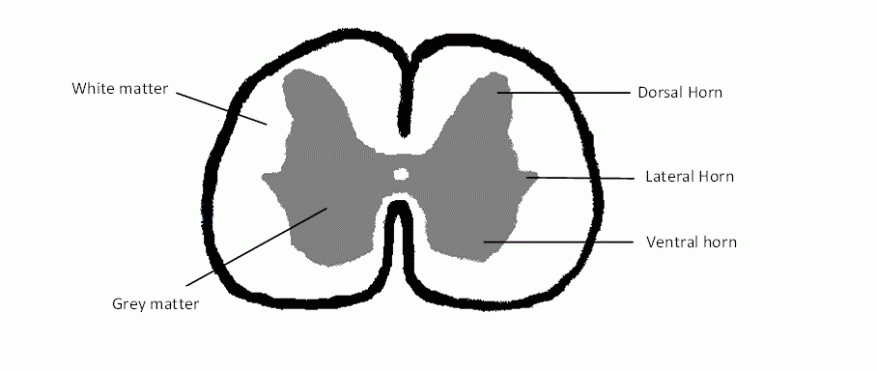
- 42Central CanalThe tube running down the centre of the spinal cord, filled with cerebrospinal fluid (CSF)
- 43Central Nervous System (CNS)The brain and the spinal cord
- 44CerebellumThe portion of the brain located beneath the occipital and temporal lobes.
A component, together with the pons and medulla, of the hind brain.
Primarily a movement control centre.
https://www.youtube.com/watch?v=Fir-v6EoZNE - 45Cerebral CortexThe outer layer of neurons that covers the cerebral hemispheres of mammals and is responsible for sensations, perceptions, learning, voluntary movement, speech and cognition
https://www.youtube.com/watch?v=mGxomKWfJXs - 46Cerebral HemispheresThe two halves of the main brain mass lying on either side of the sagittal plane above the brainstem and cerebellum
- 47Cerebrospinal Fluid (CSF)The fluid produced in the ventricular system, which fills the ventricles and central canal of the spinal cord as well as the subarachnoid space around the brain and spinal cord.
It acts both as a cushion for the brain within the skull and as a source of nutrients for it.
https://www.youtube.com/watch?v=yWR3nML_R8Q - 48ChannelsMembrane proteins that enable transfer of the small specific substances (usually ions) across membranes. Channels provide an aqueous pore in the membrane through which solutes can pass. Channels allow only passive movement of solutes.
https://www.youtube.com/watch?v=gWLqXEyEWM0 - 49Chemical SensesThe sense of smell and taste
- 50Chemical SynapseA synapse where information is exchanged between cells as a chemical signal in the form of molecules called neurotransmitters.
https://www.youtube.com/watch?v=mItV4rC57kM - 51ChemoreceptorA receptor activated by interaction with a molecule
- 52CochleaThe coiled structure of the inner ear that contains the receptor cells for hearing where sound stimuli are converted to electrical signals.
https://www.youtube.com/watch?v=WeQluId1hnQ - 53CollateralsThe axon branches of neurons (e.g pyramidal cells)
- 54Complementary ColoursThose colours (wavelengths) of light which, when added in equal proportions, produce white (uncoloured) light. E.g red and cyan, blue and yellow.
- 55Conduction VelocityThe speed at which an action potential travels along an axon.
- 56ContralateralOn the opposite side of the central plane
- 57Convergent InputsAxons from many neurons which all synapse on a single cell
- 58Coronal PlaneAny plane that divides the brain vertically into a front section and a rear section
- 59Corpus CallosumThe thick bundle of axons that forms a bridge between the two cerebral hemispheres. It is composed of axons which connect the corresponding areas of each hemisphere.
https://www.youtube.com/watch?v=xMvVAfZcU1s - 60CutaneousOf the skin
- 61CytoskeletonSystem of long filament-like protein polymers, which confer shape and support to the cell and mediate many types of cellular movement.
https://www.youtube.com/watch?v=oIrnecBfHzg - 62DendriteExtension of a neuron that receives many synapses from other neurons. It does not usually conduct action potentials.
- 63Dendritic SpinesSmall protrusions on the surface of dendrites which are contacted by, usually, one pre-synaptic terminal.
- 64DepolarizationA change in membrane potential towards a LESS negative value.
- 65Depth CueA specific feature of the two-dimensional image of an object that enables the visual system to interpret the three-dimensional structure of that object.
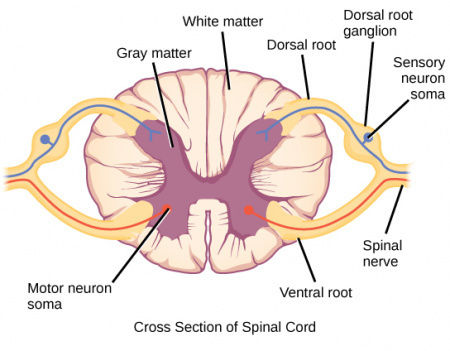
- 66DermatomeThe area of skin whose sensory receptors are sensory neurons that lie in one single dorsal root ganglion.
https://www.youtube.com/watch?v=ZZ0nNplN_KE - 67DistalFurther from the centre of origin
- 68Divergent OutputsThe outputs of one neuron that form the inputs to a number of other neurons.
- 69DorsalBelow the neck it's the direction towards the back.
Above the neck it's the direction towards the top of the brain. - 70Dorsal Column NucleiThe nuclei in the dorsal part of the medulla where the axons of the dorsal columns terminate.
The neurons of the dorsal column nuclei relay touch information to the ventrobasal nucleus of the thalamus on the opposite side of the brain.
https://www.youtube.com/watch?v=nQfRUehU4zQ - 71Dorsal ColumnsThe bundles of uncrossed axons that ascend from the dorsal spinal cord to the medulla and transmit information about touch
- 72Dorsal HornThe dorsal part of the central grey matter of the spinal cord.
It contains neurons that receive inputs from sensory axons. - 73Dorsal RootThe bundle of sensory axons that enter the dorsal part of the spinal cord
- 74Dorsal Root GangliaA swelling of the dorsal root just before it enters the spinal cord. Contains the cell bodies of the sensory neurons in the dorsal root.
- 75EfferentCarrying information from the central structures of the brain
- 76Electrical SynapseA synapse where information is passed between cells as an electrical signal
- 77Electroencephalography (EEG)This is a direct functional imaging technique that detects electrical activity associated with brain function via arrays of electrodes that are attached to the scalp
- 78EndocytosisA process by which a cell takes in substances or particles by surrounding them with part of the cell membrane, which then becomes detached to form a 'bubble' (vacuole) within the cell.
The opposite process is exocytosis.
Endocytosis is important in the re-uptake of neurotransmitter molecules into the pre-synaptic cell or glial cells. - 79EndorphinsA group of endogenous peptides that activate opiate receptors, producing a feeling of wellbeing and tolerance to pain.
- 80EnkephalinAn endogenous pentapeptide with the structure H-Tyr-Gly-Gly-Phe-Xaa-OH (where Xaa is one of the two amino acid residues Met or Leu), which activates opiate receptors.
- 81EnteroceptorA receptor that responds to a change in the internal conditions within an animals body.
- 82ExafferentStimulation of sensory receptors by changes in the external environment that do not result from one's own movement
- 83Excitatory Post-synaptic Potential (EPSP)A change in local potential occurring at the synapse which depolarizes the post-synaptic cell and thus makes an action potential more likely.
https://www.youtube.com/watch?v=u3DLs3eGc48 - 84ExocytosisThe process by which molecules are released from cells. Secreted molecules are stored in membrane-bound vesicles, which fuse with the plasma membrane. The opposite process is endocytosis.
https://www.youtube.com/watch?v=VOzV4d0HKis - 85ExteroceptorA receptor that responds to stimuli external to the animal.
- 86ExtracellularOutside the cell
- 87FiringThe passage of action potentials
- 88FrequencyThe number of complete cycles of a periodic process in one second
- 89Frontal LobeOne of the four lobes of the cerebral cortex situated at the front of the brain.
It is associated with motor control and higher mental processes. - 90Functional ImagingOne of several techniques such as MEG, EEG, PET and fMRI, which have become increasingly associated with experiments to locate distinct anatomical regions of the brain that perform particular sensory, motor or cognitive functions, and in what order, in response to carefully controlled stimulus.
- 91Functional Magnetic Resonance Imaging (fMRI)An indirect functional imaging technique which, in one version, is able to detect local increases in blood flow in activated areas of the brain and display these as highlighted areas on a conventional MRI scan.
- 92FundamentalThe component with the lowest frequency in a complex wave.
- 93G-protein ReceptorA receptor molecule that typically spans the cell membrane seven times.
When it binds to its ligand (which can be a neurotransmitter or a hormone) intracellular G proteins are activated.
https://www.youtube.com/watch?v=N7o0Fkz9iGE - 94Glia / Glial CellNon-neuronal cells found in the nervous system.
They have a range of vital support roles for neurons, which include guiding the connections formed between neurons during brain development, or producing the myelin that acts as an insulator for neuronal axons.
https://www.youtube.com/watch?v=AwES6R1_9PM - 95Golgi Apparatus (Golgi Complex)The cell organelle that processes and packages proteins into membrane-bound vesicles for delivery to different parts of the cell, or out of the cell.
https://www.youtube.com/watch?v=fqXGKDmV9Vs - 96Grey MatterThe regions of the central nervous system such as the central region that consist mainly of neuronal cell bodies.
- 97Gyrus (pl. Gyri)A ridge on the cerebral cortex
- 98HarmonicA sine wave component of a complex wave, with a frequency that is a whole number multiple of the fundamental frequency.
- 99Height-in-the-fieldA depth cue resulting from the position of an object in a picture relative to the horizon.
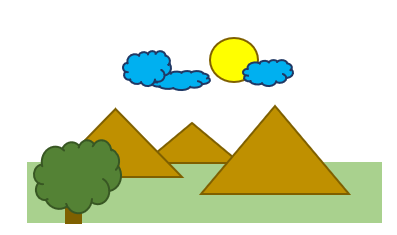
(See also 'relative height) - 100Horizontal PlaneA plane that divides the brain horizontally.
- 101HyperpolarizationA change in the membrane potential to a value MORE negative than the resting value.
- 102HypogeusiaImpaired sense of taste.
- 103HyposmiaImpaired sense of smell.
- 104IlluminationA measure of the amount of light falling upon a surface
- 105IllusionA misperception of physical reality usually caused by misleading interpretations of the signals received by our senses by the misapplication of particular cues.
- 106Impossible FiguresA type of visual illusion in which two-dimensional images containing conflicting depth cues represent three-dimensional figures that therefore could not exist in reality.
- 107InferiorAbove the neck it's the direction towards the base of the brain.
(See also 'ventral') - 108Inhibitory Post-synaptic Potential (IPSP)A change in the membrane potential of a neuron produced by synaptic activity that decreases the overall depolarization of the post-synaptic cell and makes the neuron less likely to generate an action potential.
https://www.youtube.com/watch?v=NUIGGvzLd3g - 109InnervationThe distribution of nerves to an organ
- 110InterneuronsNeurons that form connections between other neurons.
Strictly speaking, they are all interneurons except for the first sensory afferent in any pathway and the final motor efferent. - 111InterpositionA depth cue resulting from the obscuring of more distant objects by nearer ones.
- 112Intrinsic NeuronsNeurons whose axons remain within the area where the cell bodies are located, e.g in the cerebral cortex
- 113Ionotropic ReceptorA receptor molecule that, when activated by binding to a ligand, forms a channel that spans the membrane.
- 114IpsilateralOn the same side of the bodies central plane
- 115KinesthesisThe sense that provides information about the movement of individual body parts.
Also known as dynamic proprioception. - 116Labelled Line CodeA system of coding information whereby a particular neuron, or pathway of neurons, would be sensitive to and transmit information on a particular quality of stimulus, such as touch.
https://www.youtube.com/watch?v=PwrYg_dr6Nc - 117LateralFurther away from the bodies central plane.
- 118Lateral Geniculate NucleusThe specific thalamic nucleus whose neurons relay visual information to the primary visual cortex.
https://www.youtube.com/watch?v=fkzdUBseKek - 119Lateral InhibitionThe process whereby, through inhibitory interneurons, it is possible to have antagonistic relationships between two areas of a receptive field and thus to accentuate locations where there is a stimulus discontinuity.
https://www.youtube.com/watch?v=lYmQWm3ZtlA - 120LesionsRegions of damaged brain tissue.
- 121LigandA molecule, such as a neurotransmitter, that binds specifically to a receptor to form a receptor-ligand complex.
- 122LightnessThe perception corresponding to surface reflectance
- 123Lightness ConstancyThe capacity of the visual system to interpret surface reflectance consistently despite differences in lighting conditions
- 124Linear PerspectiveThe depth cue that makes use of the appearance of parallel lines converging as they recede into the distance
- 125Longitudinal WaveA wave with the oscillations being along the direction of travel of the wave
- 126LuminanceA measure of the amount of light projected by a surface
- 127Magnetoencephalography (MEG)A direct functional imaging technique that is able to detect, and locate, the very weak magnetic fields associated with the electrical currents caused by neural activity
- 128MechanoreceptorA sensory receptor cell activated by mechanical forces such as pressure. They are involved in hearing, balance and touch sensations
- 129MedialCloser to the body's central plane
- 130Medial Geniculate NucleusThe specific thalamic nucleus whose neurons relay auditory information to the primary auditory cortex
https://www.youtube.com/watch?v=R0LnPupYHyw - 131MedullaThe most inferior part of the brainstem that connects with the spinal cord. Dorsally it comprises the dorsal column nuclei.
Other medullary neurons help to control breathing and blood circulation.
https://www.youtube.com/watch?v=R6XtJOeuhNg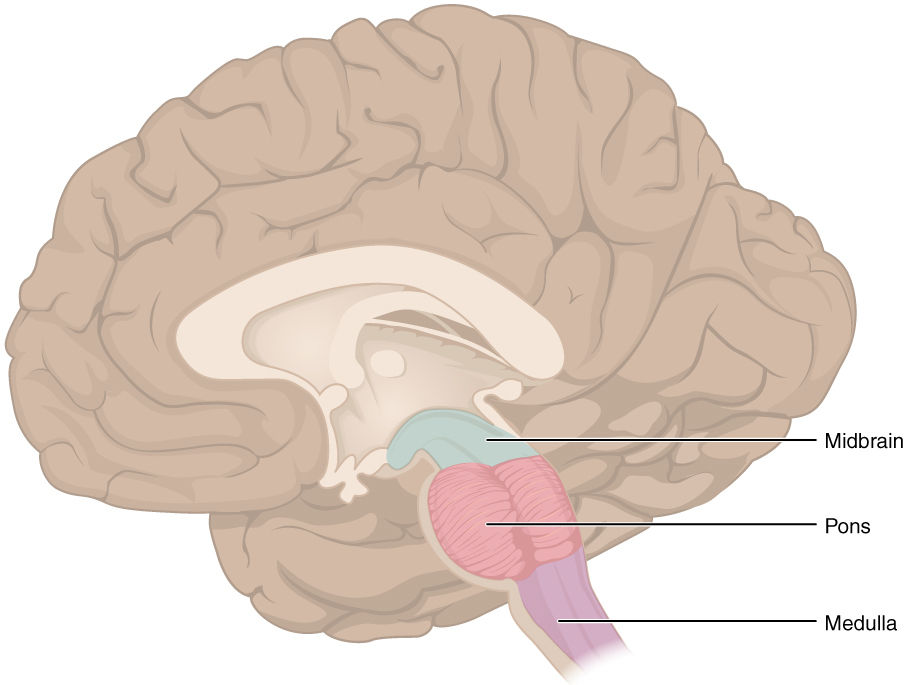
- 132Meissner's CorpuscleA type of cutaneous sensory receptor cell that responds to light touch and vibration.
Found in glabrous skin.
https://youtu.be/vF80u3qJkkQ?t=65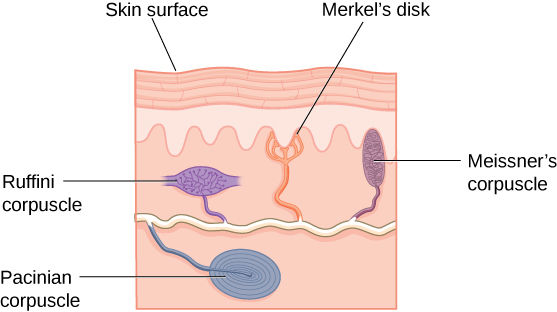
- 133Membrane PotentialDifference in electrical voltage between the inside and outside of a living cell produced by selective permeability of the membrane to ions.
A value of -70mV (inside negative with respect to the outside) is typical for a human neuron. - 134Merkel's DiscsA type of cutaneous sensory receptor cell that responds to light touch and pressure
https://youtu.be/vF80u3qJkkQ?t=52 - 135—
Información
- Descripción
- All the bold text definitions in block 1 & 2 of SD329.
- Creado por
- Glen Rooney
- Visitas
- 56
- Etiquetas
- Valoración