
Fichas
6.3 Intermolecular forces
Fichas del conjunto (31)
- 1What are intermolecular forces?Weak interactions between dipoles of different molecules.
- 2Intermolecular forces fall into which 3 categories?Induced dipole-dipole interactions (London forces)
Permanent dipole-dipole interactions
Hydrogen bonding - 3Intermolecular forces are largely responsible for what?Physical properties such as melting and boiling points.
- 4Covalent bonds determine what?Identity and chemical reactions of molecules
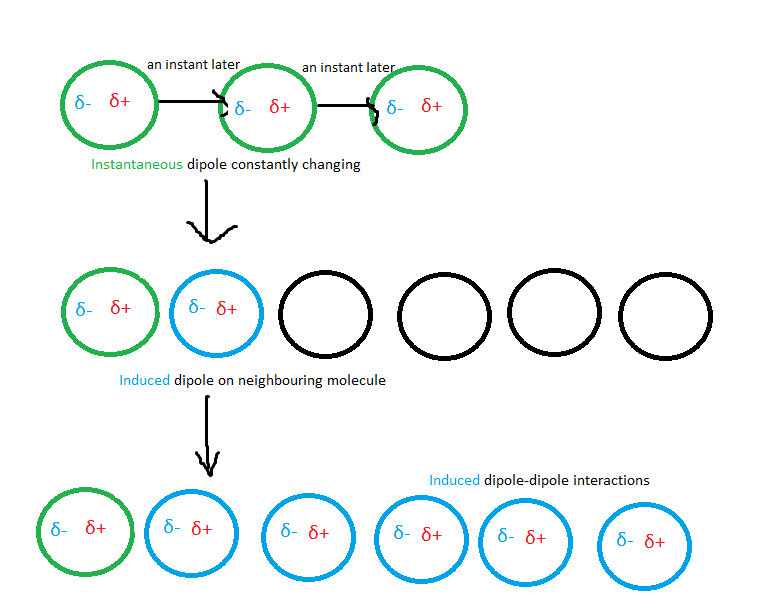
- 5What are induced dipole-dipole interactions? (London forces)Weak intermolecular forces that exist between all molecules, whether polar or non-polar. They act between induced dipoles in different molecules.
- 6What is the origin of induced dipoles?- Movement of electrons produced a changing dipole in a molecule
- At any instant, an instantaneous dipole will exist, but its position is constantly shifting
- The instantaneous dipole induces a dipole on a neighbouring molecule
- The induced dipole induces further dipoles on neighbouring molecules, which then attract one another - 7Are induced dipoles temporary or permanent?Temporary
- 8Induced dipoles result from interactions of electrons between molecules. The more electrons in each molecule ....(3)- The larger the instantaneous and induced dipoles
- The greater the induced dipole-dipole interactions
- The stronger the attractive forces between molecules - 9What is the correlation between larger induced dipoles and boiling point?- Larger numbers of electrons mean larger induced dipoles
- More energy is then needed to overcome the intermolecular forces, increasing the boiling point - 10What is van der Waals' forces?Used for both permanent and induced dipole-dipole interactions
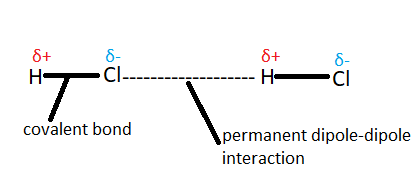
- 11What are permanent dipole-dipole interactions?Permanent dipole-dipole interactions act between the permanent dipoles in different polar molecules.
- 12Polar molecules have ______ dipole interactions as well as permanent dipole-dipole interactions.Induced
- 13Draw a diagram showing permanent dipole-dipole interactions between hydrogen chloride, HCl, molecules.
- 14HCl and F2 have the same number of electrons and the same shape, so the strength of the London forces in hydrogen chloride and fluorine should be similar. Why is HCl's boiling point higher than fluorine?- Fluorine molecules are non-polar and only have London forces between molecules
- Hydrogen chloride molecules are polar and have London forces and permanent dipole-dipole interactions between molecules
- Extra energy is needed to break the additional permanent dipole-dipole interactions between hydrogen chloride molecules
- The boiling point of hydrogen chloride is therefore higher than fluorine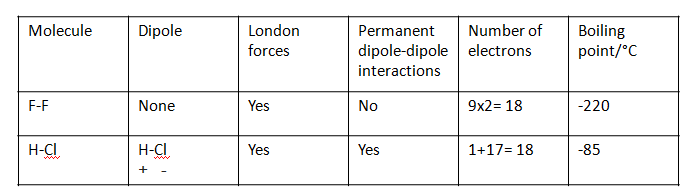
- 15In a solid state, simple molecules form a regular structure called what?Simple molecular lattice
- 16What is in the simple molecular lattice?- the molecules are held in place by weak intermolecular forces
- the atoms within each molecule are bonding together strongly by covalent bonds - 17Do simple molecular substances have high or low melting and boiling points?Low
- 18What happens when simple molecular substances are solidified into simple molecular lattices by reducing the temperature?- In a simple molecular lattice, the weak intermolecular forces can be broken even by the energy present at low temperatures
- Simple molecular substances have low melting and boiling points - 19What happens when a simple molecular lattice is broken apart during melting?- only the weak intermolecular forces break
- the covalent bonds are strong and do not break - 20Why are non-polar simple molecular substances soluble in non-polar solvents?- When a simple molecular compound is added to a non-polar solvent, such as hexane, intermolecular forces form between the molecules and the solvent
- The interactions weaken the intermolecular forces in the simple molecular lattice. The intermolecular forces break and the compound dissolves. - 21Why are simple molecular substances non-polar insoluble in polar solvents?- When a simple molecular substance is added to a polar solvent, there is little interaction between the molecules in the lattice and the solvent molecules
- The intermolecular bonding within the polar solvent is too strong to be broken - 22Can polar covalent substances dissolve in polar solvents?Yes
Polar solute molecules and polar solvent molecules can attract each other - 23What does solubility depend on?Strength of the dipole and can be hard to predict
- 24Give example of strength of dipole.Ethanol C2H5OH, contains both polar (O-H) and non-polar (carbon chain) parts in their structure and can dissolve in polar and non-polar solvents
- 25What happens when some biological molecules have hydrophobic and hydrophilic parts? (Solubility)Hydrophilic part will be polar and contain electronegative atoms (oxygen) and can interact with water
Hydrophobic part will be non-polar and comprised of a carbon chain - 26Property of electrical conductivity in simple molecular substances.- There are no mobile charged particles in simple molecular structures
- With no charged particles that can move, there is nothing to complete and electrical circuit.
Non-conductors of electricity - 27Permanent dipole-dipole interactions exist in molecules with a what?Polarity
- 28The δ+ is acctracted to what?δ- of another molecule
- 29There are weak what forces that exist between molecules with a polarity?Intermolecular forces
- 30Unlike induced dipole-dipole forces, permanent dipole-dipole interactions involves molecules with a permanent dipole and so are ________.Stronger
- 31How can polar molecules like water be tested?Placing a charged rod near a steady stream of polar liquid.
You should see the liquid bent towards the rod as the molecules align to face the oppositely charged rod.
Información
- Descripción
- A level (Module 2: Foundations in Chemistry) Chemistry Fichas sobre 6.3 Intermolecular forces, creado por Urvi B el 13/12/2017.
- Creado por
- Urvi B
- Visitas
- 51
- Valoración
Más sobre Types of Intermolecular Forces