
Fichas
DNA Synthesis, Transcription, and Translation
Fichas del conjunto (53)
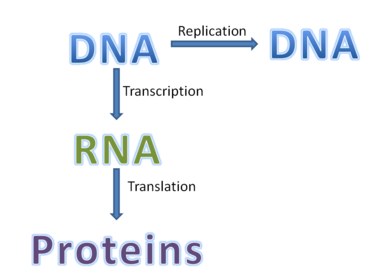
- 1molecular geneticsthe use of DNA as a code for proteins
- 2DNAdeoxyribose nucleic acid;
a double helix structure composed of nucleotides that store genetic information - 3central dogmastates that genetic information can be transferred from DNA to RNA to proteins
- 4transcriptiongenetic information in a molecule of DNA is used as a template to generate a molecule of RNA;
takes place in the nucleus - 5translationa molecule of RNA is used as code for the sequence of amino acids in a protein;
takes place on ribosomes in the cytoplasm - 6nucleotidesDNA and RNA subunits that consist of a 5-carbon sugar, a base, and one or more phosphate groups;
adenine, thymine, guanine, and cytosine (for DNA);
same for RNA, except uracil is used instead of thymine - 7purinesdouble ring structures;
G and A - 8pyrimidinessingle ring structures;
C, U, and T - 9T (nucleotide pairs with...)A
- 10G (nucleotide pairs with...)C
- 11U (nucleotide pairs with...)A
- 12peptide bondscovalent bonds between the carboxyl group of one amino acid and the amino group of another amino acid
- 13primary structurethe order of amino acids in translation (peptide bonds)
- 14secondary structurehydrogen bonds between amino and carboxyl groups;
alpha helices and beta sheets - 15tertiary and quarternary structureinteractions between side chains and carboxyl/R groups;
includes ionic bonds, hydrogen bonds, and hydrophobic interactions;
produces overall shape and function of the protein - 16promotersequence on DNA that starts transcription
- 17terminatorsequence on DNA that ends transcription
- 18RNA polymeraseenzyme that splits DNA in transcription and synthesizes the mRNA strand
- 19Direction RNA polymerase reads DNA in transcription3' to 5'
- 20Direction mRNA is synthesized in transcription5' to 3'
- 21location of transcriptionnucleus
- 22template strandstrand of DNA the RNA polymerase codes
- 23nontemplate strandstrand of DNA that RNA polymerase does not code
- 24hydrogen bondsbond between H and N, O, or F
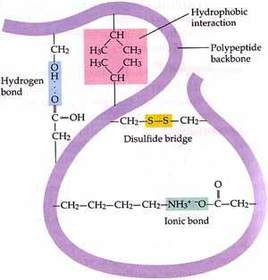
- 25hydrophobic interactionsbonds usually between C and H;
water-fearing interactions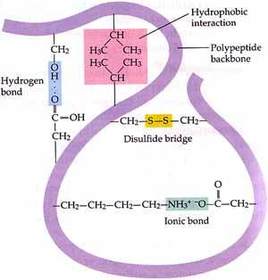
- 26ionic bondselectron exchange between atoms;
negative and positive charges present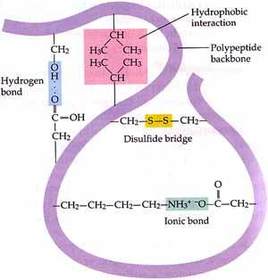
- 27start codonthree nucleotides that start translation;
AUG (Met) - 28stop codonthree nucleotide sequence that stops translation
- 29Direction mRNA is read by the ribosome in translation5' to 3'
- 30polypeptide chainbonded amino acids produced at the ribosome that later forms the protein
- 31tRNA landing and exiting sites in the ribsomeE (exit), P (peptidyl), A (aminoacyl; acceptor)
- 32missensepoint mutation of a single nucleotide that changes the amino acid
- 33Nonsensepoint mutation that changes one nucleotide which changes the amino acid to a stop codon (i.e., causes early termination)
- 34silentpoint mutation that changes one nucelotide but does not change the amino acid
- 35insertionframeshift mutation that adds an extra nucleotide and affects each subsequent amino acid
- 36deletionframeshift mutation that deletes a nucleotide and affects subsequent amino acids
- 37DNA replicationsemi-conservative (each new DNA molecule has one strand from the original DNA molecule) synthesis of a DNA molecule into two identical DNA molecules
- 38direction DNA polymerase reads DNA strands in DNA synthesis3' to 5'
- 39direction DNA is synthesized from DNA polymerase in DNA synthesis5' to 3'
- 40originlocation where DNA synthesis begins
- 41helicaseunwinds the DNA in DNA synthesis
- 42topoisomeraserelieves stress on the DNA strands as helicase breaks the strands apart
- 43primaseenzyme that make primers
- 44ligaseconnects Okazaki fragments on the laggin strand
- 45Okazaki fragmentsfragments of DNA on the lagging strand
- 46location of DNA synthesisnucleus
- 47location of translationcytoplasm (on ribosomes)
- 483' end of DNAhas a hydroxyl group linked to it
- 495' end of DNAhas a phosphate group linked to it
- 50DNA vs. RNA (differences between them)DNA:
double strand
nucleus bound
very big
stable
RNA:
single strand
free
very small
unstable - 51DNA polymerase Ireplaces RNA primers with DNA nucleotides
- 52DNA polymerase IIIsynthesizes DNA on the leading strand
- 53primersRNA that allows DNA polymerase I to attach and synthesize DNA on the lagging strand
Información
- Descripción
- Made for Rockhurst University course, General Biology I.
- Creado por
- badern
- Visitas
- 264
- Etiquetas
- Valoración