
Fichas
6.2 Gas exchange in single-celled organisms and Insects
Fichas del conjunto (14)
- 1how are Single-celled organisms adapted ?~ Small
-> Large SA:V ratio
~ O₂ absorbed by DIffusion
-> across body surface by cell-surface membrane
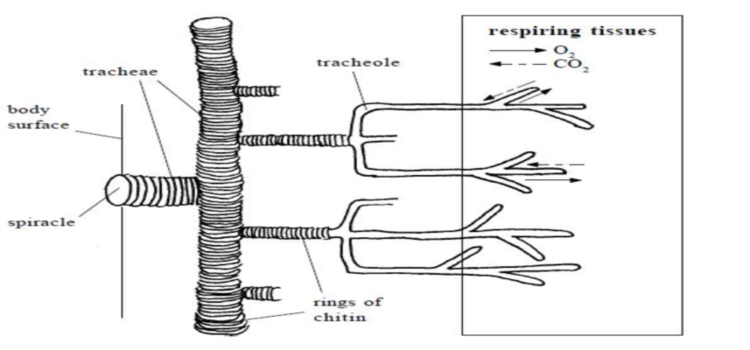
~ CO₂ from respiration diffuses out - 2how are Insects evolved for Gas Exchange~ Tracheae, Internal Network of Tubes
~ Spiracle, pores on surface
~ Tracheae support by Chitin (Strengthened Rings) -> prevent Collapse
~ Tracheoles, tracheae divides into small deadend tubes
-> extend throughout all body tissue - 3Structure inside Insect
- 4how are these Structures helpful for gas exchange in Insects~ Atmospheric air, with O₂
-> bought directly to Respiring tissue
-> due to Short diffusion Pathway from tracheoles to any body cell - 5Respiratory gases move in and put of Tracheal system in 3 ways1. Along a Diffusion Gradient
2. Mass Transport
3. Ends of the Tracheoles filled with Water - 61. How does O₂ enter the cell~ O₂ concentration decreases inside end of Tracheoles
-> cuz, O₂ used up during Respiration
~ this creates Diffusion Gradient causing Gaseous O₂ to enter cells
-> from atmospheric air
-> through Tracheae & Tracheoles - 71. how does CO₂ leave the cell~ CO₂ concentration increases inside end of Tracheoles
-> cuz CO₂ produced during Respration
~ this created conc. gradient in the other way causing Gaseous CO₂ to leave cells
-> from Tracheoles to atmospheric air - 82. what is Mass Transport~ Contraction of muscles in insects can squeeze the Trachea
-> enabling mass movement of air in and out
~ this further speeds up the exchange of respiratory gases - 9what happens when the Muscle cells around the Tracheoles respire Anaerobically? How does H₂O enter cells?~ produce Lactate, during major Activity
~ Lactate is soluble
-> Lowers the water potential of muscle cells
~ H₂O moves Into cell from Tracheoles by Osmosis - 10how does Air move into the Tracheoles?~ H₂O in ends of Tracheoles decreases in volume
~ so Air is drawn into the Tracheoles - 11what is the Final diffusion pathway? downside?~ in a Gas rather than Liquid phase
-> increases the rate of air flow into Tracheoles
~ but also Greater Water Evaporation - 12what are Spiracles?~ Gases enter and leave through tiny pores
~ on Body surface
~Opened and Closed by Valves - 13why don't Insects keep Spiracles open all the time? When do they open?~ Water vapor can evaporate from spiracle
~ > closed to Prevent water Loss
~ periodically open to allow Gas exchange - 14Limitations of the Tracheal system1. relies Mostly on Diffusion to exchange between environment and cells
-> for effectiveness
-> diffusion pathway must be short
2. Limits size of Insects
-> due to length of pathway
Información
- Descripción
- GCSE (Organisms Exchange Substances with their Environment) Biology Fichas sobre 6.2 Gas exchange in single-celled organisms and Insects, creado por Sea Chel Pie el 04/02/2019.
- Creado por
- Sea Chel Pie
- Visitas
- 41
- Etiquetas
- Valoración