
Fichas
Module 4- Ecosystem Dynamics ( Part 1)
Fichas del conjunto (67)
- 1Abiotic FactorsNon-living components that influence on parts of an environment and the functioning of their ecosystems
- 2Common Abiotic factorsClimate, soil type, altitude, latitude and oxygen.
- 3AnemometerMeasures wind speed
- 4ThermometerMeasures temperature
- 5BarometerMeasures atmospheric pressure
- 6Rain GaugeMeasures falling rain
- 7pH Meter/ Litmus paperMeasures pH ( alkaline/ acidic)
- 8Dissolved Oxygen contentDissolved oxygen content
- 9Biotic factorsAre living, or once living organisms in an ecosystem
- 10Examples of Biotic factorsHuman influence, pathogens and disease outbreaks
- 11Distinguish between biotic and abiotic factorsBiotic factors- Any living component that effects another organism, an ecosystem or a population.
Abiotic factors- Any non living components that impact an organism in an ecosystem. - 12Predator vs. PreyThe predator kills or eats an organism ( aka. the prey)
- 13Example of predator-prey relationships in nature ( Both species present.)The wooly aphid ( a pest in apple trees)
American Wasp introduced - 14Predator efficiency at catching preyIt is detrimental that predators stay efficent so that the population of their prey remains stable.
- 15Amensalism ( - / 0 )Two species-
one is harmed while the other species is unaffected. - 16Examples of AmensalismCompetition and Antibiosis ( aka. Allelopathy )
- 17CompetitionOrganisms or species attempt to comepete for a share of limited resources
- 18Meaning of 'competition for resources'A struggle for a particular resource
- 19Short vs. long term effects of competitionShort term: Changes in abundance and distribution
Long term: Endangered or extinction - 20Allelopathy ( Antibiosis)Discretion of a chemical substance to inhibit the growth and survival of another.
- 21Types of organisms that use AllelopathyCasuarina and Black walnut trees ( plants), fungi, bacteria, coral and algae.
- 22Commensalism ( +/ 0)A symbiotic relationship where one organisms benefits while the other is unharmed.
- 23Examples of commensalismShark + Remora fish: Fish gets a food source and shark is unaffected
Barnacles found on the shell of molluscs:
The barnacles adhere to the shell + finding a habitat + food source. The Invertebrate animals are unharmed. - 24Mutualism ( +/+)Both organisms benefit.
- 25Examples of MutualismOxpeckers + Zebra:
Birds eat parasites that live on skin= pest control
Plants + Insect pollinator: Pollinators help complete the plant reproductive cycle = food. - 26How do root nodules aid the survival of many Australian plants?Bacteria living in the root nodules provide nitrogen to the plant.
- 27Parasitism (+/-) / Parasite/ HostParasitism is when one species benefits and the other is harmed.
eg. Ticks and fleas on dogs - 28EctoparasiteLives off the outside of the host feeding on hair, feather, scales, skin or blood.
Eg. Crab louse - 29EndoparasiteLives internally in digestive or respiratory tracts or tissues.
eg. Hook worm - 30Intraspecific CompetitionCompetition between members of the same species.
eg. Bulls defending their territories and resources. - 31Interspecific CompetitionCompetition between members of different species
eg. Lion and tigers compete for same prey - 32DecomposerAre organisms that obtain energy by breaking down dead bodies of other organisms or the waste.
- 33Groups of decomposersBacteria and fungi
- 34Role of decomposersBreakdown waste, plants and dead animals
- 35Consumers ( Heterotrophs)Obtain energy from other organisms or their organic matter.
- 36Producers ( Autotrophs)Produce their own energy ( glucose) through photosynthesis
- 37NicheBiotic and abiotic resources within its environment. It is parts of an environment which conditions are suitable for species to live.
- 38What determines a niche?Abiotic and climate factors as well as what an organism eats, how and where it gets its food and the living organisms in which it competes.
- 39Fundamental NicheTotal range of environmental conditions to survive and reproduce.
( abiotic factors) - 40Realised NicheThe actual mode of existence by the species, which results from its adaptation and competition with other species.
( Biotic factors) - 41Realised vs. Fundamental nicheRealised niche... is the actual mode of existence, which results from its adaptation and competition.
Fundamental niche is the total range of environmental conditions needed without interactions. - 42Resource partitioningThe allocation of resources ( usual food) between two species living in a similar niche within a habitat in order to avoid competition
- 43Competitive exclusion principleTwo different species can not coexist in the same place if they are competing for the same limited resource.
- 44What happens if two species try to occupy the same niche?If two species try to occupy the same niche then the competition will eventually show one species to have a competitive advantage. This species will reproduce and multiply. The other will either become extinct or natural selection will lead to changes in the species.
( eg. occupy a different ecological niche- adaptive radiation) - 45DiseaseA disease is a condition that impairs or interferes with the normal functioning of the body.
- 46Infectious diseaseAn infectious disease is caused by pathogens which invade the body. Can be contagious and passed down from one host to another. Transfer can be direct or indirect.
- 47PathogenIs an microrganism that lives on its host. They can be microscopic or macroscopic and are found in air, water, oil and any contaminated articles.
- 48Human disease caused by virusesMeasles, Rubella, chickenpox and AIDS
- 49Example of how viruses can affect animals beside human populationsDevil facial tumor disease ( DFTD)
- 50Bacterial diseases that affect Australian animalsChlamydia in koalas and bird, beak and feather disease and jaw disease of macropod marsupials.
- 51Outline Consequences of interactions
- 52AbundanceThe abundance determines how many members of that species live throughout that ecosystem.
- 53DistributionThe distribution of a species describes the range of a species; the geographical area in which a species can be found
- 54How is distribution measuredDistribution is measured by transects that are commonly used in large areas to give scientists an idea f the variation that may occur.
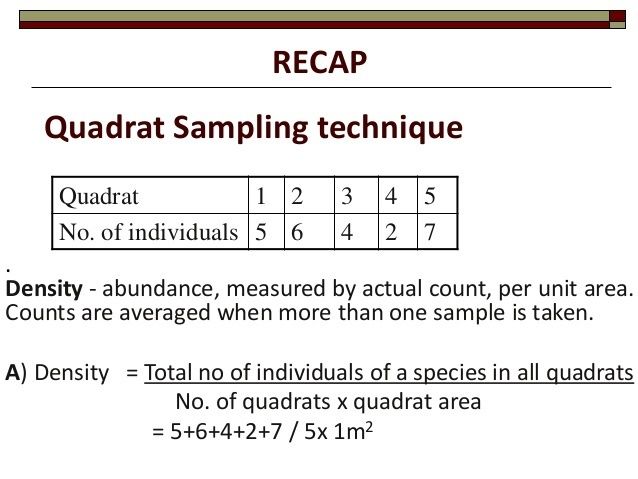
- 55Explain the quadrat method for sampling abundanceThe percentage cover method uses quadrats ( usually 1m x 1m) to cover randomly selected areas and gain an estimate of the total number of organisms of a specific species in an area.
- 56What sorts organisms are suitable for quadrat samplingOrganisms that can't move or that are slow are suitable for number testing to count.
- 57What is the process for calculating abundance using quadrats?The process requires randomly plotting a number of quadrats, finding the percentage cover and then finding an average.
- 58How is abundance of highly mobile species recorded?It is recorded using a sampling technique called the mark-release-recapture method.
- 59The process for calculating abundance via. capture-mark-recapture samplingAnimals are captured, sample animals are tagged and released. Then these animals are given time to mix again, recaptured and the number tagged on sample counted.
- 60Assumptions that can be made when using this sampling method?1.There is no population change through migration, births or deaths between the sampling periods
2.All animals are equally able to be caught (individuals are not ‘trap happy’ or ‘trap shy’)
3.Marked animals are not hampered in their ability to move and mix freely with the rest of the population - 61Example of Quadrat sampling technique
- 62ExtinctionThe end of a species or a group of organisms.
- 63Extinctions role in revolutionThe disappearance of species has opened opportunities and ecological niches for new species.
- 64Low level extinction vs. mass extinctionLow level extinction is the normal extinction rate while Mass extinction is the loss of species on a global scale
- 65Some causes of extinctionHabitat destruction, climate change, human activities and introduction of species to an area
- 66Mass extinctions affects on biodiversityA mass extinction accelerates evolution as survivors diversify to fill vacant ecological niches.
- 67Recent extinction event in Australia ( including likely causes)The Australian Megafauna were large animals that went extinct about 20,000 years ago. Some likely causes were changing environmental conditions, and less food for the megafauna caused them to go extinct.
Información
- Descripción
- Inquiry question #1: What effect can one species have on the other species in a community?
- Creado por
- Chelsea-Ann Quayle
- Visitas
- 15
- Etiquetas
- Valoración