
Fichas
IB Biology Option E
Fichas del conjunto (77)
- 1Define StimulusA change in the environment (internal or external) that is detected by a receptor and evokes a response
- 2Define ResponseA change in an organism resulting from a stimulus
- 3Define ReflexA rapid, involuntary (unconscious) response to a stimulus
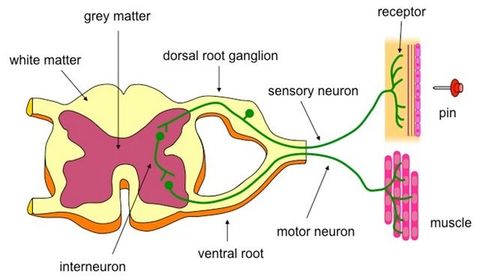
- 4Draw a reflex arc (10 labels)
- 5How does a Reflex Arc work? (5 points)1. RECEPTORS - transform stimuli to electrical nerve impulses (sensory cells or nerve endings of sensory neurons)
2. SENSORY NEURONS - Receive messages across synapses from receptors and relay nerve impulse to CNS via dorsal root
3. RELAY NEURONS - Transmit nerve impulses within CNS (receiving from sensory neurons via synapses and passing to motor neurons)
4. MOTOR NEURONS - Receive nerve impulses from CNS via ventral root. Relays signal to effector
5. EFFECTOR - Produces a response to the stimulus and can be either muscles (contraction) or glands (secretion) - 6Draw the Stimulus - Response Model
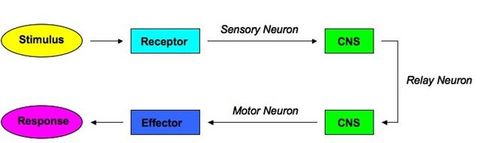
- 7Responses through Natural Selection or Inherited Behaviours (2 Examples)Changes have to be a result of external agents and will affect chances of survival and/or reproductions and the offspring will inherit the successful responses
MIGRATION PATTERNS OF THE BLACKCAP
(Germany - Spain or now UK (10%) study shows some sign of genetic inheritance)
FEEDING OF HOUSE SPARROW
Those fledglings chirping and gaping most will be fed most, alleles responsible for this will then be passed on increasing the prevalence of the behaviour - 8State 4 Types of Sensory Receptor, their stimulus and an example of where they work. Name another 21. Mechanoreceptors - Mechanical energy in forms of sound waves. E.G: Hair cells in the cochlea of the ear
2. Chemoreceptors - Chemical substances dissolved in water (on tongue) or in air (nose)
3. Thermoreceptors - Detect temperature, in nerve endings of skin
4. Photoreceptors - In form of electromagnetic radiation (visible light) in rod and cones cells of eye
5. Nocireceptors - Detect Pain
6. Proprioceptors - Detect position - 9Label a Picture of the Human Ear (10 labels)
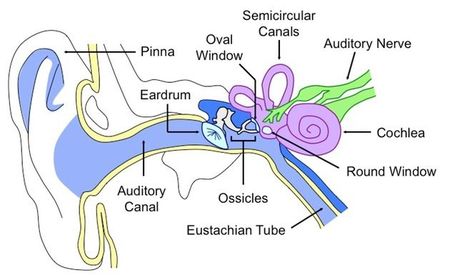
- 10Describe how Humans perceive Sound (5 points)1. EARDRUM
Sound waves push against ear drum and cause vibrations, the degree of which depends on frequency and amplitude. The vibration goes towards and away from bones of middle ear
2. OSSICLES
Each of the 3 bones touches each other, the first is connected to the eardrum and last to oval window. They reduce the amplitude of the waves, but increase force to amplify sounds (20x) . This is also helped by the oval windows small size in comparison to the eardrum. The bones displace the fluid in the cochlea when against the oval window
3. OVAL WINDOW / ROUND WINDOW
Membranous structure. Transmits sound waves to fluid. Works with the round window to keep fluid able to vibrate
4. HAIR CELLS IN COCHLEA
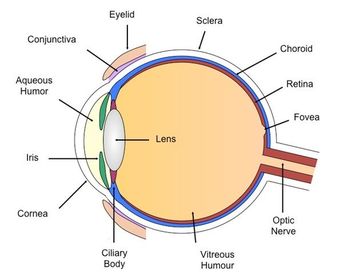
Hair cells have bundles that stretch either side of membrane. Sound waves that move fluid causes bundles to vibrate, movement affects the cilia and the width and thicknesses of each hair resonates a different sound so the frequencies are distinguished. Nerve impulse is generated and transmitted across synapse to brain through auditory nerve - 11Label a Diagram of the Human Eye (15 labels)
- 12Label a picture of the Retina (8 labels)
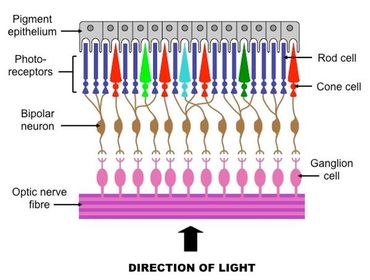
- 13Similarities and Differences (4) of Rod and Cone CellsSIMILARITIES -
Both are photoreceptors, absorbing light and transmitting messages to the brain and are found in the retina
DIFFERENCES -
1. SENSITIVITY - Rod cells more sensitive to light - work better in dim lights
2. VISION TYPE - Rod cells absorb all wavelengths of visible light so give monochrome vision. Cone cells see red, green and blue
3. NUMBERS - Groups of up to 200 rod cells to one sensory neurone. Only one cone per bipolar cell (Cone cells have greater visual acuity)
4. LOCATION - Rod cells more widely dispersed across retina- wider field of vision. Cone cells concentrate onto fovea, a single acute field of vision - 14Explain Convergence as a form of Visual ProcessingBipolar cells in Retina combine impulses form groups of rod and cone cells and pass them onto ganglion cells (the sensory neurons of the optic nerve)
- 15Describe the process of Edge Enhancement in Visual Processing (Inc. 2 types of ganglion cell)Each ganglion cell is stimulated when light falls on receptive field (small circular area of retina)
In the first type of ganglion cell, if light falls on the centre of the receptive field the cell is stimulated and stimulation is reduced when light falls on peripheries
In the other type the opposite occurs
Both types are more stimulated if the edge of the light/ dark areas are within the receptive field
(HERMAN GRID) - 16Explain Contralateral Processing as a form of Visual ProcessingThe left and right optic nerve meet at the optic chiasma
This means stimuli is processed on the opposite side to which it is detected - Information from left side of visual field is detected by the right half of the retina in both eyes and processed by right hemisphere
At optic chiasma information from both eyes may swap and can be processed together
Impulses then go to the thalamus to be processed before forming the image in the visual cortex
This allows brain to deduce size and distance - 17Define Innate BehaviourAn instinctive response that is developmentally fixed (independent of environmental context) and is genetically determined
- 18Define Learned BehaviourBehaviour that is modified and developed as a result of experience (normally through trial and error)
- 19Define TaxisA change in movement, towards or away from a directional stimulus
- 20Define KinesisThe change in activity rate to a non- directional stimulus
- 21An example of a Taxis ExperimentDaphnea will move towards a light source
- 22Kinesis Experiment ExampleWoodlice move around more in dry conditions as will seek humid areas (as have gills)
- 23Wh is Learned Behaviour important?In a diverse and changeable environment, animals can use the information from past experiences to adapt to new situations and improve survival chances
Offspring must have capacity to learn
Is better than innate behaviour as will allows responses to change to environment, giving the survival advantage - 24Give an Example of how Learning helps to Avoid DangerGOSLINGS
Imprint on their mothers as they are the first thing they see when they hatch
Follow her around they avoid predators and then have a better chance of survival
Copy her feeding habits etc. - 25Give an example of Learning how to hunt/ obtain foodGRIZZLY BEAR
The bears learn how to catch salmon via practice - 26Explain how Learnt Behaviour helps to find FoodHONEYBEES
Members of the colony learn off others where to find highest yield nectar by using the "waggle dance" - 27Other examples of Learned Behaviour (3)CHIMPS -
Learn how to catch termites by poking sticks into termite mounds
FOXES -
Avoid touching electric fences after being shocked
HEDGEHOGS -
Now run across busy roads rather than curling into a ball - 28Explain the Conditioned Reflex (Pavlovs Dogs)PAVLOV - A scientist who investigated the salivation reflex in dogs through experiments in classical conditioning, calling it the CONDITIONED REFLEX, where the stimulus causing the response had changed
1. Dogs usually salivate through an UNCONDITIONED RESPONSE when anticipating an UNCONDITIONED STIMULUS (food)
2. Pavlov used a NEUTRAL STIMULUS (bell) prior to feeding the dogs for a number of days
3. The dogs then started to salivate before the UNCONDITIONED STIMULUS arrived - this is the CONDITIONED RESPONSE to the CONDITIONED STIMULUS - 29Define ConditioningAn alteration in the behaviour of an animal in response to the association of an external stimuli
- 30Describe the development of BirdsongMale birds use birdsong to establish territories and signal attraction
Most birds are born with a genetically inherited template song
As fledglings they learn to expand their song by listening to others and mimicking the adult version - MOTOR LEARNING
The innate template stops them from learning the wrong species song
Birds raised in sound proof boxes lack the complexity developed through learning
The birds are selective in what they learn and once learnt, the song id rarely modified - 31Development of Birdsong ExampleWhite Crown Sparrow
The adult birdsong begins around 250 days after hatching
Song is a plaintive whistle followed by some trills
Dialect means song id subject to geographical variations - 32Explain how Excitatory Synapses workNeurotransmitters released by presynaptic neuron causes an influx of Na+ ions to enter the postsynaptic neuron
This depolarises the synaptic membrane and causes an action potential (may or may not reach threshold)
EG: ACETYLCHOLINE - 33Explain how Inhibitory Synapses workNeurotransmitters released by the presynaptic neuron causes hyperpolarisation (Via and influx of Cl- or a loss of K+ ions)
this makes it more difficult to depolarise the neuron sufficiently to cause an action potential, lowering the resting potential - making it difficult to reach the threshold
Postsynaptic transmission is therefore inhibited
EG: GLYCINE OR GAMMA-AMINOBUTIC ACID (GABA) - 34Describe how Decisions are made in the CNS (Reference the two ways)A single release of neurotransmitter is unlikely to be enough to trigger an action potential, as threshold potential has not been reached to cause postsynaptic transmission
To cause post synaptic transmission, either one neuron has to be repeatedly releasing the transmitter (Temporal) or more than one neuron releases neurotransmitter at the same time (Spatial) - 35Explain how Summation works to Make Decisions in the CNSThe sum of signals from both excitatory and inhibitory neurons determines whether a signal is generated in the post synaptic membrane
E + I = 0 (An excitatory transmission at the same time as a inhibitory transmission will cancel out)
This is the basis of decision making in the CNS
Summation can lead to the selection of alternative neuron pathways in the frontal cortex of the brain - 36Define DrugsDrugs are chemical substances that are either ingested, injected or put into the body to cause a change in function (of some synapses)
Psychoactive drugs affect the brain and personality - 37Explain what Excitatory drugs (Stimulants) do and how they work 3 EXAMPLESExcitatory drugs promote the transmission of excitatory synapses or inhibit the transmission at inhibitory synapses
They increase postsynaptic transmission and produce psychomotor arousal and increase alertness
They serve as a neurotransmitter precursor and stimulate neurotransmitter release. They can also directly stimulate postsynaptic receptors and block neurotransmitter reuptake
NICOTINE
COCAINE
AMPHETAMINES - 38Explain what Inhibitory drugs (Depressants) do and how they work 3 EXAMPLESInhibitory drugs decrease the transmission in the postsynaptic neuron and promote inhibitory transmission at inhibitory synapses.
They also inhibit transmitters at excitatory synapses and slow brain activity and relax muscles
They inhibit neurotransmitter synthesis, block neurotransmitter release, block postsynaptic receptors and prevent neurotransmitter storage
ALCOHOL
THC
BENZODIAZEPINES - 39Explain how Psychoactive Drugs Affect Synaptic TransmissionSome psychoactive drugs have a chemical structure similar to neurotransmitters in the postsynaptic membrane, blocking receptors and preventing neurotransmitters having normal effect
Others have the similar chemical structures but unlike the neurotransmitter are not broken down, so when they bind to the receptors they are much loner lasting
Some interfere with the breakdown of neurotransmitters in synapses or their reabsorption into the presynaptic neuron, prolonging the effect of neurotransmitters - 40Explain how Cocaine worksCocaine is an excitatory drug
It stimulates the transmission in the brain at synapses that use dopamine as the neurotransmitter
Dopamine receptors are found in the post synaptic regions in membranes of neurons in the brain associated with pleasure (The "reward pathway")
Cocaine acts indirectly on dopamine, by binding to membrane proteins that pump dopamine back into the presynaptic neuron
This causes dopamine to build up, remaining active in the synaptic cleft and able to continue binding to receptors and causing constant stimulation and excitation of the post synaptic neuron - 41Give 3 examples of the Effects of CocaineSense of euphoria and mellowness
Suppression of appetite
Enhancement of energy - more talkative, alert and energetic
Long term use is associated with severe mental disorders - 42Explain how THC worksTHC is the active part of Cannabis
It affects transmission at an unusual type of synapse where the postsynaptic neuron can release a signalling chemical that binds to receptors in the membrane of the presynaptic membrane
THC mimics the neurotransmitter anandomide by binding to presynaptic Cannaboid receptors, blocking the release of excitatory neurotransmitters
THC is therefore an inhibitory drug, causing hyperpolarisation and preventing neurotransmitter release and therefore postsynaptic excitation - 43Give 3 Effects of THCIncreased intensity of perceived sensory data
Sense of emotional wellbeing
Reduced concentration and impaired judgement of time and space - 44Define AddictionAddiction is the dependance of a substance resulting in repeated and compulsive use
(It is a chronically relaxing disorder where there is a loss of control in limiting uptake)
(Stopping is difficult and causes severe mental and physical reactions- withdrawal) - 45Name 3 Causes of Addiction1. Dopamine Secretion
2. Genetic Predisposition
3. Social Factors - 46Explain how dopamine secretion causes addictionIn addictive drugs, transmission is stimulated at synapses using dopamine as the neurotransmitter
The dopamine secretion gives the feeling of wellbeing as is released in response as a reward
Cocaine enhances dopamine activity, nicotine and alcohol induce the reward pathway via dopamine
Abuse of the drug may lead to reduction in dopamine receptors, meaning higher doses are required to achieve the same effect (habituation) - 47Explain how genetic predisposition causes addictionThere is evidence that addiction runs on families and the predisposition may be determined by polygenic inheritance
People with one or more copies of the A1 allele for the DRD2 gene coding for dopamine receptor proteins are more likely to become addicted than those with the D2 allele - 48Explain how social factors cause addictionCultural traditions such as Rastafarianism encourage the use of drugs
Personal trauma/ neglect and mental health issues
Peer pressure or parental influences
Poverty and deprivation - 49Label a diagram of the Human Brain (5 labels)
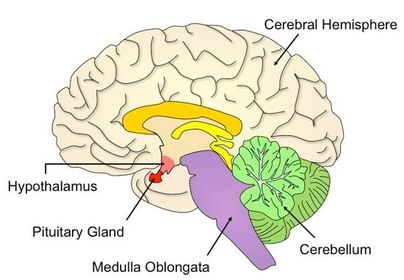
- 50Explain the functions of the 5 parts of the Human Brain1. CEREBRAL HEMISPHERE - Receives impulses from the eyes, nose, ear and tongue. Acts as an interrogation centre for higher complex functions, such as memory, emotion, learning and consciousness
2. MEDULLA OBLONGATA - Controls automatic and homeostatic activities such as swallowing, vomiting, breathing and heart activity (rate)
3. CEREBELLUM - Coordinates unconscious functions such as movement and balance (hand/ eye coordination)
4. HYPOTHALAMUS - Maintains homeostasis by coordinating the nervous and endocrine systems. Produces the hormones that are secreted by the posterior pituitary glands, sending releasing factors to stimulate hormone secretion by the anterior pituitary gland
5. PITUITARY GLAND - Produces (anterior lobe) and stores/ secretes (posterior lobe) hormones regulating many body functions - 51State the 3 ways used to Investigate Brain Functions1. Animal Experiments
2. Lesions
3. Functional MRI (fMRI) - 52Explain how animal experiments have been used to investigate areas of the brain (Good and bad)Many experiments are performed on animals, particually primates. Many procedures are surgical and involve removing parts of the skull to gain access to the brain
The animal is kept alive, so that the brain continues to function
Regions of the brain can be stimulated with electrode or removing an area (lobotomy) to asses affects
The procedures can be highly invasive, so animal models are sometimes used
GOOD: Animal experiments have been used to understand and help develop treatments for diseases such as MS
BAD: Ethical objections- Some animals are sacrificed or experience some kind of suffering . Animal brines are not the same as human's, so valid comparisons can be hard to make - 53Explain how Lesions have been used to investigate areas of the brainLesions are abnormal or damaged areas of brain tissue and are either congenital or from accidents or disease
The locations of particular functions can be deduced from the loss of an area
Split Brian Patients - (from the early treatment of epilepsy treated be a severed corpus callosum) can and have shown the roles of the right and left hemispheres of the brain
Stroke patients lose the ability to speak when one half of the brain is damaged
The brain has also shown it can relearn skills by rerouting the function to another part of the brain
BAD: Many functions involve multiple areas of the brain, so complex functions become more difficult to interpret - 54Explain how fMRI has been used to investigate areas of the brainfMRI is a technique used for determining which parts of the brain are activated by a specific though process
fMRI records the changes in blood flow and can indicate active regions of the brain - oxyhaemaglobin responds differently to a magnetic field than deoxyhaemaglobin - this is represented by different colours
The subject is placed in a scanner and a high intensity scan of the brain is taken
A series of lower resolution scans are taken while the subject is given a stimulus designed to stimulate specific brain activity
The scan is used to localise the regions involved
Temporal activities can also be recorded to allow for identification of sequential collaboration between parts
It is non invasive, but not ALL brain activity can be detected in this way
(Used to monitor stroke recovery and has also been used to identify ADHD and dyslexia) - 55Describe the components of the Nervous SystemSplit between the CNS and the peripheral nervous system (Sensory and motor neurons)
Further splits form peripheral to the somatic (motor neurons to skeletal muscle, sensory neurons form receptor sense neurons) and Autonomic nervous systems (Used to control unconscious internal processes by antagonistic actions)
These impulses are sent from the brain go through either two parts of the autonomic system - The sympathetic and parasympathetic - 56Describe the Sympathetic Nervous SystemInvolved in the processes that prepare the body for action - fight or flight
Releases noradrenaline (adrenergenic) via sympathetic nerves - 57Describe the Parasympathetic Nervous SystemInvolved in processes that occur when the body is relaxed - rest and digest
Releases acetylcholine (cholinergenic) via parasympathetic nerves - 58Explain how the Sympathetic and Parasympathetic Nervous Systems affect the HeartParasympathetic - Heart rate slows to reduce blood flow via the stimulation of the vagus nerve (body is relaxed)
Sympathetic - Heart rate increases so more blood can be pumped to the muscles via the release of adrenaline - 59Explain how the Sympathetic and Parasympathetic Nervous Systems affect the Blood Flow to the GutParasympathetic - Blood flow to gut increases to facilitate digestion due to vasodilation of blood vessels by the smooth muscle
Sympathetic - Blood flow to gut decreases due to the vasoconstriction of blood vessels by smooth muscle - 60Explain how the Sympathetic and Parasympathetic Nervous Systems affect the Iris of the EyeParasympathetic - Circular muscle fibres contract so the pupil constricts, reducing light and potential retinal damage
Sympathetic - Radial muscles contract so the pupil dilates, improving vision - 61Explain the Pupil ReflexIf bright light shines into one eye, both pupils constrict
This happens when photoreceptors in the retina detect the light stimulus. Nerve impulses are sent via sensory neurons of the optic nerve to the brain
The medulla oblongata processes the impulses and sends them to the circular muscles fibres in the iris - the parasympathetic nervous system stimulates this
Circular muscle fibres contract and pupils constrict
In dim light, the sympathetic nervous system is stimulated and radials muscles contract causing pupils to dilate - 62Explain how Brain Death is diagnosed with the help of the Pupil ReflexAdvances in medicine have meant that the body can be kept alive even when some of the organs don't work
If a patient is in a coma (prolonged unconsciousness) because of damage to the Cerebral Hemisphere, recovery can be possible
With damage to the Medulla Oblongata, recovery is slim
Whole brain death is the permanent absence of measurable activity in both the cerebrum and the brain stem
Individuals with a non- functioning brain, but a functioning stem can be kept alive in a vegetive state - if not homeostatic processes cannot function
Failiture of the pupil to respond to light is indicative of brain stem death - thus the pupil reflex is used to test for whole brain death in unconscious patients - 63Define Whole Brain DeathWhole brain death is the permanent absence of measurable activity in both the cerebrum and the brain stem
- 64Explain how Pain is Perceived and the role of EndorphinsPain is perceived when impulses are sent from pain receptors in the skin and other parts of the body (NOT brain) to the sensory areas of the Cerebral Cortex, where pain is processed
This is essential to help us identify danger
Pain can sometimes be excessive so the production of endorphins in the pituitary gland are stimulated (in times of stress, injury and exercise)
They then travel in the blood to the brain and bind to receptors in the membrane of the neurons that send pain signals, blocking the release of neurotransmitters that are used to transmit pain signals in the brain - 65Explain the term of Eusocial Behaviour in terms of Social Organisations1. Individuals in the same species cooperate in caring for the young
2. There is an overlap of at least 2 generations in which the offspring contribute to colony labour
3. There is reproductive division of labour with sterile individuals who work on behalf on the reproductive ones
Either the colony as whole survives or it doesn't - Natural Selection therefore exists at the colony level - 66Explain how Honeybees show Eusocial behaviour (Inc. the caste system)Honeybees show a division of labour, living in colonies of up to 60,000 individuals. They live and die together and can reproduce to form extra colonies by swarming
Each type of bee is specialised to a particular task that helps the group as a whole;
QUEEN - The fertile female. Produces and lays eggs, but also produces a pheromone to control worker activity
DRONE BEES - Some reproductive males that fertilise eggs and mate with virgin females
WORKER BEES - Infertile females that collect nectar and pollen then convert it into honey. Secrete wax to build the comb. Feed and look after larvae. Protect the hive. (There are further sub divisions - Foragers and soldiers etc.) - 67Explain how Naked Mole Rats show Eusocial behaviourThey live in colonies of up to 80 individuals in burrow systems in E.Africa
One DOMINANT FEMALE acts like a queen bee - the only reproductive female that mates with a single male
The other castes of mole rat help her;
FREQUENT WORKERS - Dig tunnels and bring food
INFREQUENT WORKERS- Larger and occasionally help with the heavier tasks
"NON WORKERS" - Live in the central nest keeping the breeding female and her young offspring warm. Also defend the colony if it is attacked - 68Explain how colonies evolve through altruistic behavioursNatural selection acts on the gene pool of a given population
Beneficial allele become more frequent as they promote reproductive success
Because colonies are usually comprised of related individuals, traits that benefit the colony will become more frequent, even if they don't benefit the individual
Many organisms form social clusters to improve survival prospects
Such characteristics are more likely to be passed across generations and hence be more frequent in the gene pool - 69Define Altruistic BehaviourActions that increase another individuals lifetime number of offspring at a cost to one's own survival or reproductive success.
(Behaviour that benefits another individual at the cost of the one carrying out the behaviour) - 70Explain Altruistic BehaviourAlturism is behaviour that benefits another individual at the cost of the one carrying other the behaviour
It appears to be opposition to natural selection, as it reduces the possibility of the altruistic individual passing on their own genes
If the individuals are closely related, altruistic genes will persist in the gene pool and be naturally selected
Enhancing the reproductive success of relatives is called kin selection
Alturism occurs in social animals and is more common in members of the same species who are closely related - 71Define Kin SelectionEnhancing the reproductive success of relatives
- 72Give 2 examples of Altruistic Behaviour1. VAMPIRE BATS
Vampire bats are not always successful at getting a blood meal especially if young and learning. If they go two days without one, they are likely to die.
Other colony members commonly regurgitate blood to share with its unlucky/ sickly roost mates who are unlikely to gain independent sustenance
This is RECIPROCAL ALTRUISM as the donating bat may receive blood itself in the future
There is advantage to the whole group, because the benefit of receiving blood after starvation is greater than the cost of donating blood after feeding well
2. NON BREEDING MOLE RATS
the non breeding mole rats work to allow the breeding male/ female to reproduce successfully
Even though offspring are not their own, they help to ensure the survival of their own genes as are all related - 73Explain the idea of Foraging BehavioursForaging is the act of searching for and finding food
Animals adopt strategies that
1. Minimise cost of foraging
2. Maximise the benefits to the consumer
As the availability and abundance of food sources vary, animals adapt their feeding behaviours to account for changes - 74Give two examples of Foraging BehavioursBLUEGILL FISH
Bluegill fish feed on Daphnia, a small aquatic crustacean
It changes its foraging behaviour if prey availability is altered
As high density of daphnia, Bluegills will pick out the larger ones to eat
At lower densities, Bluegills will eat a range of Daphnia sizes
Bluegills will eat more D.Pulex than D.Lumholtzi when found together
When found separately, the Bluegills will eat both types
This is all about consumption energies vs. energy gained
CROWS EATING SHELLFISH
Crows have to fly up and drop shellfish to break their shells
If they fly too high, they waste energy
If there fly too low, the shells won't break
Experiments have shown that they regularly fly to exactly the right height to optimise energy - 75Explain what is meant by an Exaggerated Trait and give examplesThe success of an organism is measured by the number (and quality) of offspring left behind, particularly their capacity to then breed (reproductive fitness)
Features that improve a males chances of successfully competing with other males for the best mate (mate selection) will become more prevalent within the gene pool via natural selection
The exaggerated traits (ornaments) are more likely to attract female attention and so promote successful reproduction
These traits will be selected for even though they may increase predator attention and diminish the survival prospects of the individual (Natural selection won't continue when the cost/benefit threshold is met and the organism must also be adapted in other ways in order to be a good mate)
the evolution of these traits in a particular gender has led to the marked sexual dimorphism of certain species
PLUMAGE FEATHERS in Peacocks
PRONGS on the antlers of the male Deers become larger and more in numbers - 76Explain what is meant by Rhythmical BehavioursAnimals often show rhythmical behaviours that appear at certain times
Diurnal (Daily) Cycles
Lunar (Monthly) Cycles
Annual (Yearly) Cycles
Or seasonal changes - 77Give 2 examples of Rhythmical BehavioursCORAL
In many species, the male and females release their gametes at the exact same time of year (mass spawning)
The advantage of such behaviour is that it increases the chances of the gametes undergoing successful fertilisation (and reduces the chances of individual gametes being eaten by fish if a few were released at once)
Spawning may be triggered by a number of factors including temperature (Seasonal) and moonlight (Lunar)
CICADAS
Most of the lifecycle is spent underground as herbivorous nymph before emerging for just a few days to breed and then die
In the Eastern US, there are 6 species, 3 of which emerge every 13 years, 3 every 17 years
These prime number events seem to be very difficult for predators to coordinate with
When cicadas emerge, it is an event that only covers a few days, but where millions of adults are present
This would be a welcome feast for a predator, but their inability to coordinate their own cyclic behaviours to a prime number has meant they are unable to take advantage of this glut of food, so the adaptive value of the cicadas is very usef
Información
- Descripción
- IB Biology Fichas sobre IB Biology Option E , creado por P H el 14/12/2014.
- Creado por
- P H
- Visitas
- 190
- Etiquetas
- Valoración