
Fichas
Chemistry aqa Triple science GCSE C2
Fichas del conjunto (106)
- 1What are compounds?substances in which 2 or more elements are chemically combined.
- 2what does chemical bonding involve?Transferring or sharing electrons in the highest energy level.
- 3What structure is obtained after a chemical bond?noble gas structure.
- 4What are formed when ions are transferred?ions
- 5what ions are formed when atom lose electrons?Positive
- 6What ions are formed when atoms gain electrons?Negative
- 7What charge do group 1 metal ions have?+1
- 8What charge do group 7 halide ions have?-1
- 9How are ionic compounds held together?Strong electrostatic forces of attraction between oppositely charged ions.
- 10When are covalent bonds formed?When atoms share pairs of electrons.
- 11Give 4 examples of simple covalent molecules?H2, Cl2, O2, HCl, H2 O , NH3, CH4
- 12Give two examples of giant covalent structures.Diamond and Graphite
- 13What is another name for a giant covalent structure?macromolecule
- 14What is a metal?A giant structure of atoms arranged in a regular pattern.
- 15What is important about the outer shell electrons in a metal?They are delocalised, so they are free to move about in the structure.
- 16Do simple molecules have a high or low melting points and boiling points?Low
- 17Why are the melting and boiling points low in simple molecules?They have weak inter-molecular forces, which are easily broken.
- 18Why do simple molecules not conduct electricity?The molecules have no overall charge.
- 19What is the name for a giant structure?Lattice
- 20Do ionic structures have a high or low melting and boiling point?High
- 21Why are the melting and boiling points high in ionic structures?Large amounts of energy are required to break the strong bonds.
- 22When do ionic compounds conduct electricity?When the compound is molten or dissolved in water (so the ions are free to move).
- 23Why do giant covalent structures have very high melting points?The covalent bonds are very strong.
- 24Why is diamond so hard?Each carbon atom has bonds to 4 other carbon atoms.
- 25Why is graphite so soft and slippery?Each carbon atom has 3 bonds to other carbon atoms; this causes distinct layers to form- the layers have no covalent bonds, so they can slide over each other.
- 26Why does graphite conduct heat and electricity?One electron from each atom is delocalised, so it is free to move.
- 27Give three uses of fullerenes.Drug delivery into the body, in lubricants, as catalysts and in nanotubes to reinforce materials.
- 28What properties do the delocalised electrons give to metals?Conduct heat and electricity.
- 29Why can metals be bent and shaped?The layers of atoms can slide over each other.
- 30How are alloys usually made?Mixing two or more different metals.
- 31Why are alloys harder than pure metal?The different sized atoms make it more difficult for the layers to slide over each other; this is because the regular pattern is disrupted.
- 32What is special about shape-memory alloys?They return to their original shape after being deformed.
- 33What do the properties of polymers depend upon?What they are made from and the conditions used.
- 34What is the difference between thermosoftening and thermosetting polymers?Thermosetting polymers have cross links between the chains, so they do not melt when heated.
Thermosoftening polymers have no crosslinks and layers can slide over each other. - 35What size are nanoparticles?1-100 nm
- 36Why are nanoparticles useful to us?They have different properties to larger molecules.
- 37Give 3 examples of how nanoparticles could be used.New computers.
New catalysts.
New coatings.
Sensors.
Stronger and lighter construction material.
New cosmetics. - 38What is the relative atomic mass of a proton?1
- 39What is the relative atomic mass of an electron?Very small (almost 0)
- 40What does the mass number tell us?The number sum of protons and neutrons.
- 41What are isotopes?Atoms of the same element with a different number of neutrons.
- 42What is the relative formula?The sum of the relative atomic masses.
- 43What is the relative formula mass of a substance also known as?One mole
- 44Why do we use instrumental methods (such as gas chromatography)to detect elements and compounds?They are more accurate, sensitive, rapid and good for small samples.
- 45For what is paper chromatography used?Detecting artificial colours.
- 46Give an example of an instrumental method.Gas chromatography linked to mass spectrometer (GM-MS)
- 47What does gas chromatography do?Separates a mixture of compounds.
- 48What does a mass spectorometer do?Identifies the substance leaving the column.
- 49What else can the mass spectrometer do?Provide the relative molecular mass of each substance.
- 50How do we calculate the % of an element in a compound?Mass of the element ÷ formula mass of the compound
- 51What is the empirical formula of a compound?The simplest ratio of atoms
- 52Why is it not possible to get the full theoretical amount of product in a reaction?The reaction may be reversible, Products maybe lost in separation, Some reactants may react differently than expected.
- 53What is a yield?The amount of product obtained.
- 54How do we calculate the % yield?Mass obtained ÷ theoretical yield x 100
- 55what is a reversible reaction?Where the products react to produce the original reactants.
- 56Give two ways of calculating the rate of a reaction.Amount of reactant used ÷ time
or
Amount of product formed ÷ time - 57When do chemical reactions occur?Particles must collide with sufficient energy.
- 58What is the minimum amount of energy particles need to react called?Activation energy
- 59Why does increasing temperature increase the rate?The particles move faster and collide more frequently and energetically.
- 60Why does increasing the pressure increase the rate of a reaction?Increases the frequency of collisions.
- 61Why does increasing concentration increase the rate?Increased frequency of collisions.
- 62Why does increasing surface area increase the rate of the reaction?Increased frequency of collision.
- 63How do we increase the surface area?Make the particles smaller.
- 64What is a catalyst?A chemical which increases the rate of a reaction, but it is not used up.
- 65Why are catalysts used in industrial processes?To reduce costs.
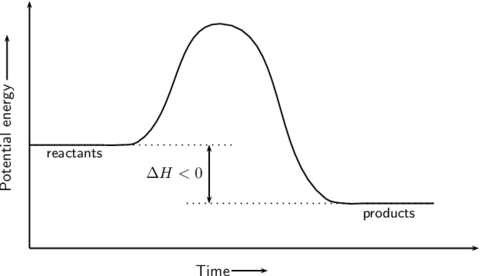
- 66What is the name for a reaction that transfers energy to the surroundings?Exothermic
- 67What type of reaction does the graph show?Exothermic
- 68Give 2 examples of exothermic reactions.Combustion, many oxidation reactions, and neutralisation.
- 69Give two uses of exothermic reactions.Self heating cans and hand warmers
- 70What is the name of a reaction that takes in energy from the surroundings?Endothermic
- 71What type of reaction does the graph show?Endothermic
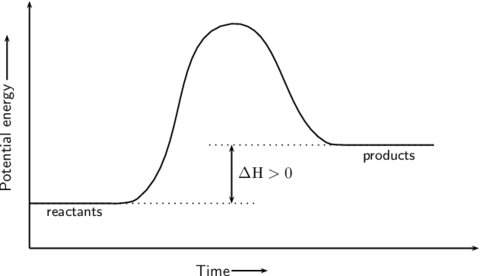
- 72Give an example of an endothermic reaction.Thermal decomposition
- 73Give a use for endothermic reactions.Sports injury packs.
- 74What can you say about reversible reaction that is exothermic in one direction?It is endothermic in the opposite direction.
- 75What does the symbol (s) mean?Solid
- 76What does the symbol (aq) mean?Aqueous- in solution
- 77Give three ways of making salts?Acid + metal
or
Acid + insoluble base
or
Acid + alkali - 78How are insoluble salts made?Precipitation reactions
- 79What is the name given to metal oxides and hydroxides?Bases
- 80What is the name for soluble hydroxides?Alkalis
- 81What does the salt depend on?The acid used and the metal in the base
or
alkali - 82What salts do we get from hydrochloric acid?Chlorides
- 83What salts do we get from sulphuric acids?Sulphates
- 84What salts do we get from nitric acids?Nitrates
- 85What type of solution is formed when ammonia dissolves in water?Alkaline solution
- 86Which salts are made from ammonia?Ammonium salts
- 87For what do we use ammonium salts?Fertilisers
- 88Which ions make a solution acidic?H+
- 89What ions make a solution alkaline?OH-
- 90How do we measure acidity and alkalinity?The pH scale
- 91What happens during neutralisation reactions?The H+ ions react with the OH- ions to form water.
- 92When are ions free to move?When the substance is molten or dissolved.
- 93What is electrolysis?Using electricity to break down compounds into their elements.
- 94What is the name for the chemical being broken down?Electrolyte
- 95Where do positive ions move?To the cathode (negative electrode)
- 96What is electroplating?Using electrolysis to coat a metal with another metal.
- 97What happens at the negative electrode?Positive ions gain an electron (reduction)
- 98What happens at the positive electrode (anode)?Negative ions lose electrons (oxidation).
- 99What happens if there is a mixture of ions?The products formed depend on the reactivity.
- 100How are reactions at the electrodes represented?Half equations.
- 101How is aluminium manufactured?Electrolysis of aluminium oxide with cryolite.
- 102What forms at the negative electrode?Aluminium
- 103At which electrode is oxygen produced?the positive electrode (anode)
- 104Why is carbon dioxide produced?The oxygen quickly reacts with the carbon rods that are used as the electrodes.
- 105What is produced in the electrolysis of brine?Hydrogen, chlorine and sodium hydroxide
H- used to make margarine
Cl- used in bleach, disinfectants, plastic
NaOH- used to make soaps and detergents - 106What do we make from sodium hydroxide?Soap
Información
- Descripción
- Fichas sobre Chemistry aqa Triple science GCSE C2, creado por d s el 22/03/2015.
- Creado por
- d s · mar 2015
- Actualizado
- 21 nov 2016
- Visitas
- 143
- Etiquetas
- Valoración