
Fichas
IB Biology Topic 3 Chemistry of Life (except Topic 3.4-3.8)
Fichas del conjunto (27)
- 13.1.1 State the most frequently occurring chemical elements in living organismsCarbon (19%)
Hydrogen (10%)
Oxygen (65%)
Nitrogen (3%) - 23.1.2 Apart from the 4 main elements for living organisms which others are necessary?Living things may contain traces of 20 or so other elements including:
Sulphur (0.25%)
Calcium (1.5%)
Phosphorous (1%)
Iron (0.7%)
Sodium (0.15%) - 33.1.3 State one use for each of the elements mentioned explicitly, apart from the 4 main ones.S: found in certain amino acids, allow proteins to form disulphide bonds
Ca: found in bones and teeth, also involved with neurotransmission
P: component of nucleic acids and cell membranes
Fe: Found in haemoglobin, allowing for oxygen transport
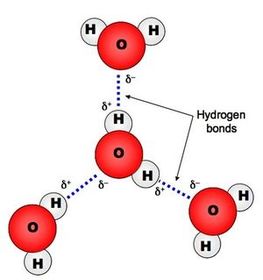
Na: involved in the generation of nerve impulses - 43.1.4 Draw and label a diagram showing the structure of water molecules to show their polarity and hydrogen bond formation
- 53.2.1 Distinguish between organic and inorganic compoundsOrganic compounds are compounds containing carbon - except hydrogen carbonates, carbonates and oxides of carbon
Inorganic compounds are all other compounds - 63.2.2 Identify glucose and ribose from diagrams showing their structureGlucose (C6H12O6)
Ribose (C5H10O5)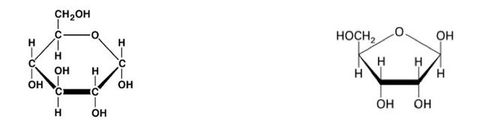
- 73.2.3 List three examples each of monosaccharides, disaccharides, polysaccharidesMono: glucose, galactose, fructose
Di: Lactose, Maltose, fructose
Poly: Cellulose, glycogen, starch - 83.2.4 State one function of glucose, lactose and glycogen in animalsGlucose: A source of energy which can be broken down to ATP via cell respiration
Lactose: A sugar found in the milk of mammals, providing energy for suckling infants
Glycogen: Used by animals for short-term energy storage (between meals) in the liver - 93.2.4 State one function each for fructose, sucrose and cellulose in plantsFructose: Found in honey and onions, it is very sweet and a good source of energy
Sucrose: Used primarily as a transportable energy form (chemically inert)
Cellulose: Used by plants as a strengthening component of the cell wall - 103.5.5 What is a condensation reaction?Condensation reactions occur when two molecules are covalently bonded and water is formed as a by-product
- 113.2.5 What is the bond called between two carbohydrates that were joined up by a condensation reaction?Glycosidic Linkage
- 123.2.5 What does a condensation reaction look like between two monosaccharides?

- 133.2.5 What are lipids?Lipids are a group of inorganic molecules that are insoluble in water but soluble in non-polar organic solvents
Common lipids include triglycerides, phospholipids and steroids - 143.2.2 Identify fatty acids from diagrams showing their structure

- 153.2.5 What are triglycerides made of?Three hydroxyl groups of glycerol and the carboxyl groups of three fatty acids
These are joined by a condensation reaction and will break into their constituents in the presence of water - 163.2.5 What is the bond called between glcerol and the fatty acids?An ester linkage
- 173.2.5 What happens when one of the fatty acids is replaced by a phosphate group?A phospholipid is formed
- 183.2.6 State three functions of lipidsSHIPS
Structure: cell membrane
Hormonal signalling: Steroids
Insulation: Fats in animals can serve as heat insulators
Protection: Triglycerides may form a layer around key internal organs and protect these from physical injury
Storage of energy: Triglycerides can be used as a long-term energy storage - 193.2.7 Compare the use of carbohydrates and lipids in energy storage (similarities)Similiarities:
polysa. and lip. contain a lot of chemical energy and can be used for energy storage
polysa. and lip. are both insoluble in water
Carbohydrates and lipids both burn cleaner than prtoeins (no Ni waste) - 203.2.7 Compare the use of carbohydrates and lipids in energy storage (differences)Lipid molecules contain more energy per gram than carbo. (~twice as much)
Carbs. are more readily digested than lips. and release their energy quicker
Monos. and Dis. are easier to transport than lipids
Animals tend to use carbs. as short-term storage and lips as long-term storage
Carbohydrates (glycogen/cellulose), lipids (fats/oil) - 213.2.8 What is a protein?Proteins are large organic compounds made of amino acids arranged in a linear chain
The sequence of amino acids in a protein is defined by a gene and encoded in the genetic code - 223.2.2 Identify amino acids from diagrams showing their structure
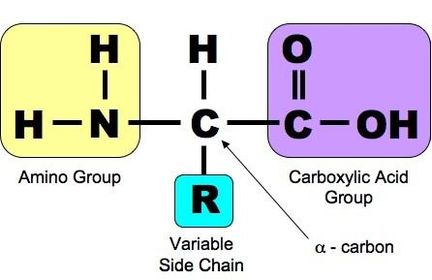
- 233.3.1 Draw a nucleotide structure
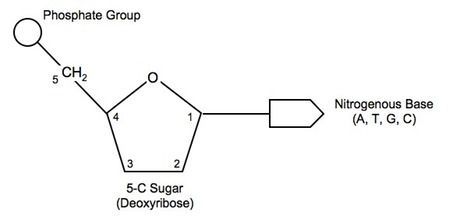
- 243.3.2 Which bases are purines and which are pyrimidines?Adenine and Guanine are purines (double ring bases)
Cytosine and Thymine are pyrimidines (single ring bases) - 253.3.3 Outline how the DNA nucleotdes are linked together by covalent bonds into a single strandThey are linked together via a condensation reaction
The phosphate (attached to the 5'-C of the sugar) joins with the hydroxyl group attached to the 3'-C of the sugar
Successive condensation reactions between nucleotides results in the formation of a long single strand - 263.3.3 What is the link formed between two nucleotides called?A phosphodiester bond
- 273.3.4 Explain how a DNA double helix is formedTwo polynucleotide chains are held together by hydorgen bonds between complementary bases
A=T (via two H-bonds)
C=G (via three H-bonds)
In order for bases to face each other and thus be able to pair they must run in opposite directions
The atoms that make up the molecule will arrange themselves in an optimal energy configuration
This position of least resistance results in the double-stranded DNA twisting to form a double helix with approximately 10-15 bases per twist
Información
- Descripción
- Fichas sobre IB Biology Topic 3 Chemistry of Life (except Topic 3.4-3.8), creado por R S el 27/04/2015.
- Creado por
- R S
- Visitas
- 128
- Etiquetas
- Valoración