
Fichas
Sustainable development stuff to know
Fichas del conjunto (100)
- 1Problems with current situation according to friedmanValues breakdown: from sustainable to situational
Acoounting principles: under-priced risk, privatized gains, socialized losses. - 25 points that will determine the stability of coming years according to FriedmanPetrodictatorships
Climate change
Energy poverty
Energy and natural resources supply and demand
Biodiversity loss - 3PRoblems with the deductive-nomological model1 correct prediction can be made with false theory
2 Hypotheses that are made without knowledge
3 a lot of science is not deductive but inductive. - 4Why trust scientistscollective authority, experience
- 5Problems with cap and trade1 Free permits - most permits are free.
2 Offsetting - hard to guarantee that real carbon is removed
3 Distraction - creates a system that distracts from the goal. - 6Smart gridA smart grid is a modernized electrical grid that uses analog[1] or digital information and communications technology to gather and act on information - such as information about the behaviours of suppliers and consumers - in an automated fashion to improve the efficiency, reliability, economics, and sustainability of the production and distribution of electricity.
- 7Natural Capital AccountingCapture info about natural assets that are currently missing from national accounts.
- 8Water supplypeak water supply: our demand has reached the limit of peak water supply. Need to rethink supply but especially demand!
- 9Environmental folkloreOur perception about environmental impact based on experiences, friends, etc... but no scientific basis.
- 10Biodegradabilitymaterial property NOT a measure of environmental benefit!
- 11Elon musk secretAbility to look at information and look at it from systemic perspective and identify solutions to problems
- 12Somatic and exosomatic energy regimeenergy limited or not by human power.
- 13Regional air pollutionruhr, sulfuric triangle, japan and the environmental miracle in the hanshin region.
- 14sulfuric triangleDresden, prague and krakow sit on seams of brown coal, high in sulfur and ash
- 15River water pollutionGanges - biological pollution
The rhine - chemical pollution
Watarase river - chemical pollution + acid rain. - 16EutrophicationToo much of nitrogen and phosphorus that are fertilizers. Create algae that consume oxygen.
- 17How did whaling pickup again?development of the harpoon cannon which fired explosive grenades in whales.
- 18Biological invasionIntroduction of new species that disrupt the natural balances of the local ecosystem. Examples: european rabbit
- 19Extinction ratesBefore 1-3 extinctions per year, now rapid increase due to human activities.
- 202 clusters related to energy, technology and economy1) cocketown cluster mid 19th - urban air pollution
2) Motown cluster 1940-1990 - global pollution - 21Potential new clusterengineering genes and bytes
- 22Link between nationalism and environmentnationalism justified heavy polluting in many cases.
- 232 phases in environmental policies and politics of the 20th century1) mid 1960s- late 1970s: mvmnts sprang up in rich countries
2) mid 1980 - poorer countries establish environmental protection agencies + international cooperation - 24anthropoceneInformal geologic epoch characterized by significant human impact on global ecosystems.
- 25silver buckshotIt's a catchy way of summing up the need for a portfolio or "wedges" approach to solve energy/climate challenges.
- 26CDMClean development Mechanism: allows a country with an emission-reduction or emission-limitation commitment under the Kyoto Protocol to implement an emission-reduction project in developing countries. Such projects can earn saleable certified emission reduction (CER) credits, each equivalent to one tonne of CO2, which can be counted towards meeting Kyoto targets.
- 27Cap and TradeEmissions trading or cap and trade ("cap" meaning a legal limit on the quantity of a certain type of chemical an economy can emit each year) is a market-based approach used to control pollution by providing economic incentives for achieving reductions in the emissions of pollutants
- 28Natural capitalNatural capital is the stock of natural resources (finite or renewable) and ecosystems that provide direct or indirect benefits to the economy, our society, and the world around us.
- 29Why price natural capitalno price, no management
- 30TEVUse value: direct, indirect, option
+
Non-use value: Existence, altruistic, Bequest - 31Valuation methods
- 32SealaskaIndustrial logging was seen as unsustainable, native corporations started to change this. Sealaska sustainability strategy, 4 pillars:
1 country or land-sea assets
2 ancestral heritage and destiny
3 human development
4 balance of humans in nature and society - 33Triple bottom line to assess sustainability of biomass energy in alaska:economic: operational savings from 3 $ per gallon upwards
environmental: emission factor values used for emissions
social: jobs. - 34Who popularizes the term sustainable developmentGro Harlem Bruntland in her book OUR COMMON FUTURE in 1987
- 357th EAPEnvironment action program to 2020: LT predictable policy framework to stimulate sustainable development.
- 36Rachel CarsonPublished a book silent spring in 1962. Effect of pesticides on birds
- 37EREPEuropean Resource Efficiency Platform. aim to secure at least a doubling of resource productivity compared with precrisis trend, equivalent to an increase of 30% by 2030
- 38+ and - with sustainable development+ Acceptance, focal point, orchestration of the sciences
- Oxymoron, fuzzy concept, legitimization of pollution. - 39Three pillars approacheconomic social and environmental
- 40IPATImpact = Population x Afflunce x technology
- 41living in urban areasover 50%
- 42Curve for CO2 concentrationKeeling curve
- 43% of protected land surface13%
- 44PEtrodictatorships: Impediments to democracyTaxation effect
Spending effect
Group formation effect
Repression effect
Anti-modernization effect - 45Why are we in trouble according to friedman?Values breakdown: from sustainable to situational, both in market and mother nature.
- 46How did we get financial crisis and environmental crisis according to friedman?Bad accounting rules
Underpricing of risk
PRivatizing gains and socializing losses - 47What to do according to friedman?No lecturing others
Redefine middle class lifestyle
Eliminate concept of waste : stop downcycling, make everything reusable or biodegradable - 48ENergy solution according to friedmanCheap, abundant, clean electrons the solution: solves 5 issues
1 growing demand for scarcer resources
2 petrodictators getting richer
3 Disruptive climate change
4 Energy proverty
5 Biodiversity loss.
He sees energy as geostatrategic, geoeconomic, capitalistic and patriotic - 49How have IPCC reports changed through times?Climate change more and more likely to be because of human activity
- 50Energy poverty1/5 no electricity
- 51# species extinct1 every 20 min, 1000x faster than the norm.
- 52Sources of emissions35% energy sector
24% Agriculture, forests
21% Industry
14% transport - 53Projected climate changesOceans warm
MEan sea level will rise
Arctic sea ice will shrink
Global glacier volume will decrease. - 54Potential Impacts of climate changeFood and water shortages
Displacement of people
INcreased poverty
Coastal flooding - 55Global warming potentialelative measure of how much heat a GHG traps in the atmosphere
- 56emission factorsindicates the quantity that can convert "activity data" into emissions.
- 57General principles of carbon accountingRelevance
Completeness
Consistency
Transparency
Accuracy - 58CDPCarbon disclosure project: based in UK, works with shareholders and corporations to disclose the GHG emissions of large corporations.
- 59Bilan Carbone, + and -Developed by French gov. Popularizes carbon footprinting
+ includes huge emission factor database, gov recognition
- develop in french context, complex and time consuming. - 60ISO standard for CO2Standard to ensure that a tonne is a tonne of CO2.
4 components: organization reporting, project reporting, validation and verification, accreditation of validation and verification bodies. - 61UNFCCCUN Framework Convention on CLimate change. They commit to reduction of GHG but no specified target (RIO 1992)
- 62COPhe Conference of Parties (COP) is the supreme body of the United Nations Framework Convention on Climate Change (UNFCCC). It currently meets once a year to review the Convention's progress and establish the rules of its implementation
- 63Most important COPs1997 Kyoto: legally binding targets
2001 Marrakech: conclusion of marrakech accords. main rules of international trading of emissions rights and the practical arrangements for the two other flexible mechanisms.
2009 Copenhagen. Presence of many leaders but no abitious agreement. - 64hy did carbon markets become instrument of choice (4) ?Diplomatic bargain during allocation process
CM are effective to meet climate target bc of cap
CM support clean tech and penalize polluting activities
CM are economically efficient - 65pectrum of policy option for CCFrom command and control to market based mechanisms:
State provision, regulatory controls, technology standards, emissions trading (in the middle) taxation, subsidies, information campaigns, voluntary agreements.... - 66Carbon markets euphoriafrom 1997-2008 (after kyoto )
- 67Marginal abatement cost curvescost of changing per tCO2 reduction.
- 68Constitutive elements of a cap and trade emissions trading systemSetting of cap
Allocation of allowances
Monitoring and reporting
Implementation of a registry to track allowances
Reconciliation and penalties for non-complience - 69Characteristics of Kyoto marketsEuropean bubble, exlusion of forestry, inclusion of all GHG, exclusion of aero+ maritime transport, grandfathering, sanctions
- 70% of emissions of countries that signed Kyoto extension14%
- 715 hypo to asses the effectiveness of CDM1 meet a climate target (absolute cap)
2 support clean tech, penalize polluting
3 econom efficient
4 raise awareness on carbon accounting
5 provide a fair solution for all - 72Problems with CDM and CAp and tradeInitial overallocation, accounting loopholes, carbon leakages
- 73differences between CDM and future market mechanismsproject vs programmes
Layers of decision making
Differences in incentivizing mitigation action
Offsetting approach vs net avoidance of emissions - 74NMM and FVA, which instrumentsmore than only emissions trading: taxation, subsidies, regulatory controlsm, voluntary....
- 752 main price mechanisms to reduce emissionscapntrade
carbon tax - 76CO2Logic approach1 Calculate
2 Reduce
3 offset remaining
4 commuinicate - 77PAS2060Publicly Available Specification (PAS) 2060 gives general requirements to be met by anyone wanting to achieve and demonstrate carbon neutrality.
- 78Natural CapitalRefers to the stock of natural resources such as minerals, plants, animals, air.... seen as the means for the production of ecological goods and ecosystem services such as: oxygen production, natural water purification, prevention of erosion, crop pollination, recreational services.
- 79Ecosystem servicesProvisioning
Supporting
Regulating
Cultural - 80TEVUse value: direct, indirect, option
+
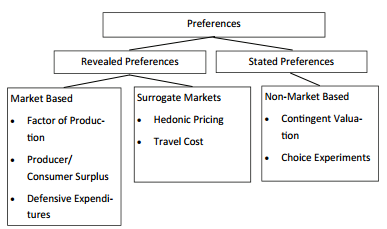
Non-use value: Existence, altruistic, Bequest - 81TEchniques to value ecosystem servicesMarket valuation
Revealed preferences
Sated preferences - 82Revealed preference methodsChange in productivity
Replacement cost
Travel cost
Hedonic pricing - 83Stated preference modelsContingent valuation
Choice modelling - 84Definition : PESPayments for environmental services: incentives which create incentives for conservation actions.
- 85Types of PESPrivate payments scheme
Cap-Trade scheme
Certification scheme
Public payment scheme - 86SSEESustainable social environmental enterprise.
- 87Circular economyKeep resources and their value within the economy
- 88Aim of the circular economyDecouple economic growth and development from the consumption of finite resources
- 892014 Circular economy packageGreen employment initiative
Green action plan for SMEs
Communication on Sustainable buildings - 90EU Circular economy package1) enabling framework
2) Waste target review
3) Specific waste challenges
4) Resource efficiency target - 91LCALife Cycle assessment: holistic approach to understand and prevent environmental impacts and resource utilization
- 924 steps in LCA1 Goal and scope definition
2 Inventory analysis
3 Impact assessment
4 Interpretation - 93Inventory analysisquantification of all basic economic flows associated with each elementary process
- 942 Impact categoriesMidpoint: problem oriented categories
Endpoint: Damage oriented categories
ex: problem: pollution that leads to damage: human health - 95Impact: focus on 5 categoriesGlobal warming potential
Ozone depletion potential
Acidification potential
Smog potential
Eutrophication potential - 96Limitations of LCAdefinition of system boundaries is at the discretion of the sponsor
Choice and complexity of the impact categories
Unclear rules of allocations
Ex: Data, time, resource requirements, lack of scientific basis, uncertainties over the implementation of results - 97Industrial ecologyis LCA applied to the whole
business - 98Industrial ecology: compelling business strategy, 4 main benefitsTo reduce costs or increase revenue
Improve LT resource scarcity
Regulatory pressure for efficiency
New business opportunities - 993 things to do to achieve industrial ecologyBy-product reuse
Utility or infrastructure sharing
Joint provision of services - 100Biomimicrylook for inspiration in nature to create new designs
Información
- Descripción
- exam preparation for MSD solvay 2015
- Creado por
- Alexander Rehn · jun 2015
- Actualizado
- 12 ene 2017
- Visitas
- 46
- Etiquetas
- Valoración