
Fichas
The Heart And Blood Vessels
Fichas del conjunto (65)
- 1Two types of circulatory system:Open and closed
- 2Open-circulatory systemThe heart pumps blood into open-ended vessels. The blood leaves these vessels and flows all around all of the cells of the animal's body.
The blood flows back to the heart, entering it through openings in the heart wall
e.g. crabs, lobsters, insects, spiders, slugs, snails - 3Closed circulatory systemBlood remains in a continuous system of blood vessels, i.e. blood is always enclosed in blood vessels
Exchange of material is possible through the thin capillary walls
e.g. earthworms, humans - 4Reasons for a closed system being more efficient:Allows the blood to be pumped around the body faster --> higher metabolic rate, faster exchange of material
Allows the blood flow to different organs to be increased or decreased - 53 components of the circulatory systemblood, blood vessels, heart
- 63 types of blood vesselsArteries
Veins
Capillaries - 7ArteriesCarry blood away from the heart, divide into smaller vessels called arterioles, oxygenated blood with the exception of the pulmonary artery
- 8VeinsCarry blood to the heart, divide into smaller vessels called venules, deoxygenated blood with the exception of the pulmonary vein
- 9CapillariesTiny vessels that link arteries and veins
- 10Tough, inelastic protein in arteries and veinsCollagen (prevents walls from over-expansion)
- 11Middle layer in arteries and veinsMuscle and elastic fibre
- 12Inner single layer of living cells surrounding the lumenEndothelium
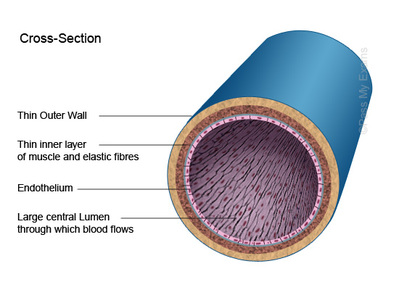
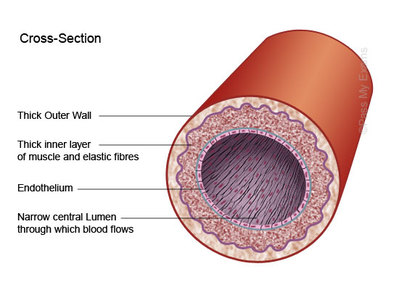
- 13—Vein
- 14—Artery
- 15Capillary walls are _____ and are made of ______permeable ; single layer of endothelium cells
- 16Blood pressureThe force the blood exerts against the wall of a blood vessel
- 17Function of valvesTo prevent the backflow of blood
- 18systoliccontraction
- 19diastolicrelaxation
- 20average systolic pressure110 -140 mm Hg
- 21average diastolic pressure75-80 mm Hg
- 22Device used to measure blood pressureSphygmomanometer
- 23Location of the heartBetween the two lungs (slightly to the left side of the chest) just above the diaphragm in the thoracic cavity.
- 24Muscle of the heartCardiac muscle
- 25Double membrane surrounding the heartPericardium
- 26Fluid in the pericardiumPericardial fluid
- 27Cardiac muscle isSlow to fatigue
- 28What type of pump is the heart?A double pump
- 29Which ventricle is thickest?Left (pumps blood all around the body)
- 30Wall that divides the heartSeptum
- 31Four chambers of the heartTwo atria
Two ventricles - 32Thickness of walls in the atriaThin
- 33Tough chords / heart stringsTendons
- 34Tendons are attached to the heart wall by projections calledpapillary muscles
- 35Valve on the right side of the heartTricuspid valve
- 36Valve on the left side of the heartBicuspid valve
- 37Valves that allow blood to flow into the aorta and pulmonary arterySemilunar valves
- 38LordLeft oxygenated
Right deoxygenated - 39Deoxygenated blood enters the heart through theVenae Cavae
- 40Blood flows out of the heart to the lungs through thepulmonary artery
- 41Oxygenated blood enters the heart through thepulmonary veins
- 42The oxygenated blood flows out of the heart and around the body through theaorta
- 43What is a portal system?A blood pathway that begins and ends in capillaries
- 44The cardiac muscle is supplied with blood from thecoronary/cardiac arteries branching from the aorta at the point where it leaves the heart, just beyond the semilunar valve
- 45Blockage of the coronary arteries can result in aheart attack
- 46chest pains often preceding a heart attackangina
- 47two circuitsPulmonary circuit
Systemic circuit - 48Pulmonary circuitthe blood is pumped to the lungs to lose carbon dioxide and gain oxygen and is then returned to the heart
- 49Systemic circuitheart - body - heart
- 50Heartbeat is controlled by thePacemaker
- 51What is the pacemaker and where is it located?A small bundle of specialised tissue located close to the entry of the superior vena cava within the right atrium wall
- 52The pacemaker sends outregular electrical impulses
- 53AV nodeatrio-ventricular node
- 54function of the pacemakerto control the rate of the heartbeat
- 55A record of the electrical activity of the heartECG (electrocardiogram)
- 56Nerves connecting the pacemaker to the brain (one reduces rate of heartbeat, the other increases)Medulla oblongata
- 57SA node / pacemakerSino-atrial node
- 58noise made when the bicuspid and tricuspid valves closelub
- 59noise made when the semilunar valves closedub
- 60filling phasediastole (approx 0.4 secs)
-relaxation (passive) - 61emptying phasesystole (approx 0.4 secs)
1. Atrial systole (0.1 secs)
2. Ventricular systole (0.3 secs) - 62heart murmuran abnormal sound associate eith the heartbeat, may indicate damage to one or more of the valves
- 63SmokingCauses heart disease (nicotine increases blood pressure and carbon monoxide interfere with the transport of oxygen in the body's cells - high levels cause the hardening of the arteries)
- 64DietA build up of cholesterol from animal fats can lead to a blockage in the cardiac artery leading to a heart attack, eating less fatty meats and fatty dairy products can reduce this risk)
- 65Exerciseincreases heat rate which strengthens the cardiac muscle making it more efficient at pumping blood, this improve the oxygen supply to the cardiac muscle and reduces blood pressure
Información
- Descripción
- Leaving Certificate (The Heart And Blood Vessels) Biology Fichas sobre The Heart And Blood Vessels, creado por eimearkelly3 el 21/10/2013.
- Creado por
- eimearkelly3
- Visitas
- 797
- Etiquetas
- Valoración