
Fichas
Ecosystem Flashcards
Fichas del conjunto (35)
- 1What is a Species?A group of organisms who can interbreed and produce fertile offspring.
Does not work for asexual organisms or species which can interbreed to produce fertile offspring (i.e dolphin) - 2What is Reproductive Isolation?Two closely related species are reproductively isolated if there is no gene flow between the groups even if they live in close proximity. Therefore, genes cannot be exchanged.
- 3Mechanisms for Reproductive IsolationSpecies produce gametes at different times
Mating recognition behaviour is different
Genitalia may prevent copulation
Zygote produced doesn't develop normally
Sperm cannot fertilise egg (destroyed)
Chemical or pheromones are different
Resulting offspring have unequal amount of chromosomes so are infertile - 4What is a Population?Organisms of same species living in a defined area.
- 5What is a Community?Different populations of organisms living and interacting with one another in a defined area.
- 6What is an Ecosystem?Community of organisms living and interacting with each other and their physical (abiotic) environment.
- 7What is a Biosphere?All the areas on the planet where there is life
e.g Sum of all Earth's ecosystems - 8What are Abiotic Factors?Non-living components of an environment
e.g rainfall, light and Oxygen levels - 9What are Biotic Factors?Living components of an environment
e.g competition, food availability, disease - 10What is exploitation and predation?Exploitation: when one organism feeds on another
Predation: where one organism hunts and kills another for food - 11What is Competition?Where organisms compete for the same resources (food, living space) or mates.
Most intense competition between members of same species (intra-specific)
Between different species is less intense (inter-specific competition) - 12What is Symbiosis?A close relationship between two organisms of different species where at least one benefits from the association.
Mutualism, Commensalism, Parasitism - 13Explain the three types of Symbiosis? Provide examples for eachMutualism: both benefit from association. e.g Remora and shark.
Commensalism: one benefits and the other is unharmed. e.g Crab and anemone.
Parasitism: one benefits and one is harmed. e.g dog and flea. - 14What is an autotroph/producer?Organism that can make their own energy rich food molecules.
e.g trees, plants, algae and seaweed - 15What is a heterotroph/consumer?Need to feed from other living things or their wastes. Consumers that eat
- Plants are herbivores
- Other animals are carnivores
- Both are omnivores - 16What are Decomposers?Feed upon dead/waste material and return useful substances to the soil for plants to use
e.g bacteria and fungi - 17What is the difference between a food chain and food web?Each successive organism in the food chain represents a different trophic level.
Food webs show that organisms eat a range of food and may exist in more than one trophic level. - 18What are the abiotic and biotic factors of a rainforest environment?ABIOTIC: Low light intensity at ground level, very rich soil substrate, high rainfall, warm and humid.
BIOTIC: Competition, symbiosis, predators, food availability, disease and population density. - 19What are the abiotic and biotic factors of a Arad Scrubland environment?ABIOTIC: Extreme temperatures (cold at night, hot in day), lack of water, low precipitation, high light intensity, dry, nutrient poor, salty, loose substrate.
BIOTIC: Competition, symbiosis, predators, food availability, disease and population density. - 20What are the abiotic and biotic factors of a Open Ocean environment?ABIOTIC: Temperature (warm at surface, cold at night), chemical composition (salt, pollution), light only penetrates top layers, high pressures at depths due to weight, currents, substrate is deep below surface.
BIOTIC: Competition, symbiosis, predators, food availability and disease - 21What are the abiotic and biotic factors of a Polar Ice Caps environment?ABIOTIC: Extremely cold, climate change, windy, extremes of day length, bright light intensity, no substrate, not a lot of shelter, water is scarce (low rain)
BIOTIC: Competition, symbiosis, predators, food availability, disease and population density. - 22What are Algal Blooms?Additional nutrients cause Algae to dramatically increase.
This creates additional organic matter that decomposers feed on. This causes them to bloom also.
Decomposers respire using up the oxygen causing other aquatic life to suffocate. - 23What causes Algal Blooms?Caused when excess nutrients containing nitrogen and phosphorus are added to water ways.
Additional nutrients come from run off containing fertilisers, sewage, waste water containing detergent. - 24What is Productivity?Gross Primary Productivity: The amount of light energy converted to chemical energy by plants. Some of this energy is then used by the plant to carry out life processes where energy is lost.
Nett Primary Productivity: The remaining energy is used to build structures such as roots and fruits (biomass) - 25How is Productivity expressed? What limits Productivity?Since plants transform energy and make it available to other organisms they set the energy budget.
Nett Primary Productivity is expressed by (energy/unit area/time) or (biomass added/unit area/time)
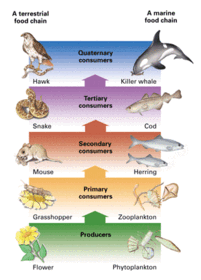
Productivity is limited by energy and nutrients available to the plants - 26Food chainsfood chains
afjsdid - 27Why are food chains usually only four to five trophic levels long?As 90% of the energy gained by each trophic level is lost in wasted forms like heat produced when organisms carry out life processes there isn't enough energy left to support a 6th/7th level.
- 28Why does the number of organisms in each trophic level generally decline as you move through the food chain?As 90% of the energy gained by each trophic level is lost in wasted forms like heat produced as organisms carry out life processes there is only enough energy passing through to support a much smaller number in successive trophic levels.
- 29What are the causes of Global Warming?- Burning fossil fuels and wood releases CO2 into the atmosphere
- Deforestation: reduction in trees which absorb CO2 when trees cur down they will eventually rot or burn to release CO2.
- Large numbers of livestock are needed to support humans they contribute to huge amount of CO2 in atmosphere - 30What are the consequences of Global Warming?- Melting ice caps cause sea levels to rise. Islands are lost and coastline move inland.
- Altered weather patterns, more extreme weather events.
-Spreading desserts - Loss of biodiversity
- High precipitation - Increased disease
- Temperature increases
- increase plant growth - 31What are the features of a r-selected or opportunistic organism? Provide examples- Density independant -short life span
- mature/reproduce quickly - small in size
- large number of offspring but only reproduce once or twice in lifetime.
- little to no nurturing of offspring
- found in early stages of succession
- take advantage of favourable conditions
e.g flies, locusts, mice and desert frogs - 32What are the features of a k-selected or equilibrium organism? Provide examples- Density dependant - Long life span
-Large in size - Later stages of succession
- Nurture offspring - Density dependant
- Take longer to mature & reproduce slowly
- Have few offspring in one reproductive cycle but reproduce more times in life.
- Thrive in an established community
e.g Elephants, Lions, Magpies and Whales - 33Which reproductive strategy do Humans use?Most animals fall somewhere in-between the r and k selected extremes.
Humans fall toward the k extreme as it shares many of the features (nuture offspring, long life span), however, humans are density independant and growth is similar to r selected organisms - 34What is Succession? What are the types of Succession?The progressive change in the composition of species in a community overtime.
PRIMARY: community develops on bare ground which never had any vegetation growing e.g sand dunes, lava flows
SECONDARY: ground has been previously colonised but destroyed (by fire/flood etc) May have traces of seeds, spores or soil - 35—
Información
- Descripción
- 12 Biology Fichas sobre Ecosystem Flashcards, creado por Molly McCarroll el 18/09/2015.
- Creado por
- Molly McCarroll
- Visitas
- 107
- Etiquetas
- Valoración