
Fichas
Materials Lecture 5
Fichas del conjunto (17)
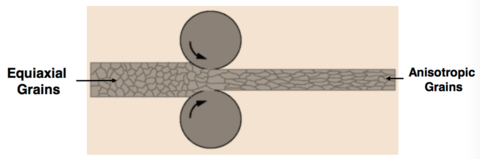
- 1How do the grains differ before and after cold rolling?Before they are equiaxial and after they are anisotropic
- 2What direction does the yield strength increase in and why?Increases in the direction of rolling because the alignment of grains along the rolling direction.
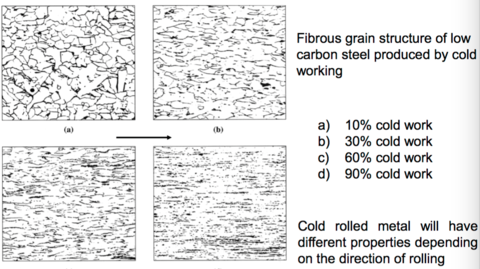
- 3How would anisotropic grains appear at 10,30,60 and 90% cold work?
- 4How does strain hardening occur in polymers?
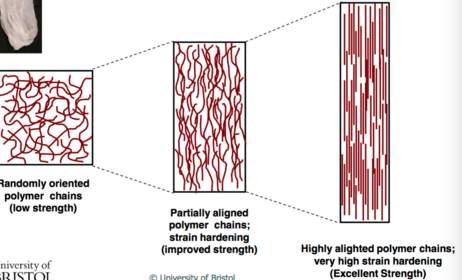
- 5What are the properties of polyethylene fibres?Extremely high degree of fibre stretching
Near perfect chain alignment along fibre axis direction
Excellent strain hardening effect; strength increased many folds
Strength ~40MPa
Stiffness~0.8GPa
Low density - 6How can the direction of strain be important for carbon fibre?In plane young modulus much higher than out of plane
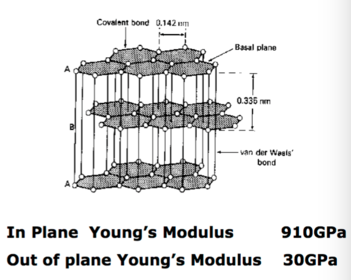
- 7How can carbon fibre strength be improved?Stretching of carbon fibres aligned with the graphitic planes along fibre axis.
- 8Properties of Carbon fibre?Strength ~ 3100MPa
Stiffness~200-580GPa
Low density - 9Which process can restore ductility?Annealing
- 10What two steps can annealing be provided in?Recovery
Recrystallisation - 11What are the features of these two steps?Recovery - partial recovery of ductility at cost of partial reduction in strength
Recrystallisation - Complete recovery of ductility at the loss of significant strength. - 12What is the process of recovery annealing?Cold work metals are heated to a relatively high temperature (lower than recrystallisation).
The metal atom can diffuse relatively easily to heal dislocations - 13What is the process of recrystallisation annealing?Carried at higher temperatures, typically between 0.4Tm and 0.6Tm (melting temp =Tm)
Converts anisotropic grains to relatively symmetric grain formation with significant reduction in dislocation density. - 14Which direction is annealing happening L-->R or R-->L?
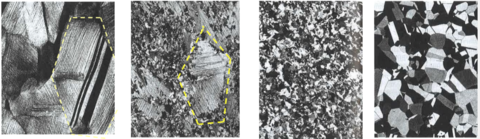
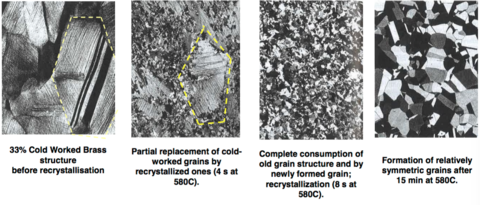
- 15How does welding of cold worked metals affect crystallisation?Welding will heat metal above recrystallisation temp and cool slowly.
Creates completely different grain structure.
Significant reduction in mechanical properties near heated zone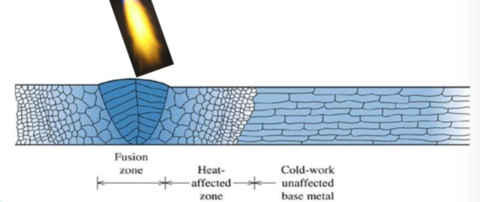
- 16What is hot working?Plastic deformation of metal carried out above recrystallisation temperature.
Grains elongate during plastic deformation but immediately recrystallise to form equiaxial grains.
No strain hardening can take place during hot working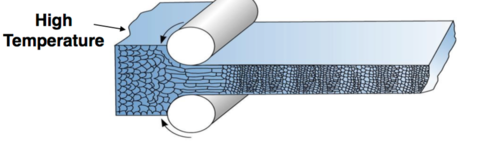
- 17Pros and cons of hot working?Pros:
- Large plastic deformation possible due to increased temp - thicker metals.
- Retention of ductility
Cons:
- Surface oxidation due to high temp
- Cost - Heating unit very expensive
- Uneven cooling can lead to differential cooling and poor dimensional control.
Información
- Descripción
- Uni Materials Fichas sobre Materials Lecture 5, creado por Luke Hansford el 09/04/2016.
- Creado por
- Luke Hansford
- Visitas
- 3
- Valoración