
Fichas
DNA and RNA, Protein Synthesis, Replication
Fichas del conjunto (38)
- 1What is the difference between DNA helicase and DNA polymerase?Helicase: breaks the hydrogen bonds within the DNA double helix "unwinding" it.
Polymerase: adds complementary nucleotides to a DNA template thus functioning in the synthesis of a new DNA strand - 2What is transcription?transcription is the process in which part of the nucleotide sequence of DNA is copied into a complementary sequence of RNA
- 3What does the term Operator mean?an Operator is a region of chromosomes in an operon to which the repressors binds when the operon is off
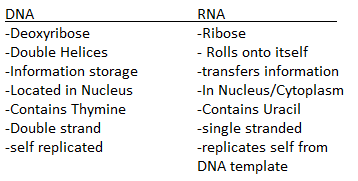
- 4Three main differences between DNA and RNA?
- 5What are Hox genes?Hox Genes are a series of genes that controls the differentiation of cells and tissues in an embryo
- 6What is an anticodon?Anticodons are groups of three bases on a tRNA molecule that are complementary to an mRNA codon
- 7What are two kinds of frameshift mutations?Insertion: inserting a base into the sequence
Deletion: a base is deleted from the sequence - 8What is the process of transcriptionDNA unwinds and unzips using DNA Helicase. RNA nucleotides rearrange and bind with one another to form a complementary strand called mRNA. The mRNA then leaves the nucleus through nuclear pores in the nuclear membrane, heading towards a ribosome for translation.
- 9What is the "tata" box?The tata box helps position RNA polymerase by marking the starting position before transcription begins.
- 10What are introns?Introns are sequences of DNA that is not involved in coding for a protein.
- 11What is the difference between purines and pyrimidines?purines have a two ring structure (bigger)
pyrimidines have one ring structure - 12What types of gene mutations are there?Point mutations and Frameshift mutations!
- 13Describe the process of translationInitiation: a ribosome utilizes enzymes to bring in tRNA molecules with anticodons to the start codon located on mRNA. The ribosome reads each codon and organizes the postion of tRNA molecules. Elongation: The amino acid of each new tRNA accepts and forms a peptide bond, elongating the polypeptide.
Termination: The final codon binds with an anticodon on tRNA that lacks an amino acid, causing the polypeptide chain to break off and form a protein. - 14What are four types of chromosomal mutations?Deletions: loss of all or part of a chromosome
Duplications: produce extra copies of parts of a chromosome
Inversions: reverse the direction of parts of a chromosome
Translocations: part of one chromosome breaks off and attaches to another. - 15What did Avery Oswald discover in 1944?Avery discovered that genes are composed of DNA
- 16What did Frederick Griffith discover in 1928?Frederick discovered that the factor in heat killed disease-causing bacteria can't transform harmless bacteria into ones that can cause disease
- 17What is a mutation?a mutation is a change in DNA sequence that affects genetic information.
- 18What are the purines/pyrimidines in DNA?Purines: Adenine , Guanine
Pyrimidines: Thymine, Cytosine - 19What are the purines/pyrimidines in RNAPurines: Adenine , Guanine
Pyrimidines: Uracil and Cytosine - 20What are four bases found in DNA?Adenine, Guanine, Cytosine, Thymine
- 21What did Watson and Crick develope in 1953?Watson and Crick developed the double helix model of the structure of DNA
- 22What are four properties of DNA polymerase?1. Requires 4 nucleotides in triphosphate forms
2. requires single-stranded DNA as a template
3. adds nucleotides to the free 3' end of an existing strand
4. requires a primer, an existing strand of nucleic acids - 23What is a frameshift mutation?Frameshift mutations are mutations that physically shift the reading frame of the genetic code by iinsertingor deleting a nucleotide
- 24How are long DNA molecules found in eukaryotes packed into short chromosomes?DNA coils around proteins called histones forming a nucleosome. These nucleosomes are tightly coiled and supercoiled to form chromosomes.
- 25Give a summary of protein synthesis.Transcription:
1. DNA in the nucleus contains code
2. When mRNA is formed from the DNA template, its codons match the strand of DNA.
Translation:
3.mRNA moves into the cytoplasm and becomes associated with ribosomes.
4. tRNA containing anticodons carry amino acids and binds with mRNA strand.
5. As tRNA departs, peptide bonds forms between amino acids and a polypeptide chain forms.
6. Polypeptide chain then leaves the ribosomes and forms a protein. - 26What did Linus Pauling and Robert Corey discover in 1951?Pauling and Robert Corey discovered that the structure of a class of proteins is a helix.
- 27Where and in what form is eukaryotic DNA found?Eukaryotic DNA is found in the nucleus in the form of chromosomes.
- 28What is a promoter?Promoters are regions of DNA that indicate to an enzyme where to bind to make RNA
- 29What are three types of RNA and what are their functions?mRNA: RNA molecules that carry copied of instructions for assembling amino acids.
rRNA: makes up the ribosomes and brings mRNA and tRNA together during translation.
tRNA: carries amino acids to ribosomes, have anticodons on them which match up with codons on mRNA during translation. - 30What are exons?Exons are expressed sequences of DNA that code for a protein.
- 31What are the major steps of DNA replication?1. Double helix unwinds
2. DNA helicase unzips DNA and hydrogen bonds are broken
3. DNA is split at the replication fork
4. Nucleotides are added in correct order to create a complementary strand
5.Primase adds RNA primers so nucleotides can be attached
6. DNA polymerase adds nucleotides, proofreads, and replaces RNA primers with DNA nucleotides. - 32What is an operon?An operon is a group of genes that work together.
- 33What is the type of point mutation that can occur?Substitution: Substitution of a nucleotide for another.
- 34What does the term Differentiation mean?Differentiation is the process in which cells become specialized in structure and function.
- 35What is a polyploidy?A polyploidy is a condition in which an organism has an extra set of chromosomes.
- 36How did Rosalind Franklin study DNA in 1952?Franklin studied the DNA molecule using a technique called x-ray diffusion.
- 37What is a bacteriophage? What are they composed of?A bacteriophage is a virus that infects other bacteria that are composed of DNA or RNA core and protein coat.
- 38What nucleotides made up of?Nucleotides are made up of the following:
1. 5 Carbon sugar called deoxyribose
2. Phosphate group
3. Nitrogeneous bases that are either double or single stranded.