
Fichas
The Nervous System and Synaptic Transmission - Biol 2016 unit 6
Fichas del conjunto (50)
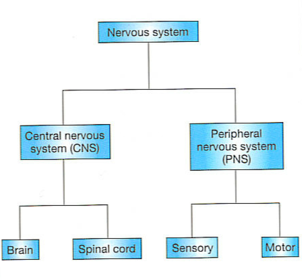
- 1The organisation of the nervous system:
- 2What do cell mediators 'Histamines' do?Stored in white blood cells called mast cells. Released following tissue damage or bacterial infection or in response to an allergen like pollen. Causes swelling, redness and itching. Allows phagocytic white blood cells to move into tissue fluid and destroy bacteria.
- 3What is myelination:Schwann cells form a lipid-rich insulating layer around the axon called a myelin sheath. Gaps between the Schwann cells are called Nodes of Ranvier and are important in transmitting nerve impulses.
- 4Diagram of a Motor Neuron:
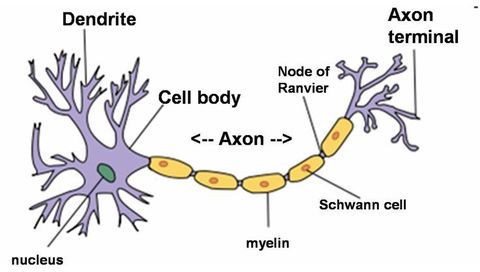
- 5Function of the Cell body:- Contains a nucleus and large amounts of Rough ER associated with the production of neurotransmitters.
- 6Function of the Dendrons and Dendrites:-Carry nerve impulses towards the cell body.
- 7Function of the Axon:-Single long fibre that carries nerve impulses away from the cell body
- 8Function of Schwann Cells:-Surrounds the axon protecting it and providing electrical insulation
- 9Function of the Myelin Sheath:-Made up of membranes of Schwann cells which are rich in the lipid Myelin
- 10Function of the Node of Ranvier:Gaps between Schwann Cells where there is no Myelin Sheath.
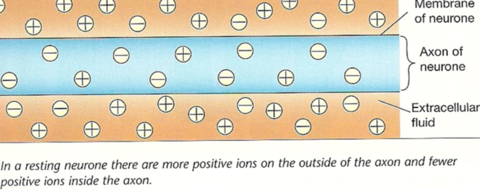
- 11What does it mean for a membrane to be Polarised?A membrane is said to be polarised if a potential difference is maintained across it with the inside being negative with respect to the outside
- 12What does Resting Potential mean?The resting potential is the potential difference which exists across the axon membrane when the neurone is not conducting an impulse
The inside of the membrane is negative compared to the outside (-65mV) - 13The distribution of charges across the axon membrane:
- 14Explain what these proteins are used for:Sodium ions moved out by sodium potassium pump; potassium ions moved in
Potassium ions diffuse out through open potassium channel proteins
Fewer sodium ions diffuse in through open sodium channel proteins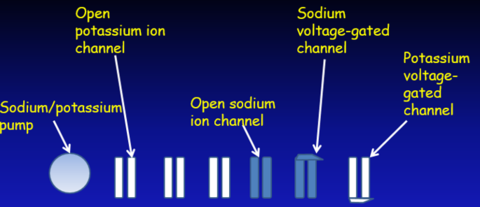
- 15Resting Potential across an axon membrane:
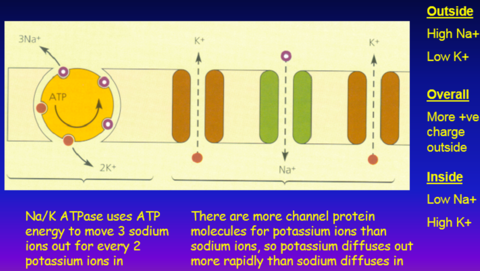
- 16and another diagram:
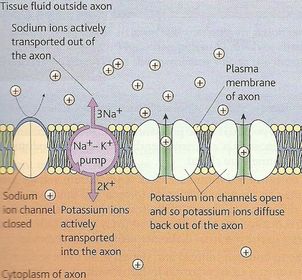
- 17What is an Action Potential:The change that occurs in the electrical charge across the membrane on an axon when it is stimulated and a nerve impulse passes
- 18The active neruone:The sodium-gated channels open and sodium ions rush into the neurone along their electrical and concentration gradients
The sodium ions are positively charged and make the inside of the axon positive compared to the outside
Eventually the potential difference across the membrane is reversed from -65 mV to about +40 mV. This is called the ACTION POTENTIAL and the nerve has become DEPOLARISED. - 19Recovery/Repolarisation:The sodium-gated channels close so the membrane becomes less permeable to sodium ions
The potassium-gated channels open and potassium ions diffuse out of the axon along a concentration and electrical gradient
The membrane becomes positive outside compared to inside. It is said to be REPOLARISED, with a resting potential of -65 mV
For a brief time the membrane becomes HYPERPOLARISED – it is more negative than the usual resting potential due to the potassium-gated channels staying open.
The potassium gates close. The sodium-potassium pump restores the normal concentration of sodium and potassium ions across the axon membrane - 20Diagram of the Action Potential:
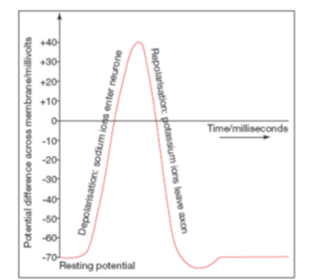
- 21The Sodium-Potassium Pump uses Active Transport to move...3 Sodium Ions out and 2 potassium ions into the cell
- 22During Resting Potential:Na+ - K+ pump working
2 k+ ions move into axon
inside of the axon has a negative charge of -70mV
3 Na+ ions move out of axon
outside the axon has a positive charge - 23When a Stimulus reaches a resting neurone (causing an action potential and depolarisation):Na+ - K+ pump stops working
Na+ gated channels open
Na+ ions diffuse into the axon
inside the axon has a positive charge of +40mV an outside the axon has a negative charge - 24What happens during Repolarisation:Na+ gated channels close and K+ gated channels open
K+ ions diffuse out of axon - 25When Resting Potential occurs again:Na+ - K+ pump working again
2 K+ move into axon
3 Na+ move out of axon
Inside the axon has a positive charge of -70mV
Outside the axon has a positive charge - 26What is meant by potential difference?unequal distribution of positively charged ions on each side of the cell membrane
- 27How large is the potential difference across a membrane?-65
- 28Which side of the membrane has the largest number of positive ions?Tissue fluid outside axon (outside)
- 29Which is found in the highest concentration on the outside of the membrane at rest?sodium
- 30Where do sodium ions go through the Gated-Channel proteins?into the axon membrane
- 31Where do potassium ions go through the Gated-Channel proteins?out of the axon membrane
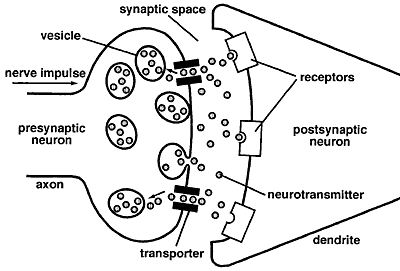
- 32The arrival of an Action Potential at the end of the presynaptic neurone causes:Calcium ion channels to open and calcium ions to enter the synaptic knobs.
- 33What does the influx of calcium ions into the presynaptic neurone cause?synaptic vesicles to fuse with the presynaptic membrane, releasing the neurotransmitter acteylcholine into the synaptic cleft.
- 34What does the neurotransmitter acteylcholine then do?it diffuses across the synaptic cleft and binds with receptor sites on sodium ion channels in the membrane of the post synaptic neurone.
- 35What do the sodium ions channels then do?The sodium ion channels open allowing sodium ions to diffuse in rapidly along a concentration gradient.
- 36What does the influx of sodium ions cause?The influx of sodium ions generates a new action potential in the post synaptic neurone.
- 37Acetylcholine is then broken down into choline and ethanoic acid (acetyl) by which enzyme?Acetylcholinesterase
- 38What then happens to the products of this reaction?Choline and ethanoic acid diffuse back into the synaptic knobs and are re-synthesised into acteylcholine. ATP from the mitochondria is needed for this.
- 39What then happens to the sodium ion channels in the absence of acetylcholine in the receptor sites:They close
- 40Synaptic Transmission diagram:
- 41What is summation?a single nerve impulse arriving at a synapse may release only a small amount of neurotransmitter - not enough to generate an action potential.
- 42What is spacial summation?several presynaptic neurones converge onto a single postsynaptic neurone. If the all release neurotransmitter, enough may be produced to fire an impulse in the postsynaptic neurone.
- 43What is temporal summation?a single presynaptic bulb fires several times in quick succession and enough neurotransmitter builds up to generate an excitatory postsynaptic potential.
- 44Action Potential - when a stimulus reaches a resting neurone, the following sequence occurs: 1:during the resting potential, some of the potassium voltage-gated channels are permanently open. The sodium voltage gated channels are closed.
- 452:The energy of the stimulus causes some sodium voltage gated channels in the axon membrane to open and sodium ions rapidly diffuses in along their electro-chemical gradient.
- 463:As the sodium ions diffuse in, more sodium voltage-gated channels open allowing more sodium ions to diffuse in. The inner surface of the membrane now has a positive of +40mV. This change in potential difference is called depolarisation and depolarisation of a small section of a nerve fibre causes an action potential.
- 47Sympathetic nervous system:Stimulus effector
Speeds up activity
Preparation for stressful activity (fight or flight, exercise ect.) - 48Parasympathetic nervous system:Inhibits effectors
Slows down activity
Controls activity at rest - conserves energy and replenishes body's reserves - 49Control of the heart rate:Controlled by the CARDIO-REGULATORY CENTRE IN THE MEDULLA of the brain
- 50The difference between myelinated and unmyelinated nerves:If the axon is covered with myelin sheath, the nerve impulse is faster, whereas the unmyelinated nerve is slower.
Información
- Descripción
- Fichas sobre The Nervous System and Synaptic Transmission - Biol 2016 unit 6, creado por Elena Cade el 03/05/2016.
- Creado por
- Elena Cade · may 2016
- Actualizado
- 5 ene 2017
- Visitas
- 78
- Etiquetas
- Valoración