
Fichas
Lipid Metabolism
Fichas del conjunto (56)
- 1What tissues don't experience FA catabolism?RBCs and brain
- 2What type of oxidation does catabolism require?B-oxidation
- 3What is the result of B-oxidation in catabolism?acetyl-CoA and 5 ATP
- 4How much ATP results from acetyl-CoA entering the Krebs cycle?12 ATP
- 5What are fatty acids stored as in adipose tissue and muscle?triglycerides
- 6What do FAs bind to when transported in the blood?albumin
- 7What enzyme is used to transfer TF into FA in adipose tissue?hormone-sensitive lipase
- 8Where are ketone bodies made?Liver
- 9What alcohol is attached to the FAs before being stored as triglycerides?glycerol-p
- 10Breakdown: TG --> FA --> _____ . What is the form of energy?ATP
- 11Most of the body lives on FA oxidation. Glycogen breakdown and gluconeogenesis occur where?liver
- 12Where are FAs activated and primed for metabolism?cytosol
- 13What enzyme is used to make an activated fatty acid from fatty acid + CoA?thiokinase
- 14Why does a FA need to be oxidized? Where does the site of this oxidation occur?needs to get inside the mitochondria, site of FA oxidation
- 15How many ATP are required to activate a FA (that happens in the cytosol)?2 ATP
- 16What molecule carries FA into the mitochondria?carnitine
- 17How many carbons in a FA chain does it require to complete B-oxidation and make 2C acetyl-CoA?all of the C atoms in the FA
- 18What is THE major source of biological energy production during fasting?B-oxidation of FAs
- 19What is significant about the B-oxidation of FAs that does not occur in the Krebs Cycle oxidation?B-oxidation results in acetyl-CoA + same carbon chain (FA) that we started with. Recycling mechanism.
- 20How many ATP result in accumulating 1 FADH2 from the B-oxidation cycle?2 ATP
- 21How many ATP result in accumulating 1 NADH from the B-oxidation cycle?3 ATP
- 22How many ATP result in accumulating 1 acetyl-CoA from the B-oxidation cycle?12 ATP
- 23What cells primarily use FA for energy metabolism?hepatocytes and adipocytes
- 24How is acetyl-CoA exported from the mitochondria to cytoplasm?shuttled out as citrate
- 25What drives FA synthesis?decarboxylation
- 26FA synthesis involves energy-driven (ATP) carboxylation of _____ to _____.2C acetyl-CoA --> 3C malonyl-CoA
- 27The chemical reversal of B-oxidation is _______.Fatty Acid synthesis
- 28How are carbon atoms added on FA synthesis?added 2 at a time using 3C malonyl-CoA
- 29What is the intermediate for FA synthesis?acyl carrier protein
- 30Where does FA synthesis occur?the cytosol
- 31What is the primary co-enzyme for FA synthesis?NADPH
- 32How are carbon atoms removed in FA oxidation?2 at a time
- 33How much energy does it cost for acetyl-CoA to exit the mitochondria as citrate/1 ATP
- 34What enzyme makes malonyl-CoA from acetyl-CoA?acetyl-CoA carboxylase
- 35What is the rate-limiting enzyme of FA synthesis?acetyl-CoA carboxylase
- 36At what point does FA synthesis stop?16C or 18C (palmitic and stearic acid)
- 37How do elongases function?extend FA by 2C units
- 38What do desaturaes do?add double bonds
- 39What is the "longest reach" when referring to desaturases?delta9 desaturase is the "longest reach"
(9C from COOH end) - 40Which three FAs are essential?Linoleic (18:2w6)
linolenic (18:3w3)
Arachidonate (20:4w6) - 41For FA synthesis, what are the two allosteric controls?Citrate (and acetyl~CoA) in cytosol activate.
Palmitate (end-product) feedback inhibits. - 42How many ATP for acetyl-CoA to be exported from the mitochondria?8 ATP
- 43How many ATP does it require for 7 malonyl-CoA syntheses?7 ATP
- 44How many ATP is offered by 2 NADPH?6 ATP
- 45How do you calculate how much ATP is used to make FA from acetyl-CoA to store?(8 ATP * # of cycles) + 1
- 46The net energy cost between FA synthesis and FA oxidation is ____ ATP.24 ATP
(3 ATP/acetyl-CoA) - 47What is the general chemical equation to make a triglyceride?glycerol + ATP + 3 fatty acyl-CoA
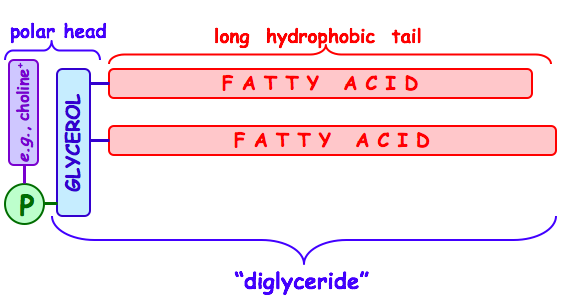
- 48Identify.phospholipid/diglyceride
- 49What type of energy activates choline in the biosynthesis of a phospholipid?CTP
- 50What phospholipid is important for lung surfactant that can also cause respiratory distress for premature babies if missing?Dipalmitoyl-PC
- 51What is the energy input required in the synthesis of FAs?ATP, NADPH
- 52What molecules result from the Krebs Cycle [ox]?FADH2, NADH, and water
- 53What molecules result from the B-oxidation of FAs?FADH2, NADH, and water
- 54What is the multi-enzyme complex in cytosol used in FA synthesis?FA synthase
- 55What is chylomicrons (lymph)?fat from gut repackaged and stored in adipose tissue… can also be functioned in skeletal muscles as proteins
- 56—
Información
- Descripción
- Lipid Metabolism I, II, & III - MED 2017
- Creado por
- Kristina Redd
- Visitas
- 17
- Etiquetas
- Valoración