
Fichas
GCSE Biology 4 OCR - The Processes of Life
Fichas del conjunto (31)
- 1What is the function of: the nucleuscontains DNA (the instructions for making proteins)
- 2What is the function of: the cyptoplasmgel like substance where proteins (like enzymes) are made
- 3What is the function of: cell membraneholds the cell together and controls what enters and leaves the cell
- 4What is the function of: mitochondriaWhere the enzymes needed for reactions of aerobic respiration are found
- 5Name 3 things that plant cells have that animal cells do and give their function.Cell wall- supports and strengthens the cell
Vacuole- contains cell sap, a weak solution of sugar and salts
Chloroplasts - where the reactions for photosynthesis occur - 6Yeast cells have mitochondria and a nucleus. True or False?True
- 7What type of cells have a cell wall but no nucleus?Bacterial cells
(instead they have a circular molecule of DNA floating within the cytoplasm) - 8Give a definition of an enzymeEnzymes are proteins produced by living things that help speed up chemical reactions
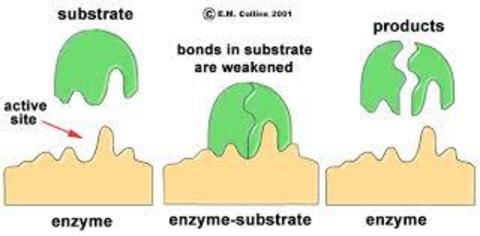
- 9Describe the lock and key model
- 10Name two things that effect how an enzyme worksTemperature and pH
- 11What is a denatured enzyme?where the bonds in the active site break and change shape, so that the substrate no longer fits
- 12Name three things that energy from respiration is used forMovement
Active transport
Synthesis of larger molecules - 13What type of respiration, aerobic or anaerobic releases more energy per glucose molecule?aerobic respiration
- 14Write the word equation for aerobic respirationglucose+oxygen
->
carbon dioxide+water+energy - 15Write the symbol equation for aerobic respirationC6H12O6 +6O2 = 6CO2 + 6H2O + energy
- 16Give an example of when humans respire anaerobicallyduring vigorous exercise (when the body can't supply oxygen to the muscles for aerobic respiration)
- 17Anaerobic respiration releases energy. What else does it release in: Animal cells?Lactic acid
- 18Anaerobic respiration releases energy. What else does it release in: Yeast cells?Ethanol and Carbon Dioxide
- 19Briefly describe how bread is made using yeast.The yeast ferments the carbohydrates in the bread and release CO2 and cause the bread to rise
- 20Briefly describe the process of photosynthesisPhotosynthesis is a series of chemical reactions that uses energy from sunlight to produce food
- 21Write the word equation for photosynthesisCarbon dioxide + Water
->
Glucose + Oxygen - 22Write the symbol equation for photosynthesis6CO2+6H2O = C6H12O6+6O2
- 23Give three main ways in which plants use glucoseRespiration
Chemicals in growth
Stored as starch - 24Name three factors that can effect the rate of photosynthesisLight
Carbon Dioxide
Temperature - 25Describe how to take a transectRun a tape measure between two points
Start at one end, collecting the data you want, then move along the transect and collect data you want - 26Describe how you might use a quadrat when investigating plantsIt helps you estimate the percentage cover of a plant species on the ground, by counting how much of the quadrat is covered by the species
- 27What's an identification key?A series of questions you can use to try and figure out what a plant is
- 28Give a definition of diffusionThe passive overall movement of particles from a region of high concentration to a region of low concentration
- 29Give two examples of chemicals that can move in or out of leaf cells by diffusionCO2 taken in for photosynthesis
O2 excreted in photosynthesis - 30What is osmosis?The overall movement of water from a dilute to a more concentrated solution through a partially permeable membrane
- 31Give two ways in which active transport differs from diffusionIt requires energy
It moves particles from a low concentration to a higher concentration
Información
- Descripción
- Flash cards from the CGP revision guide to help you with your GCSEs
- Creado por
- blairzy123
- Visitas
- 629
- Etiquetas
- Valoración