
Diagrama de flujo
The Speech Sounds
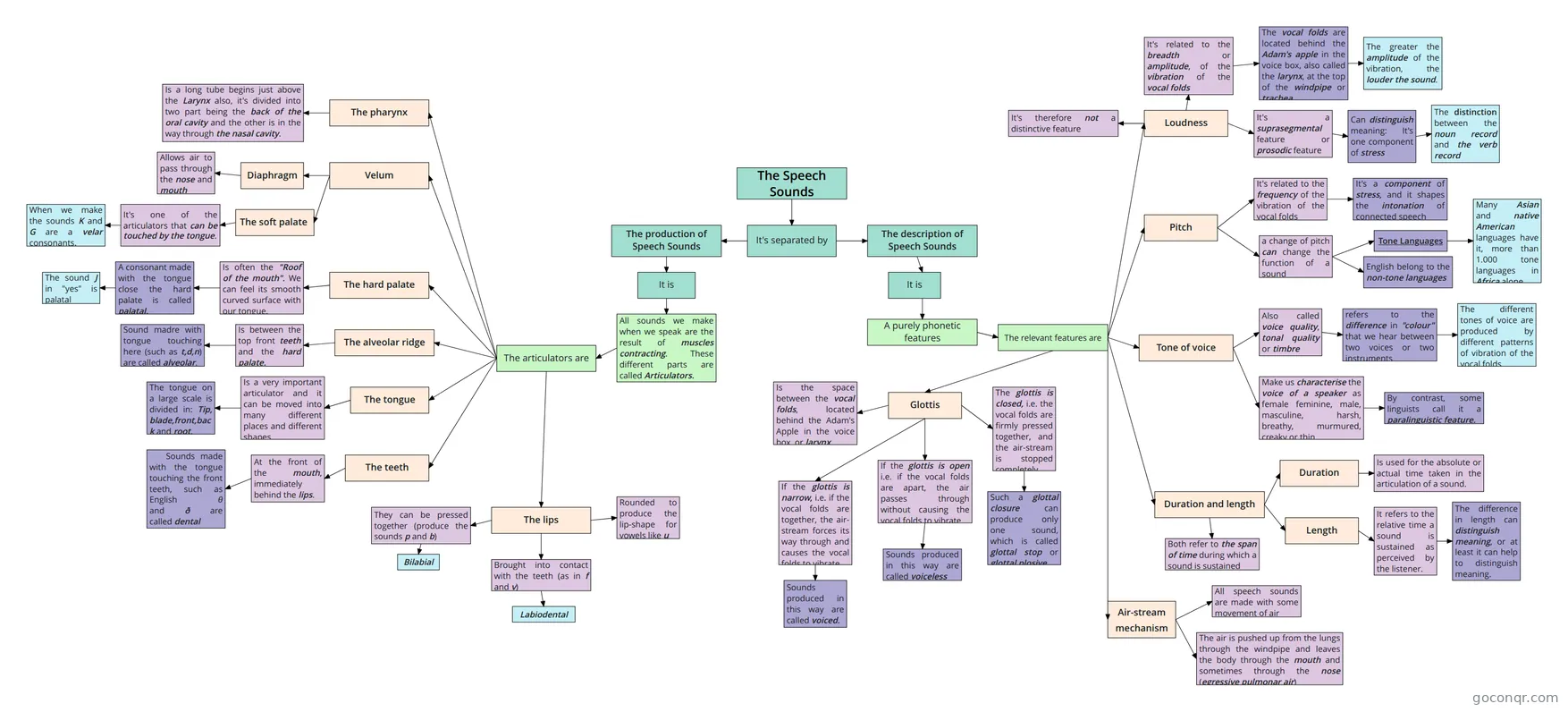
Flowchart: The speech sounds
Contenido del diagrama
The Speech Sounds
It's separated by
The description of Speech Sounds
The production of Speech Sounds
It is
All sounds we make when we speak are the result of muscles contracting. These different parts are called Articulators.
The articulators are
The pharynx
Is a long tube begins just above the Larynx also, it's divided into two part being the back of the oral cavity and the other is in the way through the nasal cavity.
Velum
The hard palate
Is often the "Roof of the mouth". We can feel its smooth curved surface with our tongue.
A consonant made with the tongue close the hard palate is called palatal.
The sound J in "yes" is palatal
The alveolar ridge
Is between the top front teeth and the hard palate.
Sound madre with tongue touching here (such as t,d,n) are called alveolar.
The teeth
The tongue
Is a very important articulator and it can be moved into many different places and different shapes.
The tongue on a large scale is divided in: Tip, blade,front,back and root.
At the front of the mouth, immediately behind the lips.
Sounds made with the tongue touching the front teeth, such as English θ and ð are called dental
It is
A purely phonetic features
The relevant features are
Loudness
Pitch
It's related to the breadth or amplitude, of the vibration of the vocal folds
The vocal folds are located behind the Adam's apple in the voice box, also called the larynx, at the top of the windpipe or trachea
The greater the amplitude of the vibration, the louder the sound.
It's a suprasegmental feature or prosodic feature
Can distinguish meaning: It's one component of stress
The distinction between the noun record and the verb record
It's therefore not a distinctive feature
It's related to the frequency of the vibration of the vocal folds
It's a component of stress, and it shapes the intonation of connected speech
a change of pitch can change the function of a sound
Tone Languages
English belong to the non-tone languages
Many Asian and native American languages have it, more than 1.000 tone languages in Africa alone.
Air-stream mechanism
Duration and length
The lips
Rounded to produce the lip-shape for vowels like u
Brought into contact with the teeth (as in f and v)
They can be pressed together (produce the sounds p and b)
Glottis
Tone of voice
Also called voice quality, tonal quality or timbre
refers to the difference in "colour" that we hear between two voices or two instruments
The different tones of voice are produced by different patterns of vibration of the vocal folds
Make us characterise the voice of a speaker as female feminine, male, masculine, harsh, breathy, murmured, creaky or thin
By contrast, some linguists call it a paralinguistic feature.
Duration
Length
Is used for the absolute or actual time taken in the articulation of a sound.
Both refer to the span of time during which a sound is sustained
It refers to the relative time a sound is sustained as perceived by the listener.
The difference in length can distinguish meaning, or at least it can help to distinguish meaning.
All speech sounds are made with some movement of air
The air is pushed up from the lungs through the windpipe and leaves the body through the mouth and sometimes through the nose (egressive pulmonar air)
Is the space between the vocal folds, located behind the Adam's Apple in the voice box, or larynx.
If the glottis is narrow, i.e. if the vocal folds are together, the air-stream forces its way through and causes the vocal folds to vibrate.
If the glottis is open i.e. if the vocal folds are apart, the air passes through without causing the vocal folds to vibrate.
Sounds produced in this way are called voiceless
The glottis is closed, i.e. the vocal folds are firmly pressed together, and the air-stream is stopped completely.
Such a glottal closure can produce only one sound, which is called glottal stop or glottal plosive.
Sounds produced in this way are called voiced.
The soft palate
It's one of the articulators that can be touched by the tongue.
When we make the sounds K and G are a velar consonants.
Diaphragm
Allows air to pass through the nose and mouth
Bilabial
Labiodental
Información
- Descripción
- LICENCIATURA Diagrama sobre The Speech Sounds, creado por Laura Mora el 03/02/2018.
- Creado por
- Laura Mora
- Visitas
- 54
- Etiquetas
- Valoración