
Mapa mental
Processors
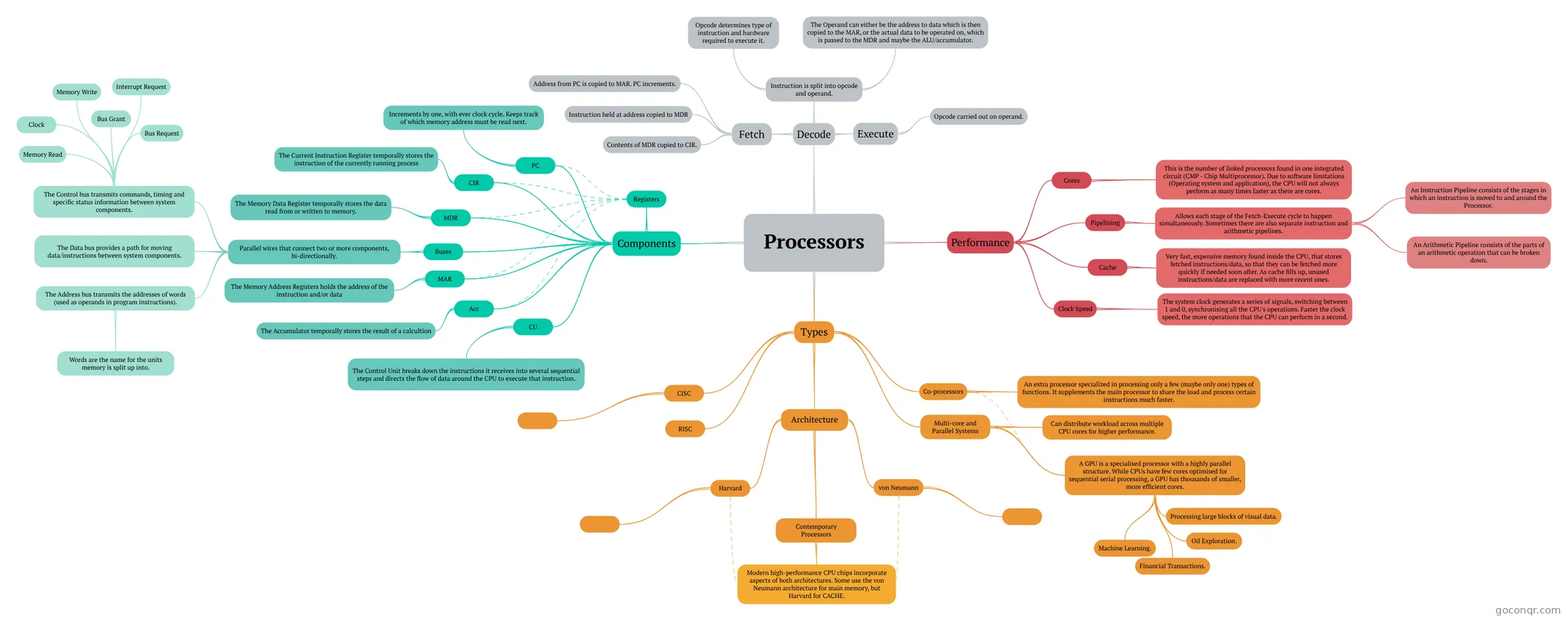
Mind map: Processors
Contenido del mapa
Processors
Components
- Acc
- The Accumulator temporally stores the result of a calcultion
- MDR
- The Memory Data Register temporally stores the data read from or written to memory.
- PC
- Increments by one, with ever clock cycle. Keeps track of which memory address must be read next.
- MAR
- The Memory Address Registers holds the address of the instruction and/or data
- CU
- The Control Unit breaks down the instructions it receives into several sequential steps and directs the flow of data around the CPU to execute that instruction.
- CIR
- The Current Instruction Register temporally stores the instruction of the currently running process
- Buses
- Parallel wires that connect two or more components, bi-directionally.
- The Control bus transmits commands, timing and specific status information between system components.
- Bus Request
- Bus Grant
- Memory Write
- Memory Read
- Interrupt Request
- Clock
- The Data bus provides a path for moving data/instructions between system components.
- The Address bus transmits the addresses of words (used as operands in program instructions).
- Words are the name for the units memory is split up into.
- The Control bus transmits commands, timing and specific status information between system components.
- Parallel wires that connect two or more components, bi-directionally.
- Registers
- Acc
Performance
- Cores
- This is the number of linked processors found in one integrated circuit (CMP - Chip Multiprocessor). Due to software limitations (Operating system and application), the CPU will not always perform as many times faster as there are cores.
- Pipelining
- Allows each stage of the Fetch-Execute cycle to happen simultaneously. Sometimes there are also separate instruction and arithmetic pipelines.
- An Instruction Pipeline consists of the stages in which an instruction is moved to and around the Processor.
- An Arithmetic Pipeline consists of the parts of an arithmetic operation that can be broken down.
- Allows each stage of the Fetch-Execute cycle to happen simultaneously. Sometimes there are also separate instruction and arithmetic pipelines.
- Cache
- Very fast, expensive memory found inside the CPU, that stores fetched instructions/data, so that they can be fetched more quickly if needed soon after. As cache fills up, unused instructions/data are replaced with more recent ones.
- Clock Speed
- The system clock generates a series of signals, switching between 1 and 0, synchronising all the CPU's operations. Faster the clock speed, the more operations that the CPU can perform in a second.
- Cores
Types
- CISC
- Architecture
- Harvard
- von Neumann
- Contemporary Processors
- Modern high-performance CPU chips incorporate aspects of both architectures. Some use the von Neumann architecture for main memory, but Harvard for CACHE.
- Harvard
- RISC
- Co-processors
- An extra processor specialized in processing only a few (maybe only one) types of functions. It supplements the main processor to share the load and process certain instructions much faster.
- Multi-core and Parallel Systems
- Can distribute workload across multiple CPU cores for higher performance.
- A GPU is a specialised processor with a highly parallel structure. While CPUs have few cores optimised for sequential serial processing, a GPU has thousands of smaller, more efficient cores.
- Processing large blocks of visual data.
- Machine Learning.
- Financial Transactions.
- Oil Exploration.
- CISC
Decode
- Execute
- Opcode carried out on operand.
- Fetch
- Address from PC is copied to MAR. PC increments.
- Instruction held at address copied to MDR
- Contents of MDR copied to CIR.
- Instruction is split into opcode and operand.
- Opcode determines type of instruction and hardware required to execute it.
- The Operand can either be the address to data which is then copied to the MAR, or the actual data to be operated on, which is passed to the MDR and maybe the ALU/accumulator.
- Execute
Información
- Descripción
- GCSE Computing Mapa Mental sobre Processors, creado por Joss Oliver el 21/09/2017.
- Creado por
- Joss Oliver
- Visitas
- 7
- Valoración