
Mapa mental
Equilibrium
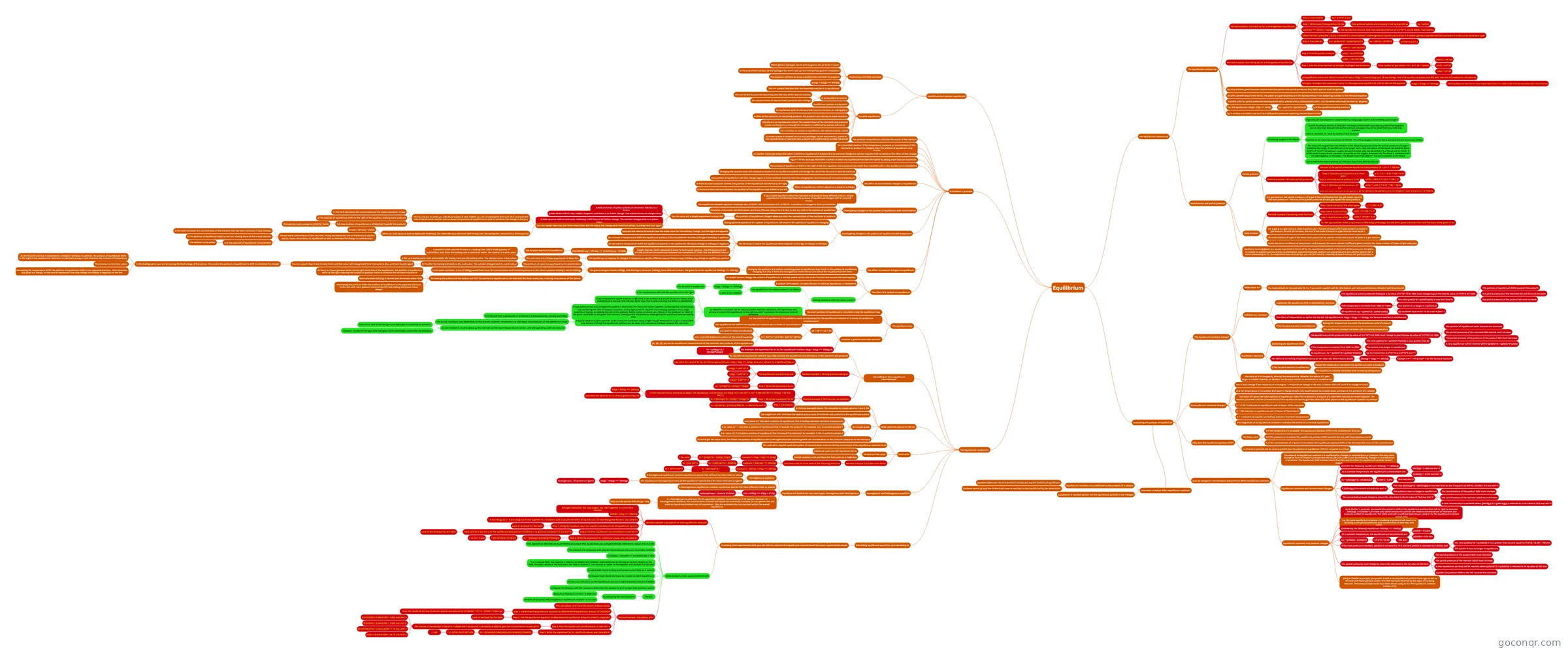
Mind map: Equilibrium
Contenido del mapa
Equilibrium
The equilibrium constant Kc
- The equilibrium law
- The exact position of equilibrium is calculated using the equilibrium law.
- For any reaction at equilibrium, it is possible to write an expression for the equilibrium constant Kc in terms of equilibrium concentrations
- Consider a general reversible reaction:
- aA + bB <=> cC + dD
- The equilibrium law defines the equilibrium constant (Kc) in terms of concentrations
- Kc = {([C]^c) * ([D]^d)} / {([A]^a) * [B]^b)}
- [] is used to show concentration
- a,b,c, d are the balasnce numbers in the overall equation
- [A], [B], [C], [D] are the equilibrium concentrations of the reactants and products of this equilibrium
- For example, the expression for Kc for the equilibrium reaction N2(g) + O2(g) <=> 2NO(g) IS
- Kc = {[NO(g)]^2} / {[N2(g)]*[O2(g)]}
- aA + bB <=> cC + dD
- Calculating Kc from equilibrium concentrations
- To calculate an equilibrium constant you need to know the equilibrium concentrations of the reactants and products
- Worked example 1: Writing and calculating Kc
- Calculate the value of Kc for the following equilibrium: H2(g) + I2(g) <=> 2HI(g). Give your answer to 3 significant figures
- The equilibrium concentration are:
- [H2(g)] = 8.00*10^-4
- [I2(g)] = 2.28*10^-4
- [HI(g)] = 2.28*10^-4
- Step 1: Write the expression for Kc
- Kc = {[HI(g)]^2} / {[H2(g)] * [I2(g)]}
- Worked example 2: Writing and calculating Kc
- In the manufacture of ammonia at 400oC, the equilibrium concentration are N2(g): 18.6 mol dm^-3, H2 = 0.900 mol dm^-3, NH3(g): 1.50 mol dm^-3
- N2(g) + 3H2(g) <=> 2NH3(g)
- Calculate the value for Kc, to three significant figures
- Step 1: Write the expression for Kc
- Kc = {[NH3(g)]^2} / {[N2(g)] * [H2(g)]^3}
- Step 2: Calculate Kc
- Kc = {(1.50)^2} / {(18.6)*(0.900)^3} = 0.166 dm^6 mol^-2
- In the manufacture of ammonia at 400oC, the equilibrium concentration are N2(g): 18.6 mol dm^-3, H2 = 0.900 mol dm^-3, NH3(g): 1.50 mol dm^-3
- What does the value of Kc tell us?
- In the two examples above, the calculated Kc values were 54.2 and 0.166
- The magnitude of Kc indicates the relative proportions of reactants and products in the equilibrium system
- As a rough guide:
- A Kc value of 1 indicates a position of equilibrium that is halfway between reactants and products
- A Kc value of > 1 indicates a position of equilibrium that is towards the products, for example, 54.2 in worked example 1
- A Kc value of < 1indicates a position of equilibrium that is towards the reactants, for example, 0.166 in worked example 2
- So the larger the value of Kc, the futher the position of equilibrium lies to the right-hand side and the greater the concentration of the products compared to the reactants
- Units of Kc
- The units of Kc depend upon the number of concentration terms on the top and bottom of the equilibrium constant term
- To work out the units:
- Substitute units into the expression for Kc
- Cancel common units and show the final units on a single line
- Worked example: Calculate units for Kc
- Calculate units for Kc in each of the following reactions
- Example 1: H2(g) + I2(g) <=> 2HI(g)
- Kc = {[HI(g)]^2} / {[H2(g)] [I2(g)]}
- = No units
- Kc = {[HI(g)]^2} / {[H2(g)] [I2(g)]}
- Example 2: N2O4(g) <=> 2NO2(g)
- Kc = {[NO2(g)]^2} / {[N2O4]}
- Kc = mol dm^-3
- Kc = {[NO2(g)]^2} / {[N2O4]}
- Example 3: 2SO2(g) + O2(g) <=> 2SO3(g)
- Kc = {[SO3(g)]^2} / {SO2(g)]^2[O2(g)]
- Kc = dm^3 mol^-1
- Kc = {[SO3(g)]^2} / {SO2(g)]^2[O2(g)]
- Example 1: H2(g) + I2(g) <=> 2HI(g)
- Calculate units for Kc in each of the following reactions
- Homogenous and heterogenous equilibria
- Equilibria are divided into two main types - homogenous and heterogenous
- Homogeneous equilibria
- A homogenous equilibrium contains equilibrium species that all have the same state or phase
- The equilibria are homogeneous since all the equilibrium species have the same state and are gases
- N2(g) + 3H2(g) <=> 2NH3(g)
- Homogenous - all species are gases
- N2(g) + 3H2(g) <=> 2NH3(g)
- A heterogeneous equilibrium contains equilibrium species that have different states or phases
- C(s) + H2O(g) <=> CO(g) + H^2(g)
- Heterogeneous - mixture of states
- In a homogenous equilibrium, the Kc expression contains concentrations of all species. However, in heterogeneous equilibria, the concentration of solids and liquids are essentially constant. So ant species that are solids or liquids are omitted from KC expression. They are automatically incorporated within the overall equilibrium
- Only include species that are (g) + (aq)
- Homogeneous equilibria
- Equilibria are divided into two main types - homogenous and heterogenous
- Calculating equilibrium quantities and calculating Kc
- If working from experimental data, you will need to calculate the equilibrium concentrations from your experimental results
- Worked example: Calculate of Kc from equilibrium amounts
- Nitrogen monoxide, NO, and oxygen, O2, react together in a reversible reaction
- 2NO(g) + O2(g) <=> 2NO2(g)
- 1.6 mol NO(g) and 1.4 mol O2(g) are mixed together in a container with a volume 4.0 dm^3. At equilibrium, 1.2 mol NO2(g) has formed. Calculate Kc:
- Step 1: Using the equation, work out equilibrium amounts of all equilibrium species
- Look at textbook for the table
- Step 2: Find the equilibrium concentrations in mol dm^-3
- Total volume is 4.0 dm-3, so the equilibrium amounts are divided by 4 to give concentrations in mol dm^-3
- Look at the textbook for the table
- Total volume is 4.0 dm-3, so the equilibrium amounts are divided by 4 to give concentrations in mol dm^-3
- Step 3: Write the expression Kc, substitute values, and calculate Kc.
- Kc = {[NO2(g)]^2}/{[NO(g)]^2[O2(g)]}
- = {[0.30]^2}/{[0.1]^2[0.2]}
- = 45 dm^-3 mol
- = {[0.30]^2}/{[0.1]^2[0.2]}
- Kc = {[NO2(g)]^2}/{[NO(g)]^2[O2(g)]}
- Determining Kc from experimental results
- This application describes an experimental procedure that would allow you to experimentally determine a value of Kc in a lab
- The reaction of a carboxylic acid with an alcohol shown below is a reversible reaction
- CH3COOH + C2H5OH <=> CH3COOC2H5 + H2O
- 1) In a conical flask, mix together 0.100 mol CH3COOH and C2H5OH. Add 0.0500 mol of HCl (aq) as an acid catalyst to the flask.The total volume of the mixture in the flask is 20.0cm^3. The amount of water in the aqueous acid catalyst is 0.500 mol
- 2) Add 0.0500 mol of HCl(aq) to a second conical flask as a control
- 3) Stopper both flasks and leave for a week to reach equilibrium
- 4) Carry out a titration on the equilibrium mixture using a standard solution of NaOH
- 5) Repeat the titration with the control to determine the amount of acid catalyst that had been added
- Results
- By analysing the two titrations:
- Amount of HCl(aq) in control = 0.0500 mol
- Amount of acid (HCl and CH3COOH) in equilibrium mixture = 0.115 mol
- By analysing the two titrations:
- Worked example: Calculation of Kc
- This calculation of Kc from the results is shown below
- Step 1: Determine the equilibrium equation to determine the equilibrium amount of CH3COOH
- From the results of the two titrations: equilibrium amount of CH3COOH = 0.115 - 0.0500 = 0.065 mol
- Step 2: Use the equilibrium equation to determine the equilibrium amounts of each component
- Look at textbook for the table
- Step 3: Find the equilibrium concentrations, in mol dm^-3
- The volume of the solution is 20cm^3 = 0.0200 dm^3 so amount is divided by 0.0200 to give the concentrations in mol dm^3
- [CH3COOH] = 0.065/0.200 = 3.025 mol dm^-3
- [C2H5OH] = 0.065/0.200 = 3.025 mol dm^-3
- [CH3COOC2H5] = 0.055/0.0200 = 1.75 mol dm^-3
- [H2O] = 0.535/0.0200 = 26.75 mol dm^-3
- The volume of the solution is 20cm^3 = 0.0200 dm^3 so amount is divided by 0.0200 to give the concentrations in mol dm^3
- Step 4: Write the expression for Kc, substitute values, and calculate Kc
- Kc = {[CH3COOC2H5][H2O]}/{[CH3COOH][C2H5OH]}
- = {1.75*26.75}/{3.25*3.25}
- = 4.43
- = {1.75*26.75}/{3.25*3.25}
- Kc = {[CH3COOC2H5][H2O]}/{[CH3COOH][C2H5OH]}
- Worked example: Calculate of Kc from equilibrium amounts
- If working from experimental data, you will need to calculate the equilibrium concentrations from your experimental results
- The equilibrium law
Equilibrium and dynamic equilibrium
- Introducing reversible reactions
- When ignited, hydrogen reacts with oxygen in the air to form water
- At the end of the reaction, all the hydrogen has been used up, the reaction has gone to completion
- The equation contains an arrow pointing from reactants to products
- 2H2(g) + 3H2(g) <=> 2NH3(g)
- The <=> symbol indicates that the reversible reaction is in equilibrium
- Dynamic equilibrium
- In an equilibrium system:
- The rate of the forward reaction is equal to the rate of the reserve reaction
- The concentration of reactants and products don't change
- Equilibrium systems are dynamic
- At equilibrium both the forward and reverse reactions are taking place
- As fast as the reactants are becoming products, the products are reacting to make reactants
- Therefore in an equilibrium system, the concentration of the reactants and products remain unchanged even though the forward is unaffected by outside influences
- For a reaction to remain in equilibrium, the system must be closed
- A closed system is isolated from its surroundings, so the temperature, pressure, and concentration of reactants and products are unaffected by outside influences
- In an equilibrium system:
- Introducing reversible reactions
le Chatelier's principle
- The position of equilibrium indicates the extent of the reaction
- In a reversible reaction, if the temperature, pressure or concentration of the reactants or products is changed, then the position of equilibrium may change
- Le Chatlier's principle states that when a system in equilibrium is subjected to an external change the system reajusts itself to minimise the effect of that change
- Figure 1 in the textbook illustrates a system in which the equilibrium has been disrupted by adding more reactant molecules
- Pg 153
- The position of equilibrium shifts to the right of the new equation, more products are made than reactants until a new equilibrium is established
- The effect of concentration changes on equilibrium
- Changing the concentration of a reactant or product in an equilibrium system will change the rate of the forward or reverse reactions
- The position of equilibrium will then change, Figure 2 in the textbook demonstrates the changing the concentration of reactants and products
- When an equilibrium system adjusts as a result of a change
- If there are more products formed, the position of the equilibrium has shifted to the right
- If there are more reactants formed, the position of the equilibrium has shifted to the left
- If you choose equilibria where the reactants and products have different colours, simple experiments can illustrate how the position of equilibrium changes with an external change
- Investigating changes to the position of equilibrium with concentration
- The equilibrium between aqueous chromate ions, (CrO4)2-, and dichromate ions, (Cr2O7)2-, is sensitive to changes in acid concentration
- Solutions of chromate and dichromate ions have different colours so it is easy to see any shift in the position of equilibrium
- The position of equilibrium changes when you alter the concentration of the reactants or products
- You can carry out a simple experiment to show this
- 1) Add a solution of yellow potassium chromate, K2CrO4, to a beaker
- 2) Add dilute sulfuric acid, H2SO4, dropwise until there is no futher change. The solution turns an orange colour
- 3) Add aqueous sodium hydroxide, NaOH(aq), unitl there is no further change. The solution changes back to a yellow colour
- You can repeat steps two and three many times and the colour will change each time from yellow to orange and back again
- This occurs due to when you add dilute sulphuric acid, H2SO4, you are increasing the [H+] ions. This increases the rate of the forward reaction and so causes the position of equilibrium to shift to minimise the change in the [H+]
- 1) This shift decreases the concentration of the added reactants, H+(aq)
- 2) The position of equilibrium shifts to the right of the equation, making more products
- 3) A new position of equilibrium is established towards the products
- The solution turns orange as (Cr2O7)2- forms
- When you add aqueous sodium hydroxide, NaOH(aq), the added OH-(aq) ions react with H+(aq) ions, decreasing the concentration of H+(aq) ions
- H+(aq) + OH-(aq) = H2O(l)
- The decrease concentration of the reactant, H+(aq) decreases the rate of the forward reaction and so causes the position of equilibrium to shift to minimise the change in concentration
- 1) The shift increases the concentration of the reactant that has been removed, H+(aq) reactant
- 2) The position of equilibrium shifts to the left, making more of the H+(aq) reactant
- 3) A new position of equilibrium is established
- The solution turns yellow
- This occurs due to when you add dilute sulphuric acid, H2SO4, you are increasing the [H+] ions. This increases the rate of the forward reaction and so causes the position of equilibrium to shift to minimise the change in the [H+]
- You can carry out a simple experiment to show this
- Investigating changes to the position of equilibrium with temperture
- Changing the temperature of a system in equilibrium will result in the position of equilibrium changing
- The direction in which the equilibrium shifts depends on the sign of change in enthalpy
- change in enthapy is delta H (triangle H)
- Forward and reserve directions have the same value for the enthalpy change - but the signs are opposite
- An increase in temperature shifts the equilibrium position in the endothermic direction (change in enthalpy is positive)
- An decrease in temperature shifts the equilibrium position in the exothermic direction (change in enthalpy is negative)
- Cobalt chloride, CoCl2, dissolves in water to form a pink solution. The dissolving process actually produces an equilibrium between two complexes of cobalt that are different colours
- [Co(H20)6]2-(aq) + 4Cl-(aq) <=> (CoCl4)2-(aq) + 6H2O(l)
- The forward reaction is endothermic
- [Co(H20)6]2-(aq) + 4Cl-(aq) <=> (CoCl4)2-(aq) + 6H2O(l)
- This equilibrium is sensitive to changes in temperature and the different colours makes it easy to follow any change in equilibrium position
- You can carry out a simple experiment to show this:
- 1) Dissolve cobalt chloride in water in a boiling tube. Add a small quantity of hydrochloric acid. Place the boiling tube in some iced water. The solution is a pink colour
- 2) Set up a boiling water bath and transfer the boiling tube into the boiling water. The solution turns a blue colour
- 3) Transfer the boiling tube back to the iced water. The solution changes back to a pink colour
- You can repeat steps 2 and 3 many times and the colour will change each time from pink to blue and back to pink again
- In the boiling water, you are increasing the heat energy of the system. The causes the position of equilibrium to shift to minimise the change
- As the forward reaction is endothermic (change in enthalpy is positive), the position of equilibrium shifts to the right in the endothermic direction, to take heat energy in and minimise the increase in temperature
- The solution turns a blue colour
- Decreasing the temperature shifts the position of equilibrium shifts to the opposite direction, in the direction that gives out energy, to the reverse exothermic side (the change of enthalpy is negative) on the left
- In the boiling water, you are increasing the heat energy of the system. The causes the position of equilibrium to shift to minimise the change
- You can repeat steps 2 and 3 many times and the colour will change each time from pink to blue and back to pink again
- You can carry out a simple experiment to show this:
- The effect of pressure changes on equilibrium
- Changing the pressure of a system containing gases in equilibrium may result in the position of equilibrium changing, but only if there are more gaseous molecules on one side of the equation than the other
- The gases nitrogen dioxide, NO2(g), and dinitrogen tetroxide, N2O4(g), have different colours. The gases form the equilibrium 2NO2(g) <=> N2O4(g)
- The pressure of a gas is proportional to its concentration
- In the same container, 2 mol of NO2(g) would have twice the concentration and twice the pressure as the same container holding 1 mol of N2O4(g)
- Increasing the pressure of the system will shift the position of equilibrium to the side with the fewer molecules, reducing the pressure of the system
- As there are fewer gaseous moles on the right-hand side of the equilibrium, the position of equilibrium shifts to the right reducing the number of gaseous moles to minimise the increase in pressure
- More colourless N2O4(g) is formed and the brown colour fade
- Decreasing the pressure shifts the position of equilibrium in the opposite direction, to the side with more gaseous moles on the left and making the brown colour deeper
- The gases nitrogen dioxide, NO2(g), and dinitrogen tetroxide, N2O4(g), have different colours. The gases form the equilibrium 2NO2(g) <=> N2O4(g)
- Changing the pressure of a system containing gases in equilibrium may result in the position of equilibrium changing, but only if there are more gaseous molecules on one side of the equation than the other
- The effect of a catalyst on equilibrium
- A catalyst doesn't change the position of equilibrium; it merely speeds up the rate of the forward and reverse reactions equally.
- A catalyst will however, increase the rate in which an equilibrium is established
- Making ammonia with the Haber process
- The equation for the Haber process is as follows
- N2(g) + 3H2(g) <=> 2NH3(g)
- The forward is exothermic
- It uses a iron catalyst
- N2(g) + 3H2(g) <=> 2NH3(g)
- Le Chatelier's principle can be used to predict the best conditions of temperature and pressure to force the equilibrium to the right in order to produce the maximum yield of ammonia
- A low temperature will push the equilibrium to the right
- A low temperature would produce a high yield of the product but would do so very slowly. If the temperature is too low, the rate may be so slow that equilibrium may not even be established
- A high pressure not only increases the yield but also forces the molecules closer together, increasing the concentration and increasing the rate of reaction. However, a very high pressure requires a very strong container and a large quantity of energy, increasing the cost of the process. Safety is also a concern, as a failure in the steelwork or seals of the plant could lead to hot gases that are toxic, leaking under the pressure, endangering the workforce and surronding area
- A typical ammonia plant operates under comprise conditions using a high enough temperature to give a reasonable rate without shifting the equilibrium position too far away from ammonia and back towards the reactants
- This ensures that a good yield of ammonia is achieved quickly, cheaply and safely
- The actual conditions vary depending on the process; however, temperature of 350-500oC and pressures of 100-200atm are usual
- An iron catalyst is used to speed up the reaction so that lower temperatures can be used and operating costs are reduced
- Only about 15% of the nitrogen and hydrogen is converted to ammonia
- However, unreacted nitrogen and hydrogen used is eventually converted into ammonia
- The equation for the Haber process is as follows
The equilibrium constant Kp
- Mole fraction and partial pressure
- Equilibria involving gases are usually expressed in terms of Kp, the equilibrium constant in terms of partial pressures. For gases, it is easier to measure pressure than concentration. Concentration and pressure are proportional to one another and Kp has a direct relationship to Kc. To understand how calculate Kp, you will first need to understand mole fractions and partial pressure
- Mole fraction
- Under the same conditions of temperature and pressure, the same volume of different gases contains the same number of moles of gas molecules
- The mole fraction of a gas is the same as its proportion by volume to the total volume of gases in a gas mixture
- For a gas A in a gas mixture: mole fractions x(A) = number of moles of A / total number of moles in gas mixture. As with all fractions, the sum of the mole fractions in a gas mixture must equal 1
- Worked example: Calculating mole fractions
- Air has approximate molar proportions of 78% N2(g), 21% O2(g), and 1% other gases. Calculate the mole fractions of the gases in air
- Step 1: mole fraction of N2
- x(N2) = 78/100 = 0.78
- Step 2 Mole fraction of O2
- x(O2) = 21/100 = 0.21
- Step 3 Mole fraction of the other gases
- x = 1/100 = 0.01
- Partial pressure
- In a gas mixture, the partial pressure p of a gas is the contribution that the gas makes towards the total pressure P. The sum of the partial pressures of each gas equals the total pressure
- Worked example: Calculate partial pressures
- Use the mole fractions of the gases in air to calculate the partial pressures of gases in air at a presure of 100kPa
- Step 1: Calculate partial pressure of N2
- p(N2) = x(N2) P = 0.78 * 100 = 78kPa
- Step 2: Calculate partial pressure of O2
- p(O2) = x(O2) * P = 0.21 * 100 = 21
- Step 3: Calculate partial pressure of other gases
- p = x * P = = 0.01 * 100 = 1kPa
- The sum of the partial pressures equals the total pressure 78 + 21 + 1 = 100 kPa
- Dissolving oxygen in the blood
- You breathe as a way of getting O2 into your blood and getting CO2 out
- The amount f oxygen that can dissolve in the blood is proportional to the partial pressure of oxygen breathed into lungs. At equilibrium in the lungs, each cubic decimetre of the blood can dissolve about 3cm^3 of 15cm^3 of gaseous oxygen. An adult human only has about 5dm^3 of blood and so 15cm^-2 of O2 doesn't seem much. However, as quickly as the oxygen dissolves into the blood it combines with the haemoglobin in the blood. This allows more than 200cm^-3 of O2 to dissolve in the blood
- Normal air at 1 atm has a pressure of 101kPa. The 21%of oxygen in the air has a partial pressure of just over 21kPa
- Look in textbook for table on pressure and altitude
- So how do people survive at altitude? The body compensates by producing more haemoglobin, but at very high altitudes the partial presure of oxygen may be so small that very little may dissolve
- High altitude mountaineers compensate by using oxygen tanks and breathing pure oxygen
- The equilibrium constant Kp
- Kp is written in a similar way to Kc but with partial pressures replacing concentrations terms
- For the equilibrium: H2(g) + I2(g) <=> 2HI(g)
- Kp = {p(HI)^2} / {p(H2)*p(I2)
- p is the equilibrium partial pressure
- Kp = {p(HI)^2} / {p(H2)*p(I2)
- Suitable units for partial pressures are kilopascals (kPa), pascals (Pa) or atmospheres (atm) - but the same units must be used for all gases
- As with concentration terms for Kc, the power of a partial pressure in the Kp expression is the balancing number in the chemical equation
- Kp only includes gases because only because only gases have partial pressures. Any other species must be ignored
- Worked example: Calculating Kp for a homogeneous equilibrium
- Nitrogen, hydrogen and ammonia coexist in a homogeneous equilibrium, with all species being gases:
- N2(g) + 3H2(g) <=> 2NH3(g)
- This equilibrium reaction is very important since it is used in the industrial production of ammonia
- N2(g) + 3H2(g) <=> 2NH3(g)
- An equilibrium mixture at 400oC contains 18 mol of N2(g), 54 mol of H2(g) and 48 mol NH3(g). The total equilibrium pressure is 200 atm. Use this information to calculate Kp
- Step 1: Find the mole fractions of nitrogen, hydrogen and ammonia
- Total number of gas moles = 18 + 54 + 48 = 120mol
- x(N2) = 18/120
- x(H2) = 54/120
- x(NH3) = 48/120
- Total number of gas moles = 18 + 54 + 48 = 120mol
- Step 2: Find the partial pressure
- p(N2) = (18/120)*200
- p(H2) = (54/120)*200
- p(NH3) = (48/120)*200
- Step 3: Calculate Kp
- Kp = {p(NH3)^2} / {p(N2)*p(H2)^3}
- Kp = (80^2) / (30*90^3)
- 2.9*10^-4 atm^-2
- Kp = (80^2) / (30*90^3)
- Kp = {p(NH3)^2} / {p(N2)*p(H2)^3}
- Nitrogen, hydrogen and ammonia coexist in a homogeneous equilibrium, with all species being gases:
- Worked example: Calculate Kp for a heterogeneous equilibrium
- When calcium carbonate, CaCO3, is heated in a closed system, a heterogeneous equilibrium is et up. It is aheterogeneous equilibrium because there is a mixture os solids and a gas
- CaCO3(s) <=> CaO(s) + CO2(g)
- In the equilibrium mixture, CO2, has a partial pressure of 2.5*10^-2 atm at 600oC. Calculate Kp
- Step 1: Write down the expression for Kp
- Only gaseous species are including in the Kp expression
- Kp = p(CO2)
- Only gaseous species are including in the Kp expression
- Step 2: Calculate Kp
- Kp = 2.5*10^-2 atm
- Mole fraction and partial pressure
Controlling the position of equilibrium
- Why does the equilibrium position shift?
- Le Chatlier's princple can be used to predict how the position of equilibrium shifts in response to a cheap
- The three rules
- 1) If the concentration of a species is increased, the equilibrium position shifts in the direction that reduces the concentration
- 2) If the pressure is increased, the equilibrium position shifts towards the side with fewer gaseous moles
- 3) If the temperature is increased, the equilibrium position shifts in the endothermic direction
- Do equilibrium constants change?
- The magnitude of an equilibrium constant K indicates the extent of a chemical equilibrium
- K = 1 indicates an equilibrium halfway between reactants and products
- K = 100 indicates an equilibrium well in favour of the products
- K = 1*10^-2 indicates an equilibrium well in favour of the reactants
- The value of K gives the exact position of equilibrium. When the reactants or products of a reversible reaction are mixed together, the reaction proceeds until the concentration of the equilibrium species give the value of K when placed in the equilibrium constant expression
- At a set temperature, K is constant and doesn't change despite any modifications to concentration, pressure or the presence of a catalyst
- But K does change if the temperature is changed - a temperature change is the only condition that will cause K to change its value
- The equilibrium constant change?
- The value of K is changed by altering the temperature. Whether the valkue of K gets larger or smaller depends on whether the forward reaction is exothermic or endothermic
- Exothermic reactions
- If the forward reaction is exothermic:
- The equlibrium constant decreases with increasing temperature
- Raised the temperature decreases the equilibrium yield of products
- The effect of increasing temperature on Kp for the SO2/ O2/ SO3 is shown across
- 2SO2(g) + O2(g) <=> 2SO3(g)
- Change in H = -197 kJ mol^-1 for the forward reactions
- 2SO2(g) + O2(g) <=> 2SO3(g)
- Explaining the equilibrium shift
- At equilibrium, Kp = {p(SO3)^2} / {p(SO2)^2*p(O2)}
- If the temperature increases from 500K to 700K:
- Kp decreases from 2.5*10^10 to 3.0*10^4 atm^-1
- The system is no longer in equilibrium
- The ratio {p(SO3)^2} / {p(SO2)^2*p(O2)} is now greater than Kp
- The equilibrium partial pressures that Kp value of 2.5*10^10 at 500K must change to give the new Kp value of 3.0*10^4 at 700K
- The partial pressure of the pressure of the product SO3 must decrease
- The partial pressures of the reactants SO2 and O2 must increase
- The position of equilibrium shifts towards the reactants
- A new equilibrium will be reached where {p(SO3)^2} / {p(SO2)^2*p(O2)}
- If the forward reaction is exothermic:
- Endothermic reactions
- If the forward reaction is endothermic:
- The equilibrium constant increases with increasing temperature
- Raising the temperature increases the equilibrium yield of products
- The effect of temperature on Kp for the N2/ O2/ NO equilibrium is: N2(g) + O2(g) <=> 2NO(g), the forward reaction is endothermic
- Explaining the equilibrium shift in endothermic reactions
- At equilibrium: Kp = {p(NO)^2} / {p(N2)*p(O2)}
- If the temperature increases from 700K to 1100K:
- Kp increases from 5*10^-13 to 4*10^-8 atm^-1
- The system is no longer in equilibrium
- The ratio {p(NO)^2} / {p(N2)*p(O2)} is now less than Kp
- The equilibrium partial pressures that gave a Kp value of 5*10^-13 at 700K must change to give the new Kp value of 4*10^-8 at 1100K
- The partial pressure of the product NO must increase
- The partial pressure of the reactants N2 and O2 must decrease
- The position of equilibrium shifts towards the products
- If the forward reaction is endothermic:
- What about Kc?
- The explanations for Kp work also for Kc. If you were suppiled with Kc information, just use concentrations instead of partial pressures
- How do changes in concentration and pressure affect equilibrium constants
- The value of an equilibrium constant K is unaffected by changes in concentration or pressure. This may seem strange as from le Chatier's princple that the equilibrium position can be shifted by changes in concentration or pressure. The equilibrium shift actually results from the very fact that the equilibrium constant doesn't change
- Equilibrium constants and concentration changes
- Consider the following equilibrium: N2O4(g) <=> 2NO2(g)
- At a constant temperature, the equilibrium concentrations are:
- [NO2(g)] = 0.400 mol dm^-3
- [N2O4(g)] = 0.010 mol dm^-3
- Kc = {[NO2(g)]^2} / {[N2O4(g)]}
- 0.400^2 / 0.010
- 16.0 mol dm^-3
- 0.400^2 / 0.010
- If [N2O4(g)] is increased to 0.020 mol dm^-3:
- The ratio {[NO2(g)]^2} / {[N2O4(g)]} is now less than Kc and is equal to (0.400^2) / (0.020) = 8.0 mol dm^-3
- the system is now no longer in equilibrium
- The concentration must change to return the ratio back to the Kc value of 16.0 mol dm^-3
- The concentration of the product NO2 must increase
- The concentration of the reactant N2O4 must decrease
- A new concentration is estabish where {[NO2(g)]^2} / {[N2O4(g)]} is restored to its Kc value of 16.0 mol dm^-3
- By le Chatlier's principle, you would also predict a shift in the equilibrium position from left to right to decrease [N2O4(g)]. Le Chatlier's principle only works because Kc controls the relative concentrations of reactants and products present at equilibrium. The same principle could have been shown using Kc for the equilibrium constant insead of Kp
- Equilibrium constants and pressure changes
- For the same equilibrium as above, a doubling of pressure will result in a doubling of the partial pressures and concentration of both NO2 and N2O4.
- Considering the following equilibrium: N2O4(g) <=> 2NO2(g)
- At a constant temperature, the equilibrium partial pressures are:
- p(NO2) = 9.6 atm
- p(N2O4) = 0.24 atm
- Kp = {p(NO2)} / {p(N2O4)}
- = (9.6^2) / (0.48)
- 384 atm
- = (9.6^2) / (0.48)
- If the total pressure is doubled, p(N2O4) is increased to 19.2 atm and p(NO2) is increased to 0.48 atm and:
- The ratio {p(NO2)^2} / {p(N2O4)} is now greater than Kp and equal to (19.6^2) / (0.48) = 768 atm
- The system is now no longer in equilibrium
- The partial pressures must change to return the ratio back to the Kp value of 384 atm:
- The partial pressure of the product NO2 must decrease
- The partial pressure of the reactant N2O4 must increase
- A new equilibrium position will be reached where {p(NO2)^2} / {p(N2O4)} is restored to its Kp value of 384 atm
- Equilibrium position shifts to the left towards the reactants
- Using le Chatlier's princple, you predict a shift in the equilibrium position from right to left to the side with fewer gaseous moles. This shift has been directed by the value of Kp being restored. The same principle could have been shown using Kc for the equilibrium constant instead of Kp
- How does a catalyst affect equilibrium constant?
- Equilibrium constants are unaffected by the presents of a catalyst
- Catalysts affect the rate of a chemical reaction but not the position of equilibrium
- Catalysts speed up both the forward and reverse reactions in the equilibrium by the same factor
- Equilibrium is reached quicker but the equilibrium position is not changed
- Equilibrium constants are unaffected by the presents of a catalyst
- Why does the equilibrium position shift?
Información
- Descripción
- AS level Chemistry Mapa Mental sobre Equilibrium, creado por Benjamin Smith el 23/09/2017.
- Creado por
- Benjamin Smith
- Visitas
- 1
- Valoración