
Mapa mental
Waves
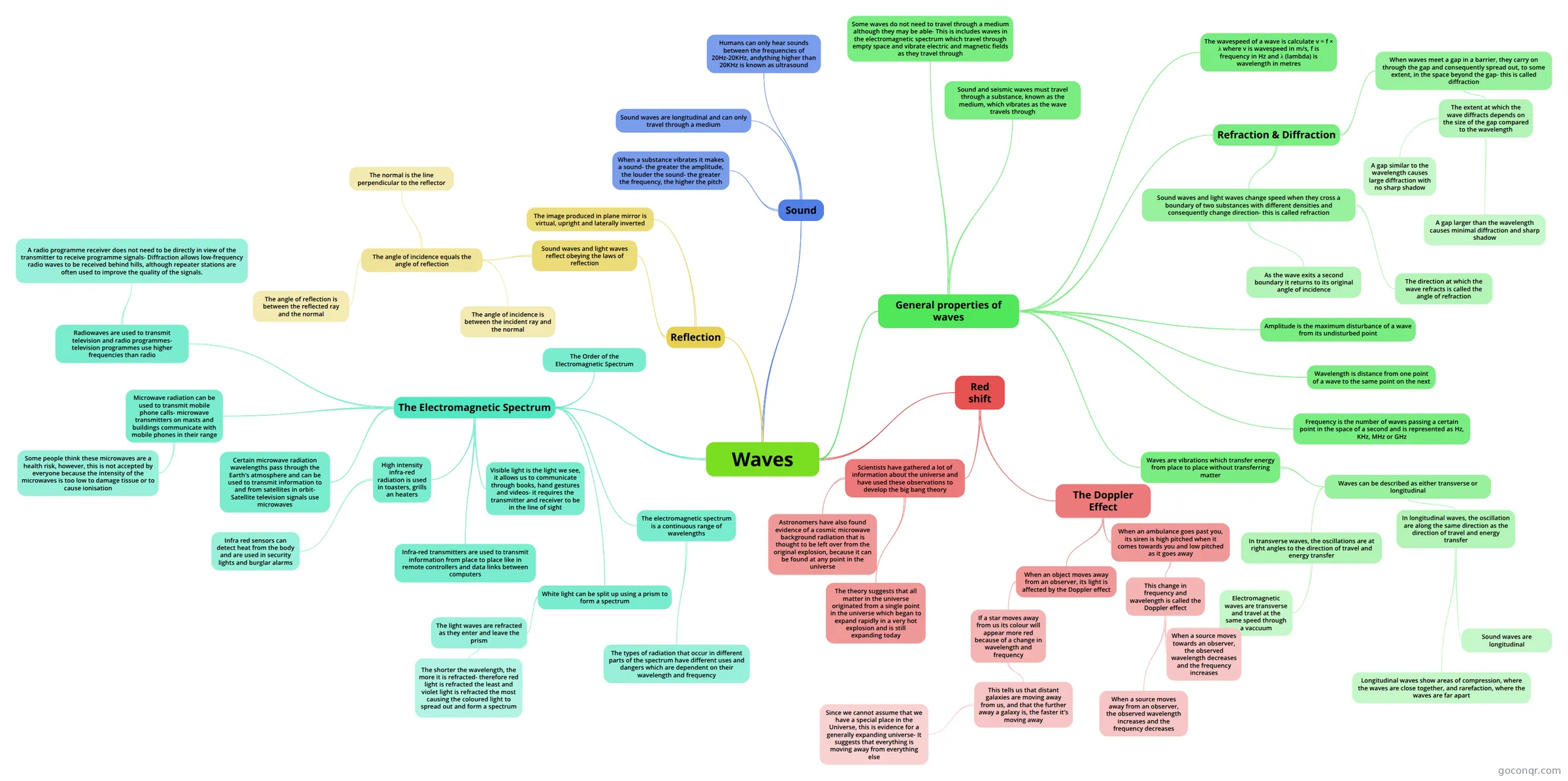
Mind map: Waves
Contenido del mapa
Waves
General properties of waves
- Waves are vibrations which transfer energy from place to place without transferring matter
- Waves can be described as either transverse or longitudinal
- In transverse waves, the oscillations are at right angles to the direction of travel and energy transfer
- Electromagnetic waves are transverse and travel at the same speed through a vaccuum
- In longitudinal waves, the oscillation are along the same direction as the direction of travel and energy transfer
- Sound waves are longitudinal
- Longitudinal waves show areas of compression, where the waves are close together, and rarefaction, where the waves are far apart
- In transverse waves, the oscillations are at right angles to the direction of travel and energy transfer
- Waves can be described as either transverse or longitudinal
- Sound and seismic waves must travel through a substance, known as the medium, which vibrates as the wave travels through
- Some waves do not need to travel through a medium although they may be able- This is includes waves in the electromagnetic spectrum which travel through empty space and vibrate electric and magnetic fields as they travel through
- Amplitude is the maximum disturbance of a wave from its undisturbed point
- Wavelength is distance from one point of a wave to the same point on the next
- Frequency is the number of waves passing a certain point in the space of a second and is represented as Hz, KHz, MHz or GHz
- The wavespeed of a wave is calculate v = f × λ where v is wavespeed in m/s, f is frequency in Hz and λ (lambda) is wavelength in metres
- Refraction & Diffraction
- Sound waves and light waves change speed when they cross a boundary of two substances with different densities and consequently change direction- this is called refraction
- As the wave exits a second boundary it returns to its original angle of incidence
- The direction at which the wave refracts is called the angle of refraction
- When waves meet a gap in a barrier, they carry on through the gap and consequently spread out, to some extent, in the space beyond the gap- this is called diffraction
- The extent at which the wave diffracts depends on the size of the gap compared to the wavelength
- A gap similar to the wavelength causes large diffraction with no sharp shadow
- A gap larger than the wavelength causes minimal diffraction and sharp shadow
- The extent at which the wave diffracts depends on the size of the gap compared to the wavelength
- Sound waves and light waves change speed when they cross a boundary of two substances with different densities and consequently change direction- this is called refraction
- Waves are vibrations which transfer energy from place to place without transferring matter
Reflection
- Sound waves and light waves reflect obeying the laws of reflection
- The angle of incidence equals the angle of reflection
- The normal is the line perpendicular to the reflector
- The angle of incidence is between the incident ray and the normal
- The angle of reflection is between the reflected ray and the normal
- The angle of incidence equals the angle of reflection
- The image produced in plane mirror is virtual, upright and laterally inverted
- Sound waves and light waves reflect obeying the laws of reflection
Sound
- Sound waves are longitudinal and can only travel through a medium
- When a substance vibrates it makes a sound- the greater the amplitude, the louder the sound- the greater the frequency, the higher the pitch
- Humans can only hear sounds between the frequencies of 20Hz-20KHz, andything higher than 20KHz is known as ultrasound
The Electromagnetic Spectrum
- The electromagnetic spectrum is a continuous range of wavelengths
- The types of radiation that occur in different parts of the spectrum have different uses and dangers which are dependent on their wavelength and frequency
- White light can be split up using a prism to form a spectrum
- The light waves are refracted as they enter and leave the prism
- The shorter the wavelength, the more it is refracted- therefore red light is refracted the least and violet light is refracted the most causing the coloured light to spread out and form a spectrum
- The light waves are refracted as they enter and leave the prism
- The Order of the Electromagnetic Spectrum
- Radiowaves are used to transmit television and radio programmes- television programmes use higher frequencies than radio
- A radio programme receiver does not need to be directly in view of the transmitter to receive programme signals- Diffraction allows low-frequency radio waves to be received behind hills, although repeater stations are often used to improve the quality of the signals.
- Microwave radiation can be used to transmit mobile phone calls- microwave transmitters on masts and buildings communicate with mobile phones in their range
- Some people think these microwaves are a health risk, however, this is not accepted by everyone because the intensity of the microwaves is too low to damage tissue or to cause ionisation
- Certain microwave radiation wavelengths pass through the Earth's atmosphere and can be used to transmit information to and from satellites in orbit- Satellite television signals use microwaves
- Visible light is the light we see, it allows us to communicate through books, hand gestures and videos- it requires the transmitter and receiver to be in the line of sight
- High intensity infra-red radiation is used in toasters, grills an heaters
- Infra red sensors can detect heat from the body and are used in security lights and burglar alarms
- Infra-red transmitters are used to transmit information from place to place like in remote controllers and data links between computers
- The electromagnetic spectrum is a continuous range of wavelengths
Red shift
- Scientists have gathered a lot of information about the universe and have used these observations to develop the big bang theory
- The theory suggests that all matter in the universe originated from a single point in the universe which began to expand rapidly in a very hot explosion and is still expanding today
- Astronomers have also found evidence of a cosmic microwave background radiation that is thought to be left over from the original explosion, because it can be found at any point in the universe
- The Doppler Effect
- When an ambulance goes past you, its siren is high pitched when it comes towards you and low pitched as it goes away
- This change in frequency and wavelength is called the Doppler effect
- When a source moves towards an observer, the observed wavelength decreases and the frequency increases
- When a source moves away from an observer, the observed wavelength increases and the frequency decreases
- This change in frequency and wavelength is called the Doppler effect
- When an object moves away from an observer, its light is affected by the Doppler effect
- If a star moves away from us its colour will appear more red because of a change in wavelength and frequency
- This tells us that distant galaxies are moving away from us, and that the further away a galaxy is, the faster it's moving away
- Since we cannot assume that we have a special place in the Universe, this is evidence for a generally expanding universe- It suggests that everything is moving away from everything else
- This tells us that distant galaxies are moving away from us, and that the further away a galaxy is, the faster it's moving away
- If a star moves away from us its colour will appear more red because of a change in wavelength and frequency
- When an ambulance goes past you, its siren is high pitched when it comes towards you and low pitched as it goes away
- Scientists have gathered a lot of information about the universe and have used these observations to develop the big bang theory
Información
- Descripción
- (Core GCSE) GCSE Physics Mapa Mental sobre Waves, creado por seth.bragg el 27/05/2013.
- Creado por
- seth.bragg
- Visitas
- 66
- Etiquetas
- Valoración