
Mapa mental
Quantitative Tests: Biological Molecules
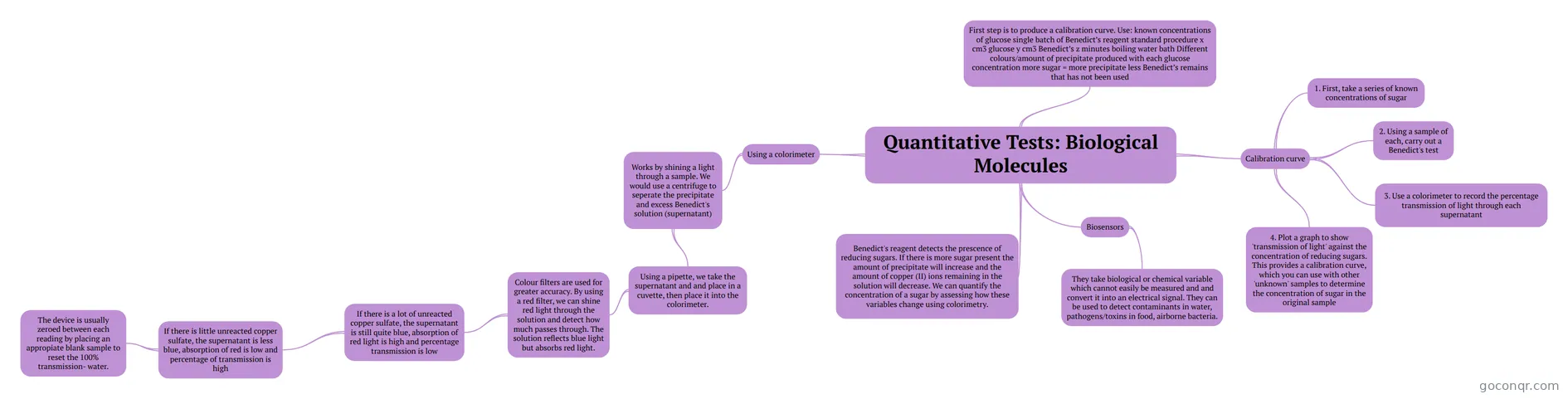
Mind map: Quantitative tests for biological molecules
Contenido del mapa
Quantitative Tests: Biological Molecules
Benedict's reagent detects the prescence of reducing sugars. If there is more sugar present the amount of precipitate will increase and the amount of copper (II) ions remaining in the solution will decrease. We can quantify the concentration of a sugar by assessing how these variables change using colorimetry.
Using a colorimeter
- Works by shining a light through a sample. We would use a centrifuge to seperate the precipitate and excess Benedict's solution (supernatant)
- Using a pipette, we take the supernatant and and place in a cuvette, then place it into the colorimeter.
- Colour filters are used for greater accuracy. By using a red filter, we can shine red light through the solution and detect how much passes through. The solution reflects blue light but absorbs red light.
- If there is a lot of unreacted copper sulfate, the supernatant is still quite blue, absorption of red light is high and percentage transmission is low
- If there is little unreacted copper sulfate, the supernatant is less blue, absorption of red is low and percentage of transmission is high
- The device is usually zeroed between each reading by placing an appropiate blank sample to reset the 100% transmission- water.
- If there is little unreacted copper sulfate, the supernatant is less blue, absorption of red is low and percentage of transmission is high
- If there is a lot of unreacted copper sulfate, the supernatant is still quite blue, absorption of red light is high and percentage transmission is low
- Colour filters are used for greater accuracy. By using a red filter, we can shine red light through the solution and detect how much passes through. The solution reflects blue light but absorbs red light.
- Using a pipette, we take the supernatant and and place in a cuvette, then place it into the colorimeter.
- Works by shining a light through a sample. We would use a centrifuge to seperate the precipitate and excess Benedict's solution (supernatant)
Calibration curve
- 1. First, take a series of known concentrations of sugar
- 2. Using a sample of each, carry out a Benedict's test
- 3. Use a colorimeter to record the percentage transmission of light through each supernatant
- 4. Plot a graph to show 'transmission of light' against the concentration of reducing sugars. This provides a calibration curve, which you can use with other 'unknown' samples to determine the concentration of sugar in the original sample
Biosensors
- They take biological or chemical variable which cannot easily be measured and and convert it into an electrical signal. They can be used to detect contaminants in water, pathogens/toxins in food, airborne bacteria.
First step is to produce a calibration curve. Use: known concentrations of glucose single batch of Benedict’s reagent standard procedure x cm3 glucose y cm3 Benedict’s z minutes boiling water bath Different colours/amount of precipitate produced with each glucose concentration more sugar = more precipitate less Benedict’s remains that has not been used
Información
- Descripción
- GCSE Maths Mapa Mental sobre Quantitative Tests: Biological Molecules, creado por Hanni Alex el 09/11/2017.
- Creado por
- Hanni Alex
- Visitas
- 1
- Valoración