
Biological Molecules and the Chemistry of Life
645 resources created by 484 users
This Biological Molecules and the Chemistry of Life page on GoConqr gathers community-made mind maps, quizzes, flashcards, notes and slides, from carbohydrates, lipids and proteins to enzymes, nucleic acids, ATP and water. It's built for school students revising a topic, and for teachers after ready-made material, with a few university students and professional candidates finding it useful too. There are over 5,100 resources here, including more than 360 quizzes and over 3,100 mind maps, with many tagged for GCSE, A-level, IB and AP Biology. Pick a topic, try a quiz, then make your own maps.
Top Biological Molecules and the Chemistry of Life resources
-
69 cardsBIO: Chapter 4 - Enzymes CORE IDEA 1: BIOMOLECULES CHAPTER 4 - ENZYMES
-
 Mind map AP Biology Mind Map: Water and Life This was done by Paul Min and he completed chapter 3: Water and Life
-
Mind map Nucleic Acids
-
Mind map Macromolecules Macromolecules
-
Mind map Nucleic Acids, ATP, and Water
-
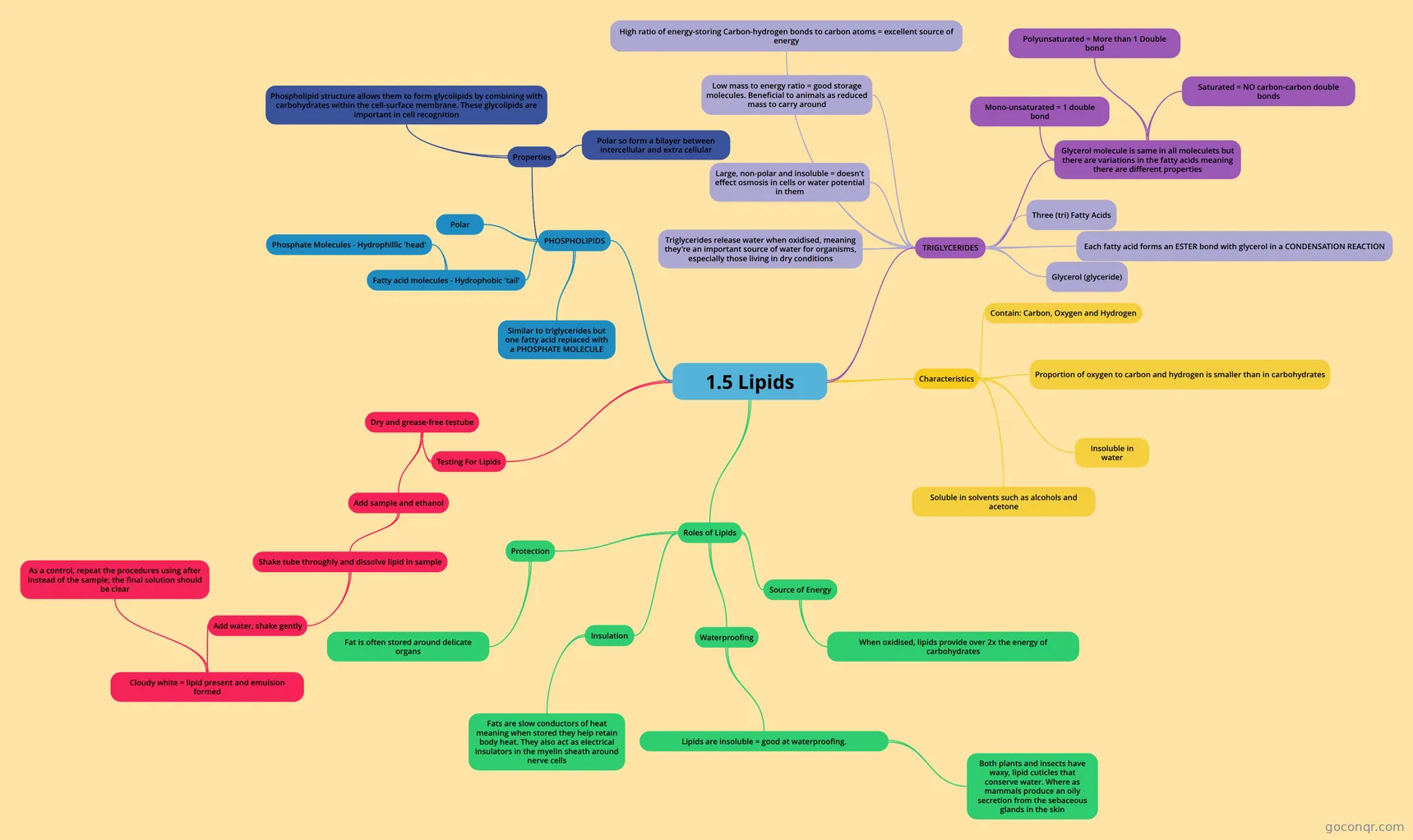 Mind map 1.5 Lipids This is my mind map: '1.5 Lipids'. Its is based on the AQA A-Level Biology specification, and it is also ba...
-
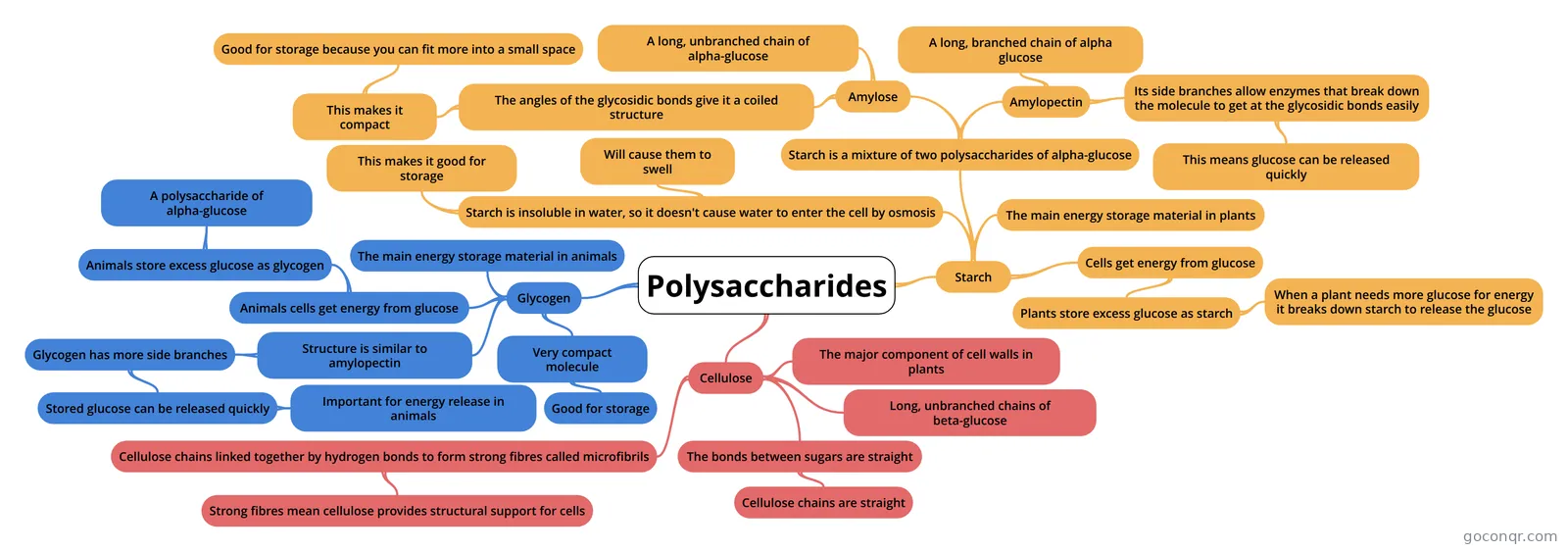 Mind map Polysaccharides
-
Mind map 1.2 - 1.3 Carbohydrates This is my mind map: '1.2 - 1.3 Carbohydrates'. It is a mind map based on the AQA A-level Biology Specifica...
Quizzes
See all 75 quizzes-
27 questionsAP Bio Chapter 2 About 25 of the 92 natural elements are known to be essential to life. Which 4 of these 25 elements make up...
-
50 questionsBiology 1107 Exam 1 What are the four types of atoms that make up 96% of all matter found in organisms?
-
30 questionsQuiz 1 A hydroxyl group is
-
67 questionsBiol. 1110: Exam on Ch. 1, Ch. 2, and Ch. 3 What are basic building blocks of life?
-
16 questionsCarbon Chapter 4 The experimental approach taken in current biological investigations presumes that
-
28 questionsStarch, Cellulose and Glycogen Quiz Which of the following are carbohydrates?
-
22 questionsChapter 9 Enzymes Revision Questions What is an enzyme?
-
29 questionsCarbohydrates and Lipids (Saccharides) This is a carbon ring. Label it in such a way that it becomes a Glucose molecule. (Monosaccharide #1) Use e...
Mind maps
See all 259 mind maps-
AP Biology Mind Map: Water and Life This was done by Paul Min and he completed chapter 3: Water and Life
-
Nucleic Acids
-
Macromolecules Macromolecules
-
Nucleic Acids, ATP, and Water
-
1.5 Lipids This is my mind map: '1.5 Lipids'. Its is based on the AQA A-Level Biology specification, and it is also ba...
-
Polysaccharides
-
1.2 - 1.3 Carbohydrates This is my mind map: '1.2 - 1.3 Carbohydrates'. It is a mind map based on the AQA A-level Biology Specifica...
-
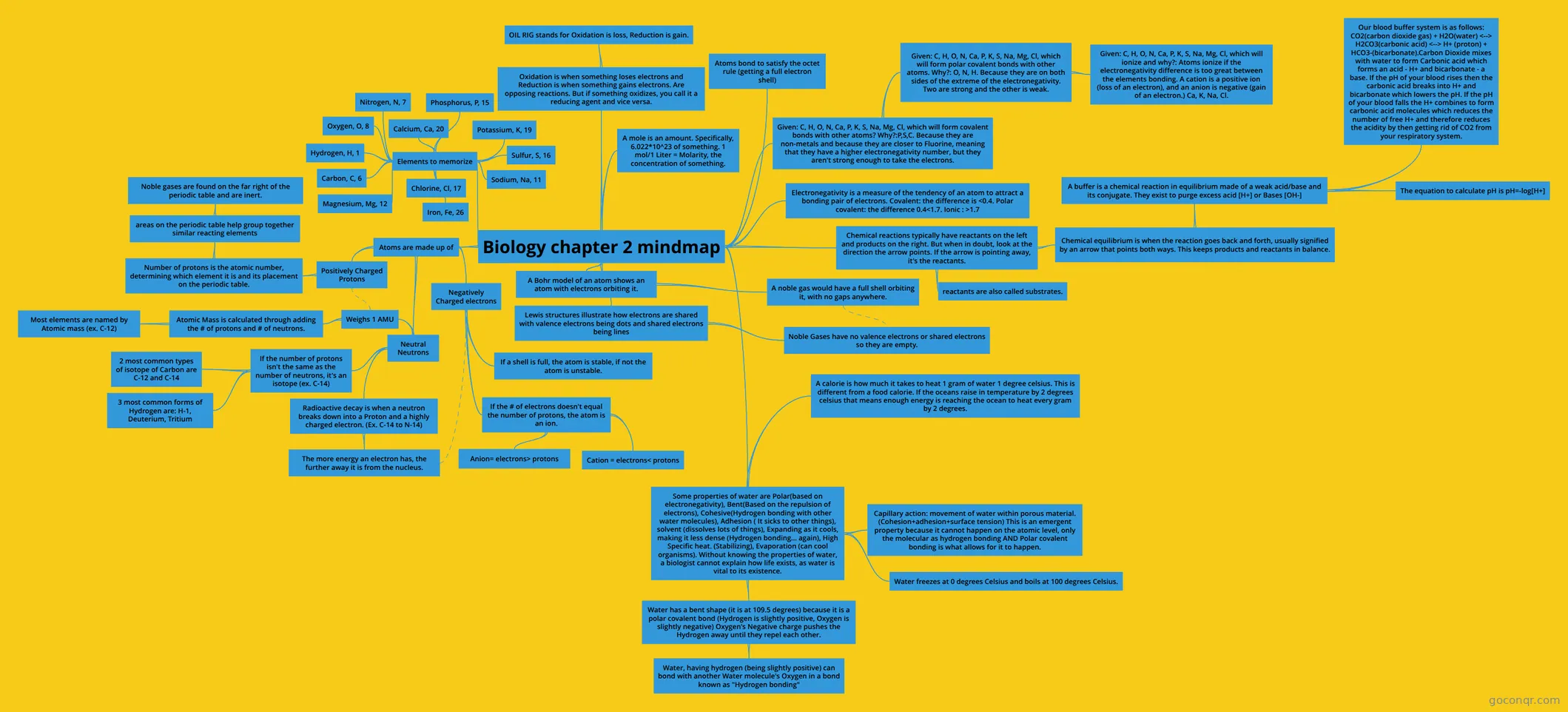 Biology chapter 2 mindmap
Flashcards
See all 250 flashcards-
69 cardsBIO: Chapter 4 - Enzymes CORE IDEA 1: BIOMOLECULES CHAPTER 4 - ENZYMES
-
30 cardsBiological Molecules - Exam Questions Maltose is hydrolysed by the enzyme maltase. Explain why maltase catalyses only this reaction. (3 marks)
-
75 cardsBiomolecules (Unit: Cells) Is Starch a Carbohydrate,Protein,Lipid or Nucleic Acid
-
26 cardsBio 12 -- Carbohydrates How are the different types of monosaccharides distinguished?
-
20 cardsA level biology Revision I What is unsaturated fatty acid?
-
16 cardsHaemoglobin If the amino acid sequence alters, what happens consequently to the polypeptide chain?
-
40 cardsAQA A-Level Biology 3.1.1, 3.1.2 and 3.1.3 What are monomers
-
15 cardsStarch cellulose & chitin What is the difference between the structure of glucose isomers a-glucose and b-glucose?
Flowcharts
See all 13 flowcharts-
Comparative Table for Cellulose, Starch and Glycogen April 5th, 2021
-
Comparative chart of cellulose, starch and glycogen April 5th
-
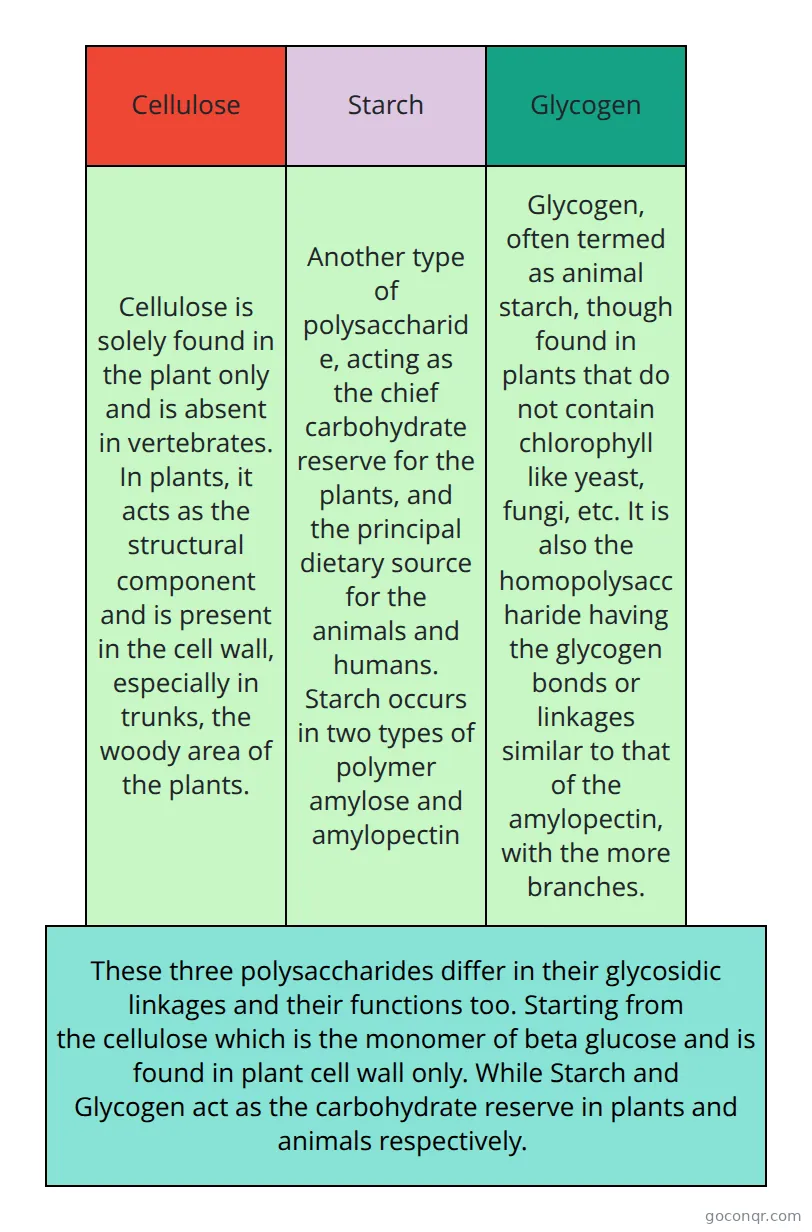 Comparative chart for cellulose, starch and glycogen Aprl 5,2021
-
Comparative Chart for Cellulose, Starch, Glycogen chart c
-
Comparative Table for Cellulose, Starch, Glycogen and Chitin April 5th 2021
-
Comparative table for Glucose, Fructose, Galactose, Sucrose, Maltose chart
-
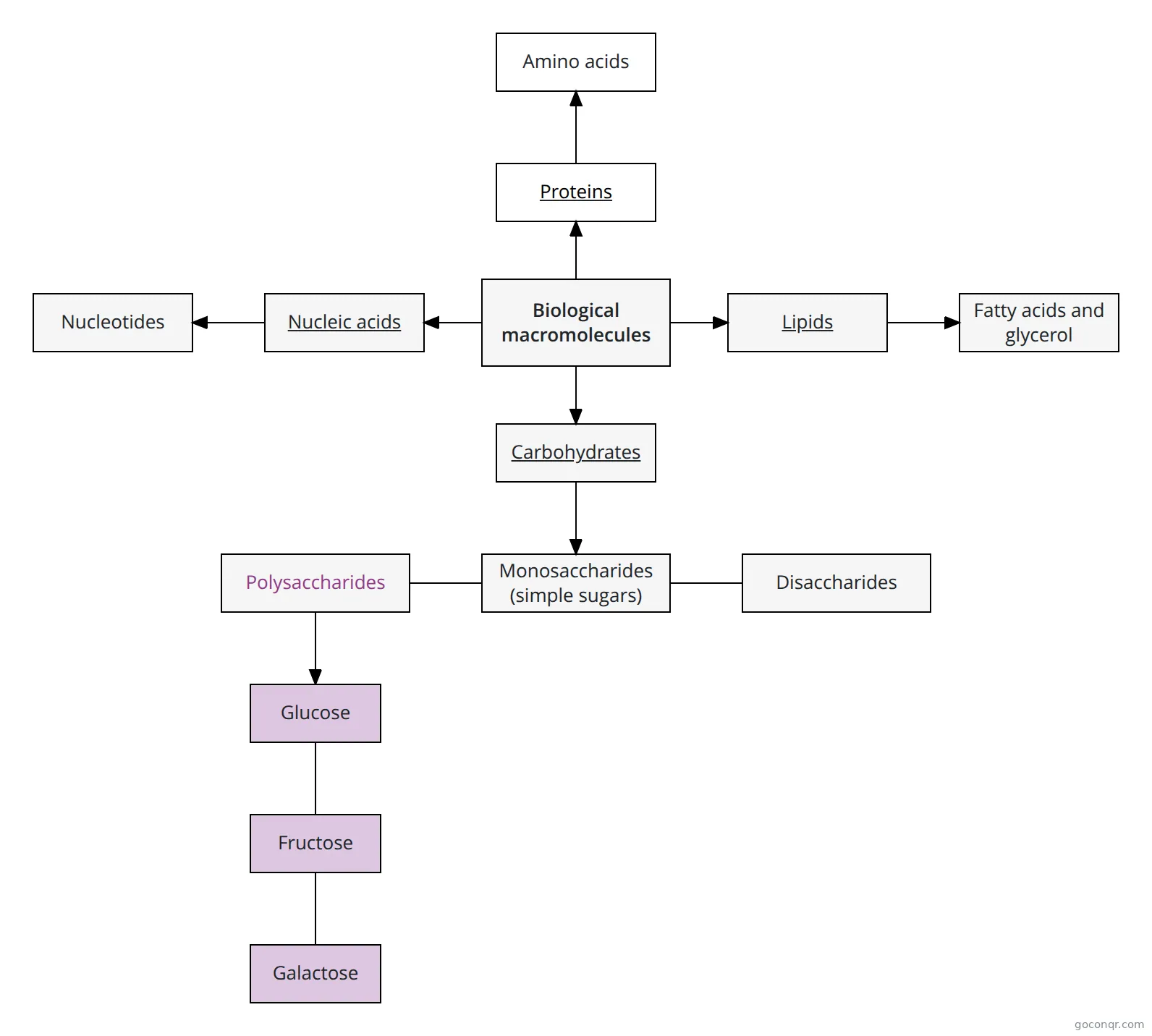 Macromolecules
-
Comparative table for Glucose, Fructose, Galactose, Sucrose, Maltose. 06 de abril
Notes
See all 38 notes-
Chemistry of Life Standard Level Biology: Chemistry of Life Topic 3: Chemistry of LifeOrganic compounds are compounds that are contain Carbon and can be found in living organisms, Inorganic compounds are the opposite of this.The most c...
-
Carbohydrates Carbohydrates: A molecule that contains CARBON HYDROGEN & OXYGEN Examples: Glucose Cellulose Fructose Starch Sucrose Glycogen
-
Lipids and triglycerides Lipids. Lipids are fats made up of molecules of glycerol and fatty acids These join together in a condensation reaction, creating a ester bond.
-
PAG 9.1 "Qualitative Testing for Proteins" (Biuret Test) Positive test for Proteins: PurpleNegative test for Proteins: Remains blue - Add a few drops of Sodium Hydroxide Solution (To make the solution alkaline)- Add Copper Su...
-
Food tests for: starch, reducing sugars (glucose), protein, lipids. Food tests To chemically test for the presence of starch in a substance, you add iodine to the food substance. If the food substance turns a blue/black colour, starch is present. If starch is not present in the food s...
-
1.1 - Monomers and Polymers Monomers and PolymersA Monomer is a molecule which can bond with other identical molecules to create Polymers. Monomers are small chemical units, from which larger chemical compounds can be formed. Polymers are large ...
-
Biology Haemoglobin Haemoglobin is found in red blood cells It has a quaternary structure It's role is to transport oxygen around the body-each haemoglobin molecule can carry 4 oxygen molecules Oxyhaemoglobin is formed in the...
-
Untitled_1 Unit F212: Molecules, Biodiversity, Food and Health Module 1: Biological Molecules (a) Describe how hydrogen bonding occurs between water molecules, and relate this, and other propertie...
Slides
See all 10 slidesMore Biology and natural sciences topics
About Biological Molecules and the Chemistry of Life
GoConqr OriginalWhat this unit covers
This unit sits in the Molecules and Cells strand of Biology and natural sciences. It follows the building blocks of living things: sugars, fats, proteins, nucleic acids, water and the energy molecule ATP. Most of the material is made for secondary-level courses, including A-level, GCSE, IB and AP Biology.
Where to start
Begin with carbohydrates. The Carbohydrates mind map covers monomers and polymers, glucose, galactose and fructose, alpha and beta glucose as isomers, and the test for reducing sugars. Then move to the Polysaccharides map, which explains starch as the main energy store in plants. Flowcharts comparing cellulose, starch and glycogen help you set the three side by side.
Then lipids, proteins and nucleic acids
- The 1.5 Lipids mind map separates triglycerides from phospholipids.
- The Proteins and Enzymes maps lead into the flashcards on enzymes, which cover their roles in cells and their general features, such as being mostly globular proteins.
- The Nucleic Acids maps break a nucleotide into a pentose sugar, a phosphate group and an organic base, and compare DNA with RNA.
Water, ATP and practical work
The AP Biology Mind Map: Water and Life explains polar covalent bonds in water molecules. Other maps and notes cover ADP and ATP, inorganic ions and food tests for starch, reducing sugars, protein and lipids.
Using maps and quizzes together
Read a map first, then close it and take a quiz on the same topic, such as Starch, Cellulose and Glycogen Quiz or Amino Acids and Proteins. Note what you missed and go back to that branch of the map. Flashcards are handy for vocabulary and exam-style questions. Teachers can pick ready-made quizzes and slides for a lesson or for homework. Choose one topic today and give its quiz a go.
Frequently asked questions
Where should I start on this page?
Start with the Carbohydrates mind map, then the Polysaccharides map. They set up monomers, polymers and glucose, which later topics build on. After that, move to the lipids map, the proteins and enzymes material, and finally nucleic acids, ATP and water.
What do the mind maps cover?
The maps cover carbohydrates, polysaccharides, lipids, proteins, enzymes, nucleic acids, ATP, water and inorganic ions. Some are tied to a course, such as the AP Biology map on water and life or the OCR module map, while others are general overviews of macromolecules.
Which exams do these resources suit?
Resources mention A-level Biology, GCSE Biology, IGCSE Biology, IB Biology and AP Biology. Some name exam boards such as AQA, OCR and Edexcel at AS or A-level. Most are for school students, so check the title or description to match your course.
Are the resources free to use?
Yes. Every resource listed here is free to open, study and take, with no account needed. They were made by GoConqr users, not by GoConqr itself. A free account also saves your quiz scores and lets you make your own quizzes, maps, flashcards and notes.
Is there help with food tests and practical topics?
Yes. There are flashcards called Food tests and Biochemical Tests for Molecules, plus notes on tests for starch, reducing sugars, protein and lipids. They suit revision of practical methods alongside the theory maps and quizzes.
What if I can't find my exact topic?
Try nearby titles, since the same topic often appears under different names, such as Macromolecules, Biomolecules or Chemistry of Life. You can also make your own mind map, flashcards or notes for the gap and use them for revision.