
Mapa mental
Gerald Croft
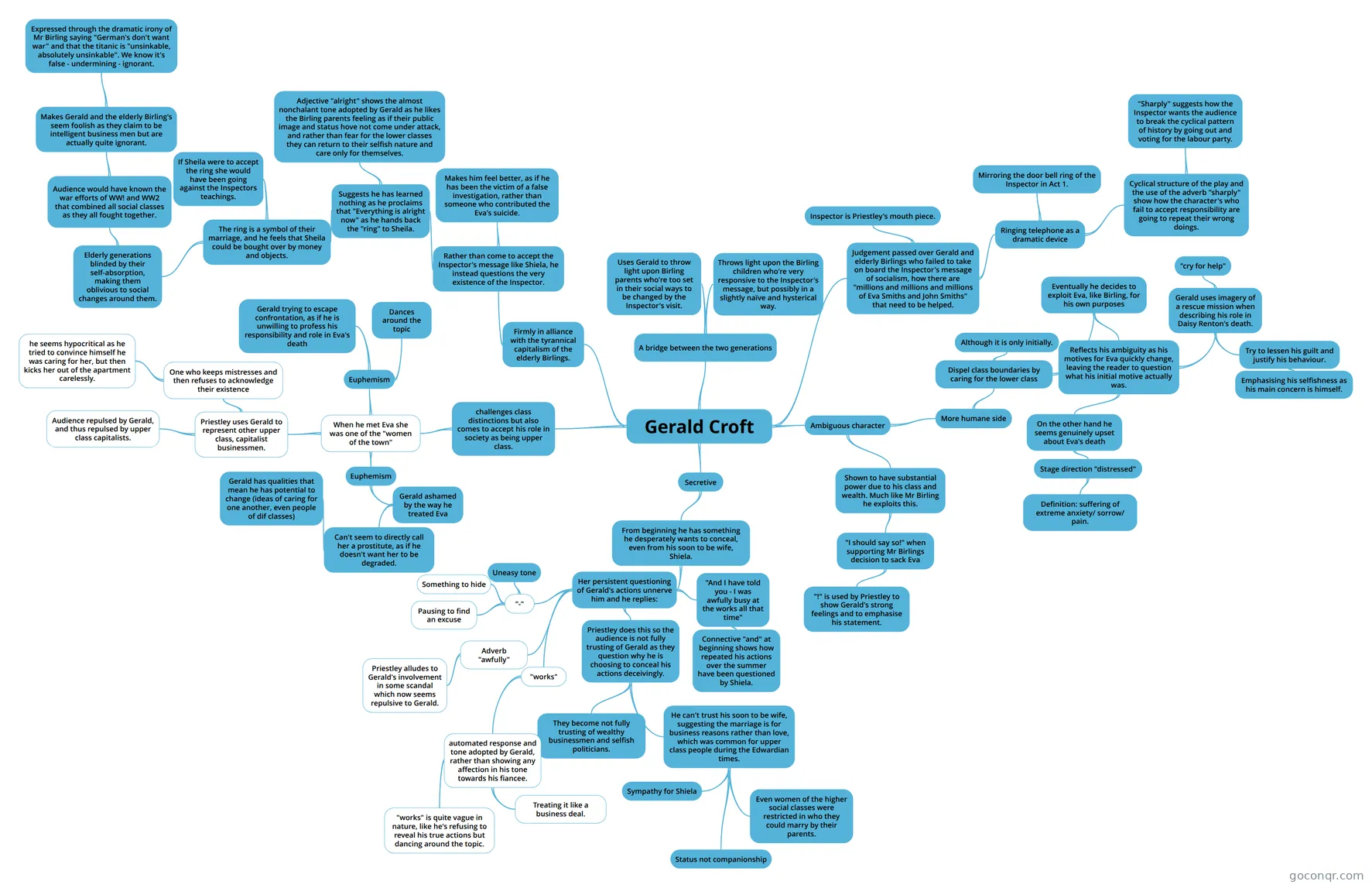
Mind map: Gerald Croft An Inspector Calls
Contenido del mapa
Gerald Croft
A bridge between the two generations
- Uses Gerald to throw light upon Birling parents who're too set in their social ways to be changed by the Inspector's visit.
- Throws light upon the Birling children who're very responsive to the Inspector's message, but possibly in a slightly naïve and hysterical way.
Ambiguous character
- Shown to have substantial power due to his class and wealth. Much like Mr Birling he exploits this.
- "I should say so!" when supporting Mr Birlings decision to sack Eva
- "!" is used by Priestley to show Gerald's strong feelings and to emphasise his statement.
- "I should say so!" when supporting Mr Birlings decision to sack Eva
- More humane side
- Dispel class boundaries by caring for the lower class
- Although it is only initially.
- Eventually he decides to exploit Eva, like Birling, for his own purposes
- Reflects his ambiguity as his motives for Eva quickly change, leaving the reader to question what his initial motive actually was.
- Gerald uses imagery of a rescue mission when describing his role in Daisy Renton's death.
- "cry for help"
- Try to lessen his guilt and justify his behaviour.
- Emphasising his selfishness as his main concern is himself.
- On the other hand he seems genuinely upset about Eva's death
- Stage direction "distressed"
- Definition: suffering of extreme anxiety/ sorrow/ pain.
- Stage direction "distressed"
- Gerald uses imagery of a rescue mission when describing his role in Daisy Renton's death.
- Reflects his ambiguity as his motives for Eva quickly change, leaving the reader to question what his initial motive actually was.
- Dispel class boundaries by caring for the lower class
- Shown to have substantial power due to his class and wealth. Much like Mr Birling he exploits this.
Secretive
- From beginning he has something he desperately wants to conceal, even from his soon to be wife, Shiela.
- Her persistent questioning of Gerald's actions unnerve him and he replies:
- "And I have told you - I was awfully busy at the works all that time"
- Connective "and" at beginning shows how repeated his actions over the summer have been questioned by Shiela.
- Priestley does this so the audience is not fully trusting of Gerald as they question why he is choosing to conceal his actions deceivingly.
- They become not fully trusting of wealthy businessmen and selfish politicians.
- He can't trust his soon to be wife, suggesting the marriage is for business reasons rather than love, which was common for upper class people during the Edwardian times.
- Sympathy for Shiela
- Even women of the higher social classes were restricted in who they could marry by their parents.
- Status not companionship
- "-"
- Uneasy tone
- Something to hide
- Pausing to find an excuse
- Adverb "awfully"
- Priestley alludes to Gerald's involvement in some scandal which now seems repulsive to Gerald.
- "works"
- automated response and tone adopted by Gerald, rather than showing any affection in his tone towards his fiancee.
- Treating it like a business deal.
- "works" is quite vague in nature, like he's refusing to reveal his true actions but dancing around the topic.
- automated response and tone adopted by Gerald, rather than showing any affection in his tone towards his fiancee.
- "And I have told you - I was awfully busy at the works all that time"
- Her persistent questioning of Gerald's actions unnerve him and he replies:
- From beginning he has something he desperately wants to conceal, even from his soon to be wife, Shiela.
challenges class distinctions but also comes to accept his role in society as being upper class.
- When he met Eva she was one of the "women of the town"
- Euphemism
- Gerald ashamed by the way he treated Eva
- Can't seem to directly call her a prostitute, as if he doesn't want her to be degraded.
- Gerald has qualities that mean he has potential to change (ideas of caring for one another, even people of dif classes)
- Can't seem to directly call her a prostitute, as if he doesn't want her to be degraded.
- Gerald ashamed by the way he treated Eva
- Euphemism
- Gerald trying to escape confrontation, as if he is unwilling to profess his responsibility and role in Eva's death
- Dances around the topic
- Priestley uses Gerald to represent other upper class, capitalist businessmen.
- One who keeps mistresses and then refuses to acknowledge their existence
- he seems hypocritical as he tried to convince himself he was caring for her, but then kicks her out of the apartment carelessly.
- Audience repulsed by Gerald, and thus repulsed by upper class capitalists.
- One who keeps mistresses and then refuses to acknowledge their existence
- Euphemism
- When he met Eva she was one of the "women of the town"
Firmly in alliance with the tyrannical capitalism of the elderly Birlings.
- Rather than come to accept the Inspector's message like Shiela, he instead questions the very existence of the Inspector.
- Makes him feel better, as if he has been the victim of a false investigation, rather than someone who contributed the Eva's suicide.
- Suggests he has learned nothing as he proclaims that "Everything is alright now" as he hands back the "ring" to Sheila.
- Adjective "alright" shows the almost nonchalant tone adopted by Gerald as he likes the Birling parents feeling as if their public image and status hove not come under attack, and rather than fear for the lower classes they can return to their selfish nature and care only for themselves.
- The ring is a symbol of their marriage, and he feels that Sheila could be bought over by money and objects.
- If Sheila were to accept the ring she would have been going against the Inspectors teachings.
- Elderly generations blinded by their self-absorption, making them oblivious to social changes around them.
- Audience would have known the war efforts of WW! and WW2 that combined all social classes as they all fought together.
- Makes Gerald and the elderly Birling's seem foolish as they claim to be intelligent business men but are actually quite ignorant.
- Expressed through the dramatic irony of Mr Birling saying "German's don't want war" and that the titanic is "unsinkable, absolutely unsinkable". We know it's false - undermining - ignorant.
- Makes Gerald and the elderly Birling's seem foolish as they claim to be intelligent business men but are actually quite ignorant.
- Audience would have known the war efforts of WW! and WW2 that combined all social classes as they all fought together.
- Rather than come to accept the Inspector's message like Shiela, he instead questions the very existence of the Inspector.
Judgement passed over Gerald and elderly Birlings who failed to take on board the Inspector's message of socialism, how there are "millions and millions and millions of Eva Smiths and John Smiths" that need to be helped.
- Inspector is Priestley's mouth piece.
- Ringing telephone as a dramatic device
- Mirroring the door bell ring of the Inspector in Act 1.
- Cyclical structure of the play and the use of the adverb "sharply" show how the character's who fail to accept responsibility are going to repeat their wrong doings.
- "Sharply" suggests how the Inspector wants the audience to break the cyclical pattern of history by going out and voting for the labour party.
Información
- Descripción
- GCSE (Inspector) English Mapa Mental sobre Gerald Croft, creado por Jordan m el 16/02/2018.
- Creado por
- Jordan m
- Visitas
- 162
- Valoración