
Mapa mental
Computer Science
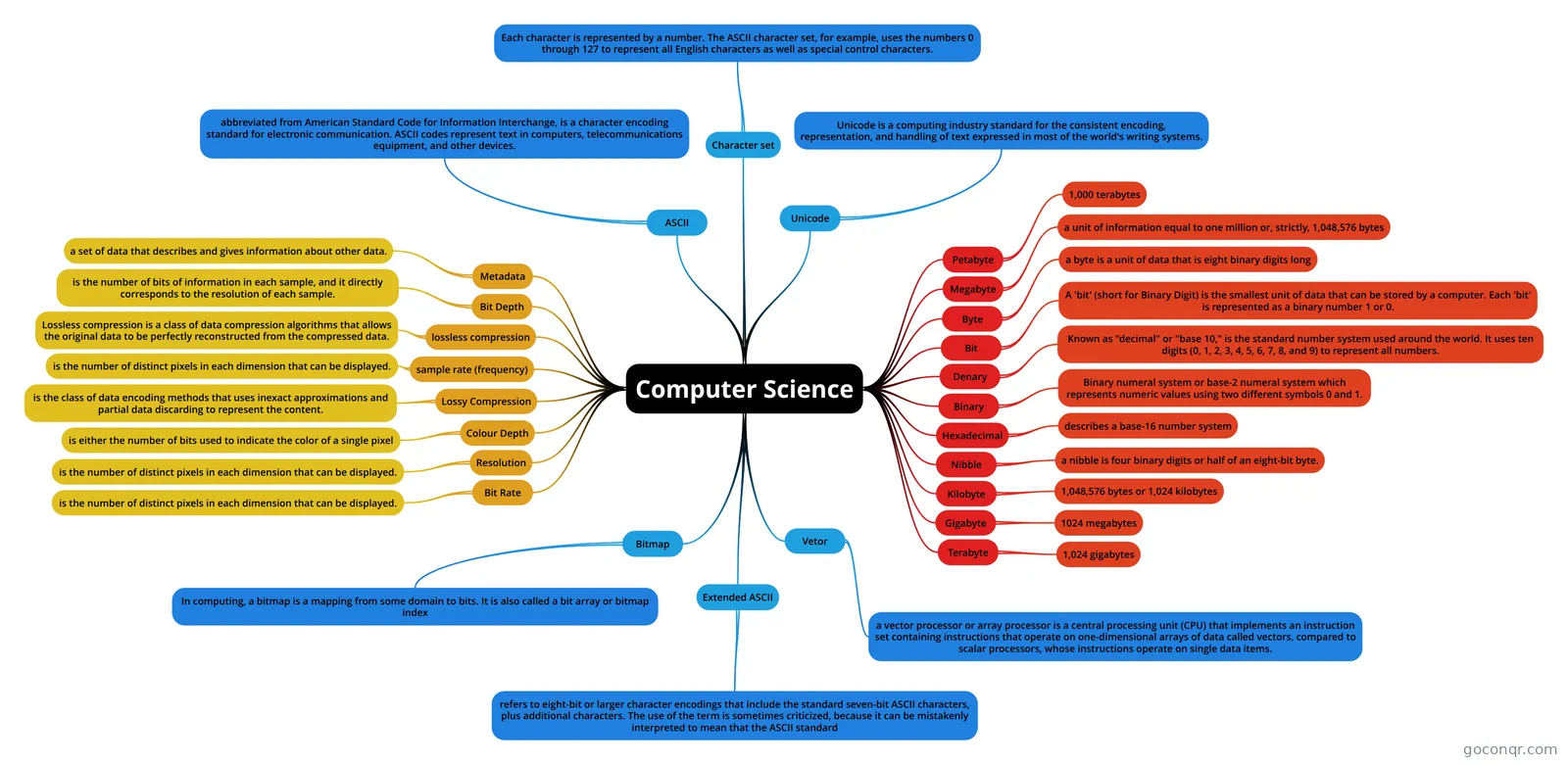
Mind map: Computer Science Data Representation
Contenido del mapa
Computer Science
Binary
- Binary numeral system or base-2 numeral system which represents numeric values using two different symbols 0 and 1.
Denary
- Known as "decimal" or "base 10," is the standard number system used around the world. It uses ten digits (0, 1, 2, 3, 4, 5, 6, 7, 8, and 9) to represent all numbers.
Hexadecimal
- describes a base-16 number system
Bit
- A 'bit' (short for Binary Digit) is the smallest unit of data that can be stored by a computer. Each 'bit' is represented as a binary number 1 or 0.
Nibble
- a nibble is four binary digits or half of an eight-bit byte.
Byte
- a byte is a unit of data that is eight binary digits long
Kilobyte
- 1,048,576 bytes or 1,024 kilobytes
Megabyte
- a unit of information equal to one million or, strictly, 1,048,576 bytes
Gigabyte
- 1024 megabytes
Petabyte
- 1,000 terabytes
Terabyte
- 1,024 gigabytes
Character set
- Each character is represented by a number. The ASCII character set, for example, uses the numbers 0 through 127 to represent all English characters as well as special control characters.
ASCII
- abbreviated from American Standard Code for Information Interchange, is a character encoding standard for electronic communication. ASCII codes represent text in computers, telecommunications equipment, and other devices.
Extended ASCII
- refers to eight-bit or larger character encodings that include the standard seven-bit ASCII characters, plus additional characters. The use of the term is sometimes criticized, because it can be mistakenly interpreted to mean that the ASCII standard
Unicode
- Unicode is a computing industry standard for the consistent encoding, representation, and handling of text expressed in most of the world's writing systems.
Bitmap
- In computing, a bitmap is a mapping from some domain to bits. It is also called a bit array or bitmap index
Vetor
- a vector processor or array processor is a central processing unit (CPU) that implements an instruction set containing instructions that operate on one-dimensional arrays of data called vectors, compared to scalar processors, whose instructions operate on single data items.
Resolution
- is the number of distinct pixels in each dimension that can be displayed.
Colour Depth
- is either the number of bits used to indicate the color of a single pixel
Metadata
- a set of data that describes and gives information about other data.
sample rate (frequency)
- is the number of distinct pixels in each dimension that can be displayed.
Bit Depth
- is the number of bits of information in each sample, and it directly corresponds to the resolution of each sample.
Bit Rate
- is the number of distinct pixels in each dimension that can be displayed.
lossless compression
- Lossless compression is a class of data compression algorithms that allows the original data to be perfectly reconstructed from the compressed data.
Lossy Compression
- is the class of data encoding methods that uses inexact approximations and partial data discarding to represent the content.
Información
- Descripción
- Mapa Mental sobre Computer Science, creado por Chloe Bassnett el 22/02/2018.
- Creado por
- Chloe Bassnett
- Visitas
- 0
- Valoración