
Mapa mental
DEFENCES
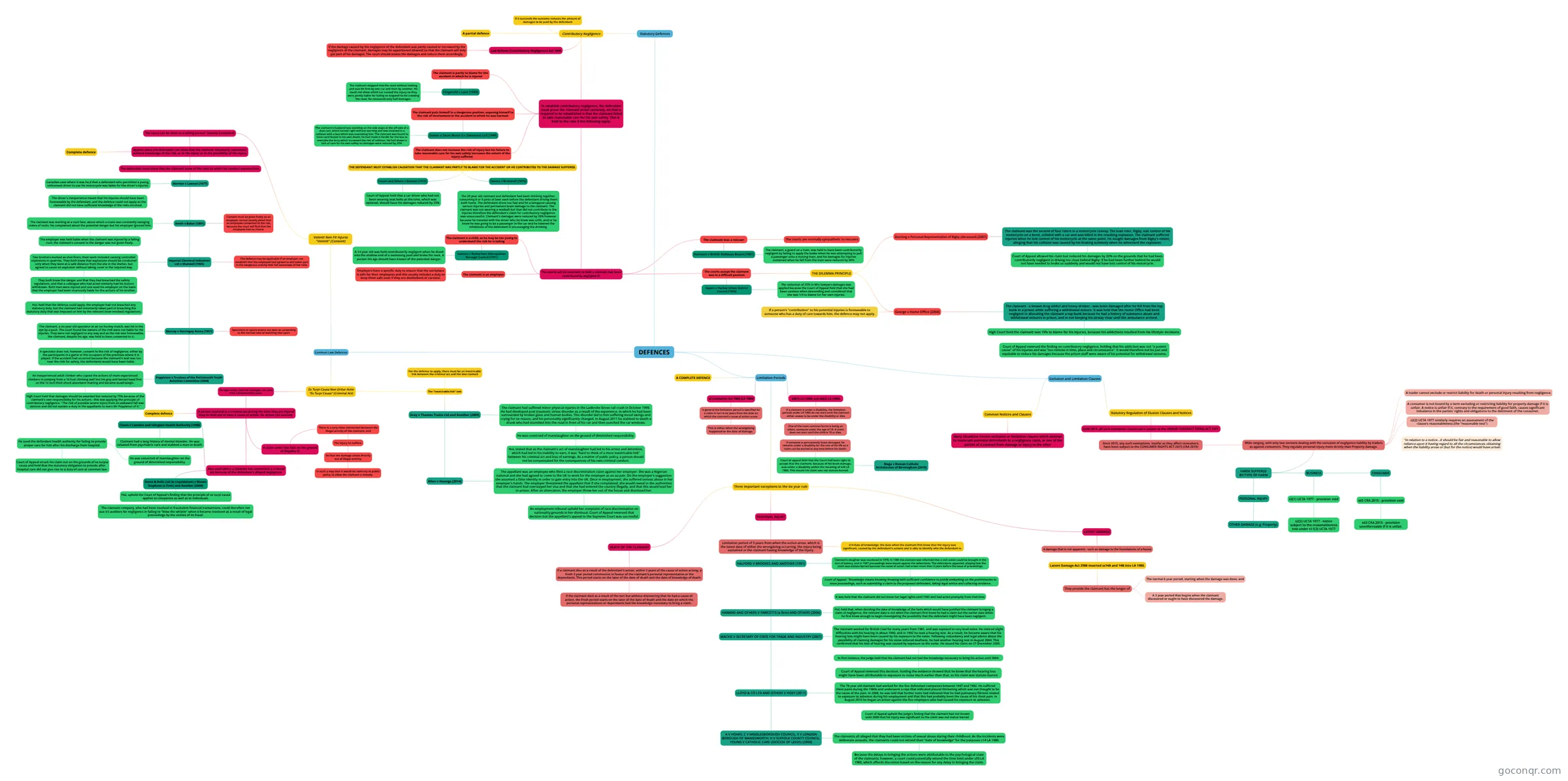
Mind map: Defences in tort law
Contenido del mapa
DEFENCES
Common Law Defences
- Ex Turpi Causa Non Oritur Actio "Ex Turpi Causa" (Criminal Act)
- No legal action, claim for damages, can arise from a blameworthy cause.
- A person involved in a criminal act during the time they are injured may be held not to have a cause of action. No action can succeed.
- Complete defence
- A claim under this fails on the ground of illegality if:
- There is a very close connection between the illegal activity of the claimant; and
- The injury he suffers;
- So that the damage arises directly out of illegal activity;
- In such a way that it would be contrary to public policy to allow the claimant a remedy.
- So that the damage arises directly out of illegal activity;
- The injury he suffers;
- There is a very close connection between the illegal activity of the claimant; and
- Also used where a claimant has committed a criminal act because of the defendant's alleged negligence.
- Clunis v Camden and Islington Health Authority [1998]
- Claimant had a long history of mental disorder. He was released from psychiatric care and stabbed a man to death.
- He was convicted of manslaughter on the ground of diminished responsibility.
- He sued the defendant health authority for failing to provide proper care for him after his discharge from hospital.
- Court of Appeal struck his claim out on the grounds of ex turpia causa and held that the statutory obligation to provide after hospital care did not give rise to a duty of care at common law.
- He sued the defendant health authority for failing to provide proper care for him after his discharge from hospital.
- He was convicted of manslaughter on the ground of diminished responsibility.
- Claimant had a long history of mental disorder. He was released from psychiatric care and stabbed a man to death.
- Stone & Rolls Ltd (in Liquidation) v Moore Stephens (a Firm) and Another [2009]
- HoL upheld the Court of Appeal's finding that the principle of ex turpi causa applies to companies as well as to individuals.
- The claimant company, who had been involved in fraudulent financial transactions, could therefore not sue it's auditors for negligence in failing to "blow the whistle" when it became insolvent as a result of legal proceedings by the victims of its fraud.
- HoL upheld the Court of Appeal's finding that the principle of ex turpi causa applies to companies as well as to individuals.
- Clunis v Camden and Islington Health Authority [1998]
- A person involved in a criminal act during the time they are injured may be held not to have a cause of action. No action can succeed.
- The "inextricable link" test
- For the defence to apply, there must be an inextricable link between the criminal act and the loss claimed
- Gray v Thames Trains Ltd and Another [2009]
- The claimant had suffered minor physical injuries in the Ladbroke Grove rail crash in October 1999. He had developed post traumatic stress disorder as a result of the experience, in which he had been surrounded by broken glass and human bodies. This disorder led to him suffering mood swings and crying for no reason, and his personality significantly changed. In August 2011 he stabbed to death a drunk who had stumbled into the road in front of his car and then punched the car windows.
- He was convicted of manslaughter on the ground of diminished responsibility.
- HoL stated that as the claimant's act of manslaughter had led to his arrest and detention, which had led to his inability to earn, it was "hard to think of a more inextricable link" between his criminal act and loss of earnings. As a matter of public policy, a person should not be compensated for the consequences of his own criminal conduct.
- He was convicted of manslaughter on the ground of diminished responsibility.
- Allen v Hounga [2014]
- The appellant was an employee who filed a race discrimination claim against her employer. She was a Nigerian national and she had agreed to come to the UK to work for the employer as an au pair. On the employer's suggestion she assumed a false identity in order to gain entry into the UK. Once in employment, she suffered serious abuse in her employer's hands. The employer threatened the appellant that if she complained, she would reveal to the authorities that the claimant had overstayed her visa and that she had entered the country illegally, and that this would lead her to prison. After an altercation, the employer threw her out of the house and dismissed her.
- An employment tribunal upheld her complaint of race discrimination on nationality grounds in her dismissal. Court of Appeal reversed that decision but the appellant's appeal to the Supreme Court was successful.
- The appellant was an employee who filed a race discrimination claim against her employer. She was a Nigerian national and she had agreed to come to the UK to work for the employer as an au pair. On the employer's suggestion she assumed a false identity in order to gain entry into the UK. Once in employment, she suffered serious abuse in her employer's hands. The employer threatened the appellant that if she complained, she would reveal to the authorities that the claimant had overstayed her visa and that she had entered the country illegally, and that this would lead her to prison. After an altercation, the employer threw her out of the house and dismissed her.
- The claimant had suffered minor physical injuries in the Ladbroke Grove rail crash in October 1999. He had developed post traumatic stress disorder as a result of the experience, in which he had been surrounded by broken glass and human bodies. This disorder led to him suffering mood swings and crying for no reason, and his personality significantly changed. In August 2011 he stabbed to death a drunk who had stumbled into the road in front of his car and then punched the car windows.
- No legal action, claim for damages, can arise from a blameworthy cause.
- Volenti Non Fit Injuria "Volenti" (Consent)
- "No injury can be done to a willing person" (loosely translated)
- Applies when the defendant can show that the claimant voluntarily consented, without knowledge of the risk, or to the injury or to the possibility of the injury.
- Complete defence
- The defendant must show that the claimant knew of the risks to which his conduct exposed him.
- Stermer v Lawson [1977]
- Canadian case where it was he;d that a defendant who permitted a young, unlicensed driver to use his motorcycle was liable for the driver's injuries
- The driver's inexperience meant that his injuries should have been foreseeable by the defendant, and the defence could not apply as the claimant did not have sufficient knowledge of the risks involved.
- Smith v Baker [1891]
- The claimant was working at a rock face, above which a crane was constantly swinging crates of rocks. He complained about the potential danger but his employer ignored him.
- The employer was held liable when the claimant was injured by a falling rock; the claimant's consent to the danger was not given freely.
- Consent must be given freely so an employer cannot usually plead that an employee consented to the risk, because the court will find that the employee had no choice.
- Imperial Chemical Industries Ltd v Shatwell [1965]
- Two brothers worked as shot-firers; their work included causing controlled explosions in quarries. They both knew that explosions should be conducted only when they were at a safe distance from the site in the shelter, but agreed to cause an explosion without taking cover in the required way.
- They both knew the danger and that they had breached the safety regulations, and that a colleague who had acted similarly had his licence withdrawn. Both men were injured and one sued his employer on the basis that the employer had been vicariously liable for the actions of his brother.
- HoL held that the defence could apply: the employer had not breached any statutory duty, but the claimant had voluntarily taken part in breaching the statutory duty that was imposed on him by the relevant (now-revoked) regulations.
- They both knew the danger and that they had breached the safety regulations, and that a colleague who had acted similarly had his licence withdrawn. Both men were injured and one sued his employer on the basis that the employer had been vicariously liable for the actions of his brother.
- The defence may be applicable if an employer can establish that the employee had agreed to and taken part in the dangerous activity with full awareness of the risks.
- Murray v Harringay Arena [1951]
- The claimant, a six year old spectator at an ice hockey match, was hit in the eye by a puck. The court found the owners of the rink were not liable for his injuries. They were not negligent in any way and as the risk was foreseeable, the claimant, despite his age, was held to have consented to it.
- A spectator does not, however, consent to the risk of negligence, either by the participants in a game or the occupiers of the premises where it is played. If the accident had occurred because the claimant's seat was too near the rink for safety, the defendants would have been liable.
- Spectators at sports events are seen as consenting to the normal risks of watching that sport
- Poppleton v Trustees of the Portsmouth Youth Activities Committee [2008]
- An inexperienced adult climber who copied the actions of more experienced climbers in jumping from a 16 foot climbing wall lost his grip and landed head first on the 12 inch thick shock absorbent matting and became quadriplegic.
- High Court held that damages should be awarded but reduced by 75% because of the claimant's own responsibility for his actions - this was applying the principle of contributory negligence. "The risk of possible severe injury from an awkward fall was obvious and did not sustain a duty in the appellants to warn Mr Poppleton of it."
- An inexperienced adult climber who copied the actions of more experienced climbers in jumping from a 16 foot climbing wall lost his grip and landed head first on the 12 inch thick shock absorbent matting and became quadriplegic.
- The claimant, a six year old spectator at an ice hockey match, was hit in the eye by a puck. The court found the owners of the rink were not liable for his injuries. They were not negligent in any way and as the risk was foreseeable, the claimant, despite his age, was held to have consented to it.
- Two brothers worked as shot-firers; their work included causing controlled explosions in quarries. They both knew that explosions should be conducted only when they were at a safe distance from the site in the shelter, but agreed to cause an explosion without taking cover in the required way.
- The claimant was working at a rock face, above which a crane was constantly swinging crates of rocks. He complained about the potential danger but his employer ignored him.
- Canadian case where it was he;d that a defendant who permitted a young, unlicensed driver to use his motorcycle was liable for the driver's injuries
- Stermer v Lawson [1977]
- Applies when the defendant can show that the claimant voluntarily consented, without knowledge of the risk, or to the injury or to the possibility of the injury.
- "No injury can be done to a willing person" (loosely translated)
- Ex Turpi Causa Non Oritur Actio "Ex Turpi Causa" (Criminal Act)
Statutory Defences
- Contributory Negligence
- A partial defence
- If it succeeds the outcome reduces the amount of damages to be paid by the defendant
- Law Reform (Contributory Negligence) Act 1945
- If the damage caused by the negligence of the defendant was partly caused or increased by the negligence of the claimant, damages may be apportioned (shared) so that the claimant will only get part of his damages. The court should assess the damages and reduce them accordingly.
- To establish contributory negligence, the defendant must prove the claimant acted carelessly. All that is required to be established is that the claimant failed to take reasonable care for his own safety. This is held to the case if the following apply:
- The claimant is partly to blame for the accident in which he is injured
- Fitzgerald v Lane [1989]
- The claimant stepped into the road without looking and was hit first by one car and then by another. He could not show which car caused the injury so they were jointly liable for failing to respond to his crossing the road. He recovered only half damages.
- Fitzgerald v Lane [1989]
- The claimant puts himself in a dangerous position, exposing himself to the risk of involvement in the accident in which he was harmed.
- Davies v Swan Motor Co (Swansea) Ltd [1949]
- The claimant's husband was standing on the side steps at the off-side of a dust cart, which turned right without warning and was involved in a collision with a bus which was overtaking him. The claimant was found to have contributed to his own death; he had made it harder for the bus to overtake the lorry which increased the risk of collision. He had shown a lack of care for his own safety so damages were reduced by 20%.
- Davies v Swan Motor Co (Swansea) Ltd [1949]
- The claimant does not increase the risk of injury but his failure to take reasonable care for his own safety increases the extent of the injury suffered.
- THE DEFENDANT MUST ESTABLISH CAUSATION THAT THE CLAIMANT WAS PARTLY TO BLAME FOR THE ACCIDENT OR HE CONTRIBUTED TO THE DAMAGE SUFFERED.
- Froom and Others v Butcher [1975]
- Court of Appeal held that a car driver who had not been wearing seat belts at the time, which was optional, should have his damages reduced by 25%
- Owens v Brimmell [1976]
- The 20 year old claimant and defendant had been drinking together, consuming 8 or 9 pints of beer each before the defendant driving them both home. The defendant drove too fast and hit a lamppost causing serious injuries and permanent brain damage to the claimant. The claimant was not wearing a seatbelt but that did not contribute to the injuries therefore the defendant's claim for contributory negligence was unsuccessful. Claimant's damages were reduced by 20% however because he traveled with the driver who he knew was unfit, and/or he knew he was going to be a passenger in the car and he lowered the inhibitions of the defendant in encouraging the drinking.
- Froom and Others v Butcher [1975]
- THE DEFENDANT MUST ESTABLISH CAUSATION THAT THE CLAIMANT WAS PARTLY TO BLAME FOR THE ACCIDENT OR HE CONTRIBUTED TO THE DAMAGE SUFFERED.
- The courts will be reluctant to hold a claimant has been contributorily negligent if:
- The claimant is a child, as he may be too young to understand the risk he is taking
- Gannon v Rotherham Metropolitan Borough Council [1991]
- A 14 year old was held contributorily negligent when he dived into the shallow end of a swimming pool and broke his neck. A person his age should have known of the potential danger.
- Gannon v Rotherham Metropolitan Borough Council [1991]
- The claimant is an employee
- Employers have a specific duty to ensure that the workplace is safe for their employees and this usually includes a duty to keep them safe even if they are disobedient or careless.
- The claimant was a rescuer
- The courts are normally sympathetic to rescuers
- Harrison v British Railways Board [1981]
- The claimant, a guard on a train, was held to have been contributorily negligent by failing to apply the brake when he was attempting to pull a passenger onto a moving train, and his damages for injuries sustained when he fell from the train were reduced by 20%
- The courts accept the claimant was in a difficult position
- THE DILEMMA PRINCIPLE
- Dorning v Personal Representative of Rigby (deceased) [2007]
- The claimant was the second of four riders in a motorcycle convoy. The lead rider, Rigby, lost control of his motorcycle on a bend, collided with a car and was killed in the resulting explosion. The claimant suffered injuries when he lost control of his motorcycle at the same point. He sought damages from Rigby's estate, alleging that his collision was caused by his braking suddenly when he witnessed the explosion.
- Court of Appeal allowed his claim but reduced his damages by 20% on the grounds that he had been contributorily negligent in driving too close behind Rigby: if he had been further behind he would not have needed to brake so suddenly and would not have lost control of his motorcycle.
- The claimant was the second of four riders in a motorcycle convoy. The lead rider, Rigby, lost control of his motorcycle on a bend, collided with a car and was killed in the resulting explosion. The claimant suffered injuries when he lost control of his motorcycle at the same point. He sought damages from Rigby's estate, alleging that his collision was caused by his braking suddenly when he witnessed the explosion.
- George v Home Office [2008]
- The claimant - a known drug addict and heavy drinker - was brain damaged after he fell from the top bunk in a prison while suffering a withdrawal seizure. It was held that the Home Office had been negligent in allocating the claimant a top bunk because he had a history of substance abuse and withdrawal seizures in prison, and in not keeping his airway clear until the ambulance arrived.
- High Court held the claimant was 15% to blame for his injuries, because his addictions resulted from his lifestyle decisions.
- Court of Appeal reversed the finding on contributory negligence, holding that his addiction was not "a potent cause" of his injuries and was "too remote in time, place and circumstance". It would therefore not be just and equitable to reduce his damages because the prison staff were aware of his potential for withdrawal seizures.
- High Court held the claimant was 15% to blame for his injuries, because his addictions resulted from his lifestyle decisions.
- If a person's "contribution" to his potential injuries is foreseeable to someone who has a duty of care towards him, the defence may not apply.
- The claimant - a known drug addict and heavy drinker - was brain damaged after he fell from the top bunk in a prison while suffering a withdrawal seizure. It was held that the Home Office had been negligent in allocating the claimant a top bunk because he had a history of substance abuse and withdrawal seizures in prison, and in not keeping his airway clear until the ambulance arrived.
- Dorning v Personal Representative of Rigby (deceased) [2007]
- Sayers v Harlow Urban District Council [1958]
- The reduction of 25% in Mrs Sawyers damages was applied because the Court of Appeal held that she had been careless when descending and considered that she was 1/4 to blame for her own injuries.
- THE DILEMMA PRINCIPLE
- The claimant is a child, as he may be too young to understand the risk he is taking
- The claimant is partly to blame for the accident in which he is injured
- Contributory Negligence
Limitation Periods
- s2 Limitation Act 1980 (LA 1980)
- In general the limitation period is specified for a claim in tort is six years from the date on which the claimant's cause of action arose.
- This is either when the wrongdoing happened or the date of damage.
- In general the limitation period is specified for a claim in tort is six years from the date on which the claimant's cause of action arose.
- A COMPLETE DEFENCE
- s28(1) LA (1980) and s38(2) LA (1980)
- If a claimant is under a disability, the limitation periods under LA 1980 do not start until the claimant either ceases to be under the disability or dies
- One of the most common forms is being an infant, someone under the age of 18. A claim does not start until the child is 18 or dies.
- If someone is permanently brain-damaged, he remains under a disability for the rest of his life so a claim can be started at any time before his death.
- Court of appeal held that the Court had been right to accept that the claimant, because of his brain damage, was under a disability within the meaning of s28 LA 1980. This meant his claim was not statute-barred.
- Maga v Roman Catholic Archdiocese of Birmingham [2010]
- Court of appeal held that the Court had been right to accept that the claimant, because of his brain damage, was under a disability within the meaning of s28 LA 1980. This meant his claim was not statute-barred.
- If someone is permanently brain-damaged, he remains under a disability for the rest of his life so a claim can be started at any time before his death.
- One of the most common forms is being an infant, someone under the age of 18. A claim does not start until the child is 18 or dies.
- If a claimant is under a disability, the limitation periods under LA 1980 do not start until the claimant either ceases to be under the disability or dies
- Three important exceptions to the six year rule
- PERSONAL INJURY
- Limitation period of 3 years from when the action arose, which is the latest date of either the wrongdoing occurring, the injury being sustained or the claimant having knowledge of the injury.
- s14 date of knowledge: the date when the claimant first knew that the injury was significant, caused by the defendant's actions and is able to identify who the defendant is.
- HALFORD V BROOKES AND ANOTHER [1991]
- HAWARD AND OTHERS V FAWCETTS (a firm) AND OTHERS [2006]
- MACKIE V SECRETARY OF STATE FOR TRADE AND INDUSTRY [2007]
- LLOYD & CO LTD AND OTHERS V HOEY [2011]
- A V HOARE; C V MIDDLESBOROUGH COUNCIL; X V LONDON BOROUGH OF WANDSWORTH; H V SUFFOLK COUNTY COUNCIL; YOUNG V CATHOLIC CARE (DIOCESE OF LEEDS) [2008]
- The claimants all alleged that they had been victims of sexual abuse during their childhood. As the incidents were deliberate assaults, the claimants could not extend their "date of knowledge" for the purposes s14 LA 1980.
- Because the delays in bringing the actions were attributable to the psychological state of the claimants, however, a court could potentially extend the time limit under s33 LA 1980, which affords discretion based on the reason for any delay in bringing the claim.
- The claimants all alleged that they had been victims of sexual abuse during their childhood. As the incidents were deliberate assaults, the claimants could not extend their "date of knowledge" for the purposes s14 LA 1980.
- The 79 year old claimant had worked for the five defendant companies between 1947 and 1992. He suffered chest pains during the 1980s and underwent x-rays that indicated pleural thickening which was not thought to be the cause of the pain. In 2008, he was told that further tests had indicated that he had pulmonary fibrosis related to exposure to asbestos during his employment and that this had probably been the cause of his chest pain. In August 2010 he began an action against the five employers who had caused his exposure to asbestos.
- Court of Appeal upheld the judge's finding that the claimant had not known until 2008 that his injury was significant so the claim was not statue barred.
- A V HOARE; C V MIDDLESBOROUGH COUNCIL; X V LONDON BOROUGH OF WANDSWORTH; H V SUFFOLK COUNTY COUNCIL; YOUNG V CATHOLIC CARE (DIOCESE OF LEEDS) [2008]
- The claimant worked for British Coal for many years from 1981, and was exposed to very loud noise. He noticed slight difficulties with his hearing in about 1990, and in 1992 he took a hearing test. As a result, he became aware that his hearing loss might have been caused by his exposure to the noise. Following redundancy and legal advice about the possibility of claiming damages for his noise induced deafness, he had another hearing test in August 2004. This confirmed that his loss of hearing was caused by exposure to the noise. He issued his claim on 21 December 2005.
- In first instance, the judge held that the claimant had not had the knowledge necessary to bring his action until 2004.
- Court of Appeal reversed this decision, holding the evidence showed that he knew that the hearing loss might have been attributable to exposure to noise much earlier than that, so his claim was statute-barred.
- In first instance, the judge held that the claimant had not had the knowledge necessary to bring his action until 2004.
- LLOYD & CO LTD AND OTHERS V HOEY [2011]
- HoL held that, when deciding the date of knowledge of the facts which would have justified the claimant bringing a claim of negligence, the relevant date is not when the claimant first knew he had a claim but the earlier date when he first knew enough to begin investigating the possibility that the defendant might have been negligent.
- MACKIE V SECRETARY OF STATE FOR TRADE AND INDUSTRY [2007]
- Claimant's daughter was murdered in 1978. In 1985 the claimant was informed that a civil action could be brought in the tort of battery, and in 1987 proceedings were issued against the defendants. The defendants appealed, alleging that the claim was statute barred because the cause of action had arisen more than 3 years before the issue of proceedings.
- Court of Appeal: "Knowledge means knowing knowing with sufficient confidence to justify embarking on the preliminaries to issue proceedings, such as submitting a claim to the proposed defendant, taking legal advice and collecting evidence.
- It was held that the claimant did not know her legal rights until 1985 and had acted promptly from that time
- Court of Appeal: "Knowledge means knowing knowing with sufficient confidence to justify embarking on the preliminaries to issue proceedings, such as submitting a claim to the proposed defendant, taking legal advice and collecting evidence.
- HAWARD AND OTHERS V FAWCETTS (a firm) AND OTHERS [2006]
- Limitation period of 3 years from when the action arose, which is the latest date of either the wrongdoing occurring, the injury being sustained or the claimant having knowledge of the injury.
- DEATH OF THE CLAIMANT
- If a claimant dies as a result of the defendant's action, within 3 years of the cause of action arising, a fresh 3 year period commences in favour of the claimant's personal representative or the dependants. This period starts on the later of the date of death and the date of knowledge of death.
- If the claimant died as a result of the tort but without discovering that he had a cause of action, the fresh period starts on the later of the date of death and the date on which the personal representatives or dependants had the knowledge necessary to bring a claim.
- If a claimant dies as a result of the defendant's action, within 3 years of the cause of action arising, a fresh 3 year period commences in favour of the claimant's personal representative or the dependants. This period starts on the later of the date of death and the date of knowledge of death.
- LATENT DAMAGE
- A damage that is not apparent - such as damage to the foundations of a house
- Latent Damage Act 2986 inserted ss14A and 14B into LA 1980.
- They provide the claimant has the longer of:
- The normal 6 year period, starting when the damage was done; and
- A 3 year period that begins when the claimant discovered or ought to have discovered the damage.
- They provide the claimant has the longer of:
- Latent Damage Act 2986 inserted ss14A and 14B into LA 1980.
- A damage that is not apparent - such as damage to the foundations of a house
- PERSONAL INJURY
- s2 Limitation Act 1980 (LA 1980)
Exclusion and Limitation Clauses
- Common Notices and Clauses
- Many situations involve exclusion or limitation clauses which attempt to exonerate potential defendants to a negligence claim, or one of the parties of a contract from damage or injury to the other
- Statutory Regulation of Elusion Clauses and Notices
- Until 2015, all such exemption clauses were subject to the UNFAIR CONTRACT TERMS ACT 1977.
- Since 2015, any such exemptions, insofar as they affect consumers, have been subject to the CONSUMER RIGHTS ACT 2015 (CRA 2015)
- Wide ranging, with only two sections dealing with the exclusion of negligence liability by traders as against consumers. They regulate personal injury more strictly than Property damage.
- A trader cannot exclude or restrict liability for death or personal injury resulting from negligence.
- A consumer is not bound by a term excluding or restricting liability for property damage if it is unfair. A notice is unfair if it, contrary to the requirement of good faith, causes significant imbalance in the parties' rights and obligations to the detriment of the consumer.
- s2(2) UCTA 1977 similarly requires an assessment of the clause's reasonableness (the "reasonable test")
- "in relation to a notice...it should be fair and reasonable to allow reliance upon it having regard to all the circumstances obtaining when the liability arose or (but for the notice) would have arisen
- HARM SUFFERED BY/TYPE OF HARM
- BUSINESS
- CONSUMER
- s65 CRA 2015 - provision void
- s63 CRA 2015 - provision unenforceable if it is unfair.
- s65 CRA 2015 - provision void
- s2(1) UCTA 1977 - provision void
- s2(2) UCTA 1977 - notice subject to the reasonableness test under s11(3) UCTA 1977
- CONSUMER
- PERSONAL INJURY
- OTHER DAMAGE (e.g. Property)
- BUSINESS
- Wide ranging, with only two sections dealing with the exclusion of negligence liability by traders as against consumers. They regulate personal injury more strictly than Property damage.
- Since 2015, any such exemptions, insofar as they affect consumers, have been subject to the CONSUMER RIGHTS ACT 2015 (CRA 2015)
- Until 2015, all such exemption clauses were subject to the UNFAIR CONTRACT TERMS ACT 1977.
- Common Notices and Clauses
Información
- Descripción
- Diploma Tort of Negligence Mapa Mental sobre DEFENCES, creado por Hannah Thompson el 29/03/2018.
- Creado por
- Hannah Thompson
- Visitas
- 0
- Valoración