
Mapa mental
Bandura (1961,1963)
Contenido del mapa
Bandura (1961,1963)
ABOUT
- AIM
- To see whether young children will imitate behaviour they have seen.
- IV
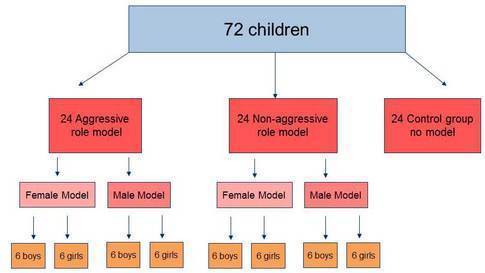
- 1) whether the role model was aggressive or non-aggressive
- (2) whether the role model was the same sex or opposite sex to the child
- (3) a Control condition where the children did not see a role model at all.
- DV
- Bandura’s observers recorded the number of verbal, physical, mallet and gun-play aggressive actions the children carried out
- SAMPLE
- 72 children, 36 boys and 36 girls, aged 3-5, recruited from Stanford University Nursery School.
- AIM
PROCEDURE
- 72 children aged 3 –5 yrs matched for aggression before the study started
- Some groups watched aggressive behaviour; some non-aggressive behaviour and control group watched neither.
- Laboratory Experiment at Stanford University. 8 experimental groups in 4 conditions.
- Children were playing in a room when an adult entered and either behaved aggressively or non-aggressively.
- Children were then put in a slightly aggressive state by being told they could not play with certain toys. Then behaviour observed with access to a Bobo doll and child was observed.
- The child was observed playing with the toys for 20 minutes through a one-way mirror.
RESULTS
- Children in non-aggressive state showed almost no aggression, (70%).
- Those that watched aggressive models showed physical and verbal aggression imitating model.
- The boys showed more nearly twice as much imitative aggression than the girls
- However, the girls showed similar levels of physical and verbal aggression, while the boys had a tendency to model physical aggression much more than verbal aggression.
CONCLUSION
- Children watching adults behaving aggressively are more likely to imitate aggression so observational learning does take place.
- Children also imitated non-aggressive behaviour, which led to less aggression.
- A male adult showing aggressive behaviour is copied more than a female adult aggressive model.
- Girls are more verbally aggressive
- Children watching adults behaving aggressively are more likely to imitate aggression so observational learning does take place.
EVALUATION
- GENERALISABILTY
- A sample in all three studies was large: 72, 96 and 66, large enough that anomalies (eg disturbed children) might be cancelled out (eg by particularly mild mannered ones).
- RELIABILITY
- Bandura also used two observers behind the one-way mirror. This creates inter-rater reliability because a behaviour had to be noted by both observers otherwise it didn’t count.
- APPLICATION
- Can be applied to parenting and teaching styles as it suggests children observe and imitate adults
- VALIDITY
- Lacks ecological validity because it is a lab experiment
- ETHICS
- The children may have been distressed by the aggressive behaviour they witnessed
- The aggressive behaviour they learned from the study may have stayed with them, going on to become a behavioural problem.
- GENERALISABILTY
Imágenes y archivos del mapa
Información
- Descripción
- Edexcel A Level Learning Theories Psychology: Bandura (1961,1963)
- Creado por
- Molly Burns
- Visitas
- 478
- Valoración