
Mapa mental
Enter text here
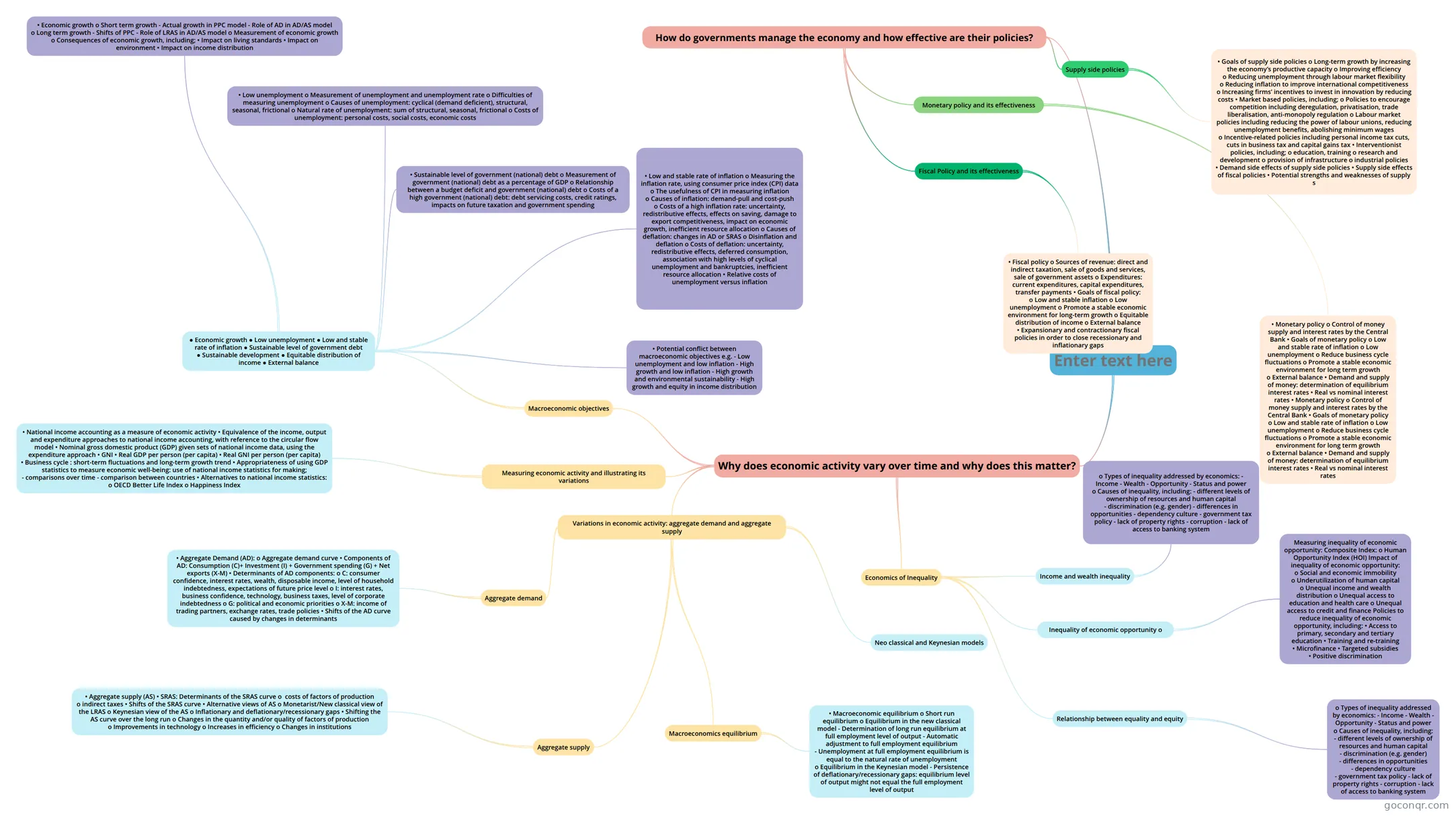
Mind map: Macroeconomic activity and policy
Contenido del mapa
Enter text here
Why does economic activity vary over time and why does this matter?
- Macroeconomic objectives
- ● Economic growth ● Low unemployment ● Low and stable rate of inflation ● Sustainable level of government debt ● Sustainable development ● Equitable distribution of income ● External balance
- • Economic growth o Short term growth - Actual growth in PPC model - Role of AD in AD/AS model o Long term growth - Shifts of PPC - Role of LRAS in AD/AS model o Measurement of economic growth o Consequences of economic growth, including; • Impact on living standards • Impact on environment • Impact on income distribution
- • Low unemployment o Measurement of unemployment and unemployment rate o Difficulties of measuring unemployment o Causes of unemployment: cyclical (demand deficient), structural, seasonal, frictional o Natural rate of unemployment: sum of structural, seasonal, frictional o Costs of unemployment: personal costs, social costs, economic costs
- • Low and stable rate of inflation o Measuring the inflation rate, using consumer price index (CPI) data o The usefulness of CPI in measuring inflation o Causes of inflation: demand-pull and cost-push o Costs of a high inflation rate: uncertainty, redistributive effects, effects on saving, damage to export competitiveness, impact on economic growth, inefficient resource allocation o Causes of deflation: changes in AD or SRAS o Disinflation and deflation o Costs of deflation: uncertainty, redistributive effects, deferred consumption, association with high levels of cyclical unemployment and bankruptcies, inefficient resource allocation • Relative costs of unemployment versus inflation
- • Sustainable level of government (national) debt o Measurement of government (national) debt as a percentage of GDP o Relationship between a budget deficit and government (national) debt o Costs of a high government (national) debt: debt servicing costs, credit ratings, impacts on future taxation and government spending
- • Potential conflict between macroeconomic objectives e.g. - Low unemployment and low inflation - High growth and low inflation - High growth and environmental sustainability - High growth and equity in income distribution
- ● Economic growth ● Low unemployment ● Low and stable rate of inflation ● Sustainable level of government debt ● Sustainable development ● Equitable distribution of income ● External balance
- Measuring economic activity and illustrating its variations
- • National income accounting as a measure of economic activity • Equivalence of the income, output and expenditure approaches to national income accounting, with reference to the circular flow model • Nominal gross domestic product (GDP) given sets of national income data, using the expenditure approach • GNI • Real GDP per person (per capita) • Real GNI per person (per capita) • Business cycle : short-term fluctuations and long-term growth trend • Appropriateness of using GDP statistics to measure economic well-being: use of national income statistics for making; - comparisons over time - comparison between countries • Alternatives to national income statistics: o OECD Better Life Index o Happiness Index
- Variations in economic activity: aggregate demand and aggregate supply
- Aggregate demand
- • Aggregate Demand (AD): o Aggregate demand curve • Components of AD: Consumption (C)+ Investment (I) + Government spending (G) + Net exports (X-M) • Determinants of AD components: o C: consumer confidence, interest rates, wealth, disposable income, level of household indebtedness, expectations of future price level o I: interest rates, business confidence, technology, business taxes, level of corporate indebtedness o G: political and economic priorities o X-M: income of trading partners, exchange rates, trade policies • Shifts of the AD curve caused by changes in determinants
- Aggregate supply
- • Aggregate supply (AS) • SRAS: Determinants of the SRAS curve o costs of factors of production o indirect taxes • Shifts of the SRAS curve • Alternative views of AS o Monetarist/New classical view of the LRAS o Keynesian view of the AS o Inflationary and deflationary/recessionary gaps • Shifting the AS curve over the long run o Changes in the quantity and/or quality of factors of production o Improvements in technology o Increases in efficiency o Changes in institutions
- Macroeconomics equilibrium
- • Macroeconomic equilibrium o Short run equilibrium o Equilibrium in the new classical model - Determination of long run equilibrium at full employment level of output - Automatic adjustment to full employment equilibrium - Unemployment at full employment equilibrium is equal to the natural rate of unemployment o Equilibrium in the Keynesian model - Persistence of deflationary/recessionary gaps: equilibrium level of output might not equal the full employment level of output
- Neo classical and Keynesian models
- Aggregate demand
- Economics of Inequality
- Income and wealth inequality
- o Types of inequality addressed by economics: - Income - Wealth - Opportunity - Status and power o Causes of inequality, including: - different levels of ownership of resources and human capital - discrimination (e.g. gender) - differences in opportunities - dependency culture - government tax policy - lack of property rights - corruption - lack of access to banking system
- Relationship between equality and equity
- o Types of inequality addressed by economics: - Income - Wealth - Opportunity - Status and power o Causes of inequality, including: - different levels of ownership of resources and human capital - discrimination (e.g. gender) - differences in opportunities - dependency culture - government tax policy - lack of property rights - corruption - lack of access to banking system
- Inequality of economic opportunity o
- Measuring inequality of economic opportunity: Composite Index: o Human Opportunity Index (HOI) Impact of inequality of economic opportunity: o Social and economic immobility o Underutilization of human capital o Unequal income and wealth distribution o Unequal access to education and health care o Unequal access to credit and finance Policies to reduce inequality of economic opportunity, including: • Access to primary, secondary and tertiary education • Training and re-training • Microfinance • Targeted subsidies • Positive discrimination
- Income and wealth inequality
- Macroeconomic objectives
How do governments manage the economy and how effective are their policies?
- Monetary policy and its effectiveness
- • Monetary policy o Control of money supply and interest rates by the Central Bank • Goals of monetary policy o Low and stable rate of inflation o Low unemployment o Reduce business cycle fluctuations o Promote a stable economic environment for long term growth o External balance • Demand and supply of money: determination of equilibrium interest rates • Real vs nominal interest rates • Monetary policy o Control of money supply and interest rates by the Central Bank • Goals of monetary policy o Low and stable rate of inflation o Low unemployment o Reduce business cycle fluctuations o Promote a stable economic environment for long term growth o External balance • Demand and supply of money: determination of equilibrium interest rates • Real vs nominal interest rates
- Fiscal Policy and its effectiveness
- • Fiscal policy o Sources of revenue: direct and indirect taxation, sale of goods and services, sale of government assets o Expenditures: current expenditures, capital expenditures, transfer payments • Goals of fiscal policy: o Low and stable inflation o Low unemployment o Promote a stable economic environment for long-term growth o Equitable distribution of income o External balance • Expansionary and contractionary fiscal policies in order to close recessionary and inflationary gaps
- Supply side policies
- • Goals of supply side policies o Long-term growth by increasing the economy’s productive capacity o Improving efficiency o Reducing unemployment through labour market flexibility o Reducing inflation to improve international competitiveness o Increasing firms’ incentives to invest in innovation by reducing costs • Market based policies, including; o Policies to encourage competition including deregulation, privatisation, trade liberalisation, anti-monopoly regulation o Labour market policies including reducing the power of labour unions, reducing unemployment benefits, abolishing minimum wages o Incentive-related policies including personal income tax cuts, cuts in business tax and capital gains tax • Interventionist policies, including; o education, training o research and development o provision of infrastructure o industrial policies • Demand side effects of supply side policies • Supply side effects of fiscal policies • Potential strengths and weaknesses of supply s
- Monetary policy and its effectiveness
Información
- Descripción
- IB Economics Mapa Mental sobre Enter text here, creado por m a el 27/06/2018.
- Creado por
- m a
- Visitas
- 0
- Valoración