
Mapa mental
Unit 4
Contenido del mapa
Unit 4
The Standard Model, Particle Interactions and Mass Energy
- Mass Number: Total number of protons and neutrons. Atomic/Proton number: Number of protons (=number of electrons)
- Isotopes: Atoms of an element with same number protons, different number neutrons
- Hadrons: composed of quarks. Either as quark-antiquark pair(mesons) or three quarks(baryons). Example, pion is a meson. Proton is a baryon.
- Each particle has an anti-particle. Same mass, opposite charge. If the pair collide, they annihilate and produce two photons.
- These collisions must obey three rules. Conservation of energy, momentum and charge.
- Two types of fundamental particles: Quarks and Leptons
- Relativistic Effects
- At speeds reaching c, 'special' physics takes over. Energy increases but cannot exceed c. This 'extra' energy causes an increase in mass. This is where the equation, E=mc^2 comes from.
Rutherford's Experiment
Momentum
Circular Motion
Particle Accelerators
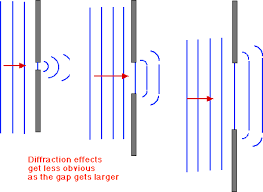
Electron Diffraction/De Broglie
Electric Fields/Coulombs Law
- gravitational field acts on anything with mass, electric fields act on charged particles that are moving
- Electric Field Strength
- Force acting per unit positive charge at that point in the field. N/c
- E=F/Q
- E=V/d
- E=kQ/r^2
- F=(kQ1Q2)/r
Electromagnetism/The Motor Effect
- Magnetic Fields
- We draw lines to represent magnetic fields. These lines are called lines of flux. Field direction always goes from North to South. The spacing between the lines of flux tells you about the strength of field
- Around any conductor that has a current flowing through it there is a magnetic field. Switch off the current and the magnetic field disappears
- Conventional current is the flow of positive charges.
- Use right hand grip rule to figure out direction of magnetic field in solenoid
- Magnetic field strength = magnetic flux density
- By putting a ferrous (iron) core inside a solenoid, the field lines are concentrated. This has the effect of strengthening the field.
- strength of a magnetic field is directly proportional to the current flowing.
- Magnetic Flux = total flux intersecting a given point
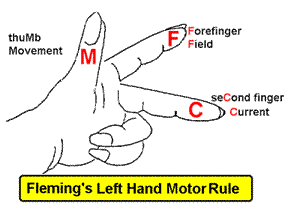
- Current carrying conductors in a magnetic field
- Motor Effect
- If two magnetic fields combine, a force is exerted. One magnet exerts a force (attractive or repulsive) on the other.
- allows us to turn electrical energy into kinetic
- The size of the force can be increased by: •Increasing the magnetic field strength; •Increasing the length of the wire in the field; •Increasing the current in the wire.
- F=BIl
- If two magnetic fields combine, a force is exerted. One magnet exerts a force (attractive or repulsive) on the other.
- Magnetic Fields
Electromagnetic Induction
- What causes an EMF (voltage) to be induced? When the amount of magnetic field (Flux) is changed around the coil.
- FARADAYS LAW: EMF proportional to rate of change of flux
- LENZ LAW: The direction of the induced EMF is such that it creates a B field which opposes the motion or change in flux
- Magnet moves towards coil or electromagnet turned on. Coil experiences a change in flux linkage. More Flux lines are cut, or flux linkage cut. Flux links coil. An EMF is induced in the coil A current is induced in the coil. Lenz’s law. The direction of the induced EMF is such that it creates a B field which opposes the motion or change in flux. Energy is conserved.
- FARADAYS LAW: EMF proportional to rate of change of flux
- F=Bil F=BQv E=Blv Phi=BA
- area must be perpendicular to the field
- What causes an EMF (voltage) to be induced? When the amount of magnetic field (Flux) is changed around the coil.
Capacitors
- A basic capacitor has two parallel plates separated by an insulating material A capacitor stores an electrical charge between the two plates
- The dielectric material is an insulator therefore no current flows through the capacitor
- Unit of capacitance is farads
- Storing a charge between the plates Electrons on the left plate are attracted toward the positive terminal of the voltage source This leaves an excess of positively charged holes The electrons are pushed toward the right plate These build up a negative charge
- Charge builds up until pd across plates = pd of power supply
- When cell is removed..: Electrons flow back in the opposite direction, until the positive “holes” are again filled with electrons and the capacitor has no charge.
- Q=VC W=½ CV2 W= ½ Q2/C
- T.C = RC = time taken to fall to 1/e of Vo
- Q = Q0 e^ –t/RC V = V0 e^ –t/RC
- In series...... 1/Ct=1/C1+1/C2
- In Parallel... Ct=C1+C2
- A basic capacitor has two parallel plates separated by an insulating material A capacitor stores an electrical charge between the two plates
Imágenes y archivos del mapa
Información
- Descripción
- Mapa Mental sobre Unit 4, creado por ajeavons el 14/12/2014.
- Creado por
- ajeavons
- Visitas
- 3
- Valoración