
Mapa mental
SPECIATION
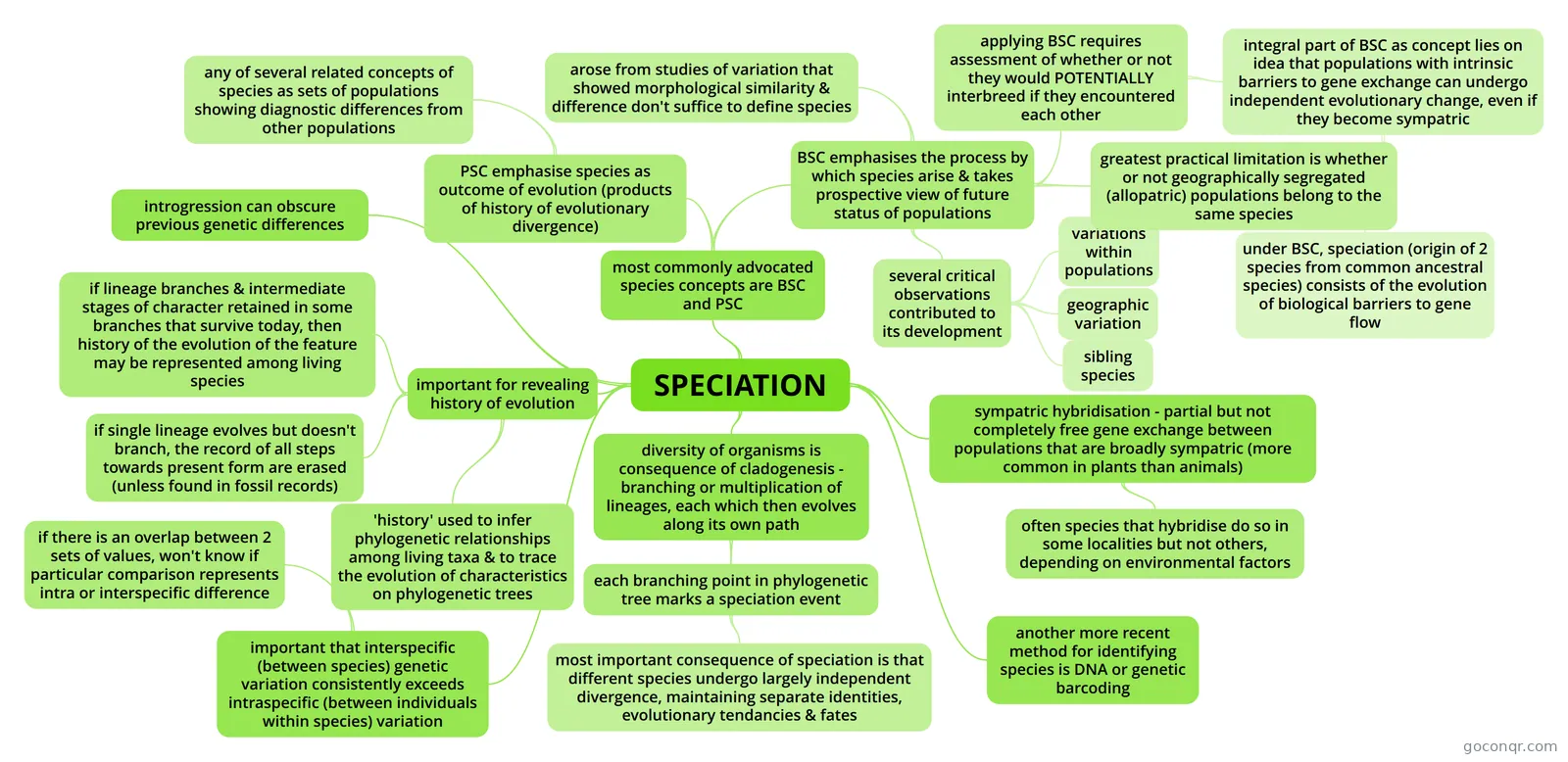
Mind map: Speciation
Contenido del mapa
SPECIATION
diversity of organisms is consequence of cladogenesis - branching or multiplication of lineages, each which then evolves along its own path
- each branching point in phylogenetic tree marks a speciation event
- most important consequence of speciation is that different species undergo largely independent divergence, maintaining separate identities, evolutionary tendancies & fates
- each branching point in phylogenetic tree marks a speciation event
important for revealing history of evolution
- if single lineage evolves but doesn't branch, the record of all steps towards present form are erased (unless found in fossil records)
- if lineage branches & intermediate stages of character retained in some branches that survive today, then history of the evolution of the feature may be represented among living species
- 'history' used to infer phylogenetic relationships among living taxa & to trace the evolution of characteristics on phylogenetic trees
most commonly advocated species concepts are BSC and PSC
- PSC emphasise species as outcome of evolution (products of history of evolutionary divergence)
- any of several related concepts of species as sets of populations showing diagnostic differences from other populations
- BSC emphasises the process by which species arise & takes prospective view of future status of populations
- arose from studies of variation that showed morphological similarity & difference don't suffice to define species
- several critical observations contributed to its development
- variations within populations
- geographic variation
- sibling species
- greatest practical limitation is whether or not geographically segregated (allopatric) populations belong to the same species
- applying BSC requires assessment of whether or not they would POTENTIALLY interbreed if they encountered each other
- integral part of BSC as concept lies on idea that populations with intrinsic barriers to gene exchange can undergo independent evolutionary change, even if they become sympatric
- under BSC, speciation (origin of 2 species from common ancestral species) consists of the evolution of biological barriers to gene flow
- integral part of BSC as concept lies on idea that populations with intrinsic barriers to gene exchange can undergo independent evolutionary change, even if they become sympatric
- PSC emphasise species as outcome of evolution (products of history of evolutionary divergence)
sympatric hybridisation - partial but not completely free gene exchange between populations that are broadly sympatric (more common in plants than animals)
- often species that hybridise do so in some localities but not others, depending on environmental factors
another more recent method for identifying species is DNA or genetic barcoding
important that interspecific (between species) genetic variation consistently exceeds intraspecific (between individuals within species) variation
- if there is an overlap between 2 sets of values, won't know if particular comparison represents intra or interspecific difference
introgression can obscure previous genetic differences
Información
- Descripción
- Mapa Mental sobre SPECIATION, creado por tomking304 el 06/09/2013.
- Creado por
- tomking304
- Visitas
- 46
- Valoración