
Mind map
Classification
Map content
Classification
Animals
- E.g. Wolf Animals are multicellular organisms that requires movement and to feed heterotropically in order to obtain food and reproduce sexually.
- Mammals
- E.g. Fox. Mammals are warm-blooded animals with a significant amount of hair on their bodies. They can be carnivorous, omnivorous, or herbivorous.
- Birds
- E.g. Red Kites Birds are warm-blooded feathered animals that are herbivorous. Most have the ability to fly, however some cannot fly at all! They are, predominantly, directly descended from prehistoric reptiles.
- Fish
- E.g. Barracuda Fish are scaly fully-aquatic animals with the ability to breathe underwater will gills. They are cold-blooded and lay eggs, and occasionally, such as in the case of a good few species of shark, let babies grow in a uterus of sorts. They are majorly carnivorous, with very few omnivorous/herbivorous species.
- Amphibians
- E.g. Frogs Amphibians are cold-blooded animals that are predominantly carnivorous. They can in some cases breath underwater through their skin. They lay their offspring in large bodies of water in order to allow for them to develop healthily.
- Reptiles
- E.g. Salamanders Reptiles are scaly cold-blooded animals that are predominantly carnivorous. They lay large, rough eggs with a leathery texture. They normally live in arid enviroments.
Plants
- E.g. Rose Plants are multicellular organisms that require to perform Photosynthesis (feed phototrophically) in order to obtain food and reproduce sexually.
Fungi
- E.g. Cordeceps Fungi are multicellular organisms that require to break down dead or dying cells in order to obtain food (feed saprophytically). They reproduce asexually.
Enter text here
Protoctista/Protists
- E.g. Seaweed Protists are unicellular organisms that can form, in the case of some species, large covalent colonies. They can reproduce sexually or asexually, using either binary fission or conjunction. They can, in quite a few cases, use photosynthesis to obtain food or by engulfing their prey with their bodies.
Prokaryotes
- E.g. Escherichia Coli Prokaryotes are unicellular organisms without nuclei, but still a fair bit of mitochondria. They can reproduce with binary fission, but most use conjunction. They obtain food by engulfing their prey and then digesting them.
Binomial system
- The Binomial system is when you take the Genus and Species name for an organism and combine them to form their Latin name. E.g. Homo is the Genus name Sapien is the Species name Homo Sapien.
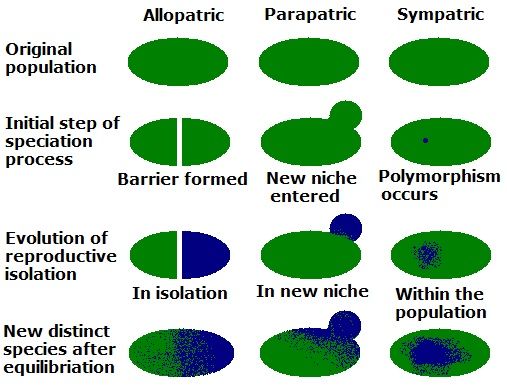
Speciation
- Speciation it when, due to allopatric, parapatric or sympatric conditions, one group of a single species gets separated. Then, at least one of the separated parties goes through a significant amount of change due to the different conditions the other half of the split group must face. Once the conditions return to whatever they were before the signifcant change occured, if it ever does revert, the two separated parties are altogether different species. In some cases, they are both different to the original species!
Images and files in the map
Information
- Description
- A mind map on speciation and classification
- Created by
- aidanmullins
- Views
- 103
- Tags
- Rating