
Mapa mental
Second Boer War
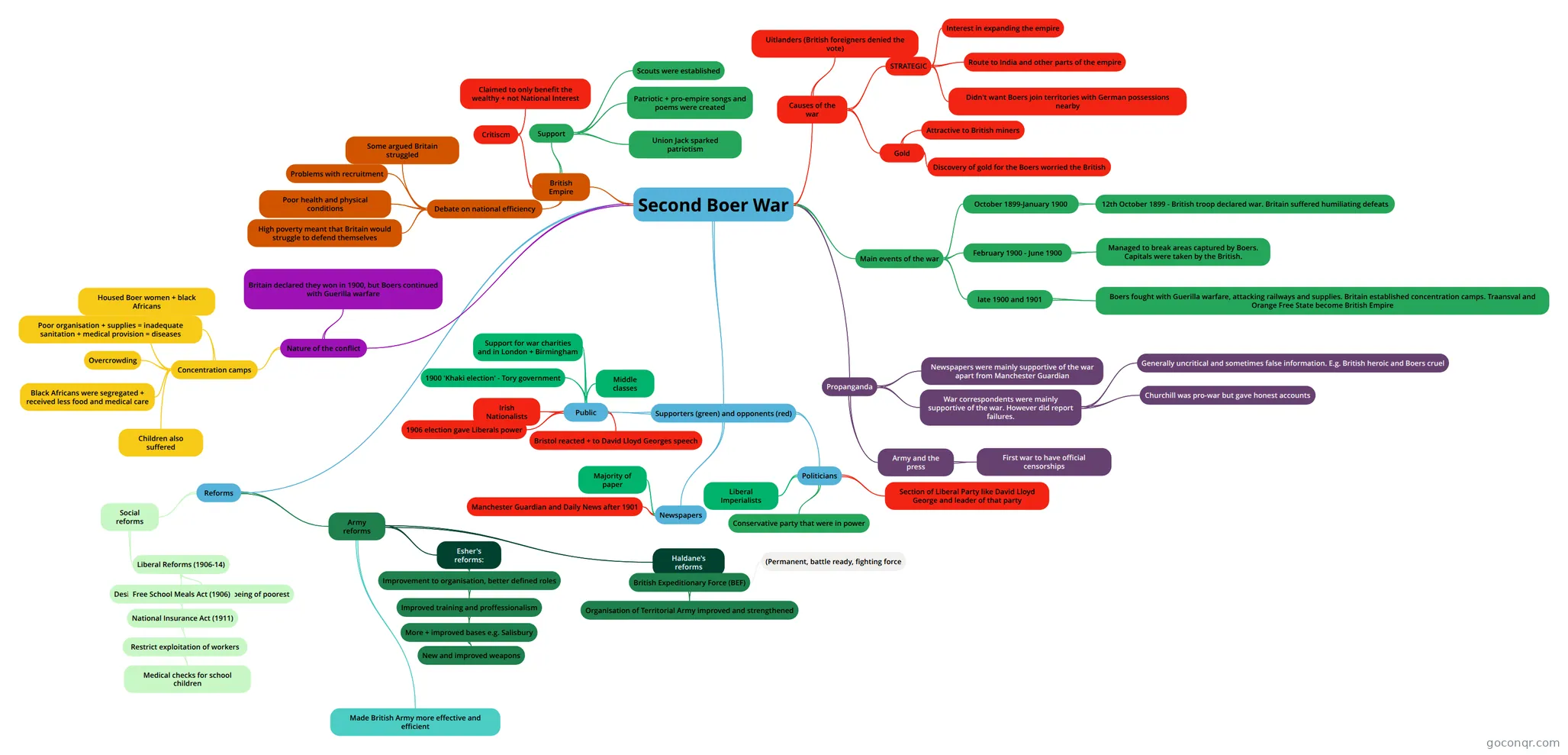
Mind map: Second Boer War
Contenido del mapa
Second Boer War
Causes of the war
- STRATEGIC
- Interest in expanding the empire
- Route to India and other parts of the empire
- Didn't want Boers join territories with German possessions nearby
- Gold
- Attractive to British miners
- Discovery of gold for the Boers worried the British
- Uitlanders (British foreigners denied the vote)
- STRATEGIC
Main events of the war
- October 1899-January 1900
- 12th October 1899 - British troop declared war. Britain suffered humiliating defeats
- February 1900 - June 1900
- Managed to break areas captured by Boers. Capitals were taken by the British.
- late 1900 and 1901
- Boers fought with Guerilla warfare, attacking railways and supplies. Britain established concentration camps. Traansval and Orange Free State become British Empire
- October 1899-January 1900
Propanganda
- Newspapers were mainly supportive of the war apart from Manchester Guardian
- War correspondents were mainly supportive of the war. However did report failures.
- Generally uncritical and sometimes false information. E.g. British heroic and Boers cruel
- Churchill was pro-war but gave honest accounts
- Army and the press
- First war to have official censorships
Supporters (green) and opponents (red)
- Politicians
- Conservative party that were in power
- Liberal Imperialists
- Section of Liberal Party like David Lloyd George and leader of that party
- Newspapers
- Majority of paper
- Manchester Guardian and Daily News after 1901
- Public
- 1900 'Khaki election' - Tory government
- Support for war charities and in London + Birmingham
- Middle classes
- Bristol reacted + to David Lloyd Georges speech
- Irish Nationalists
- 1906 election gave Liberals power
- Politicians
British Empire
- Support
- Patriotic + pro-empire songs and poems were created
- Union Jack sparked patriotism
- Scouts were established
- Critiscm
- Claimed to only benefit the wealthy + not National Interest
- Debate on national efficiency
- Some argued Britain struggled
- Problems with recruitment
- Poor health and physical conditions
- High poverty meant that Britain would struggle to defend themselves
- Support
Nature of the conflict
- Britain declared they won in 1900, but Boers continued with Guerilla warfare
- Concentration camps
- Housed Boer women + black Africans
- Poor organisation + supplies = inadequate sanitation + medical provision = diseases
- Overcrowding
- Black Africans were segregated + received less food and medical care
- Children also suffered
Reforms
- Army reforms
- Esher's reforms:
- Improvement to organisation, better defined roles
- Improved training and proffessionalism
- More + improved bases e.g. Salisbury
- New and improved weapons
- More + improved bases e.g. Salisbury
- Improved training and proffessionalism
- Improvement to organisation, better defined roles
- Haldane's reforms
- British Expeditionary Force (BEF)
- (Permanent, battle ready, fighting force
- Organisation of Territorial Army improved and strengthened
- British Expeditionary Force (BEF)
- Made British Army more effective and efficient
- Esher's reforms:
- Social reforms
- Liberal Reforms (1906-14)
- Designed to improve health + well being of poorest
- Free School Meals Act (1906)
- National Insurance Act (1911)
- Restrict exploitation of workers
- Medical checks for school children
- Restrict exploitation of workers
- National Insurance Act (1911)
- Liberal Reforms (1906-14)
- Army reforms
Información
- Descripción
- A level History Mapa Mental sobre Second Boer War, creado por 09shor1r el 27/04/2015.
- Creado por
- 09shor1r
- Visitas
- 151
- Valoración