
Mapa mental
CLIL
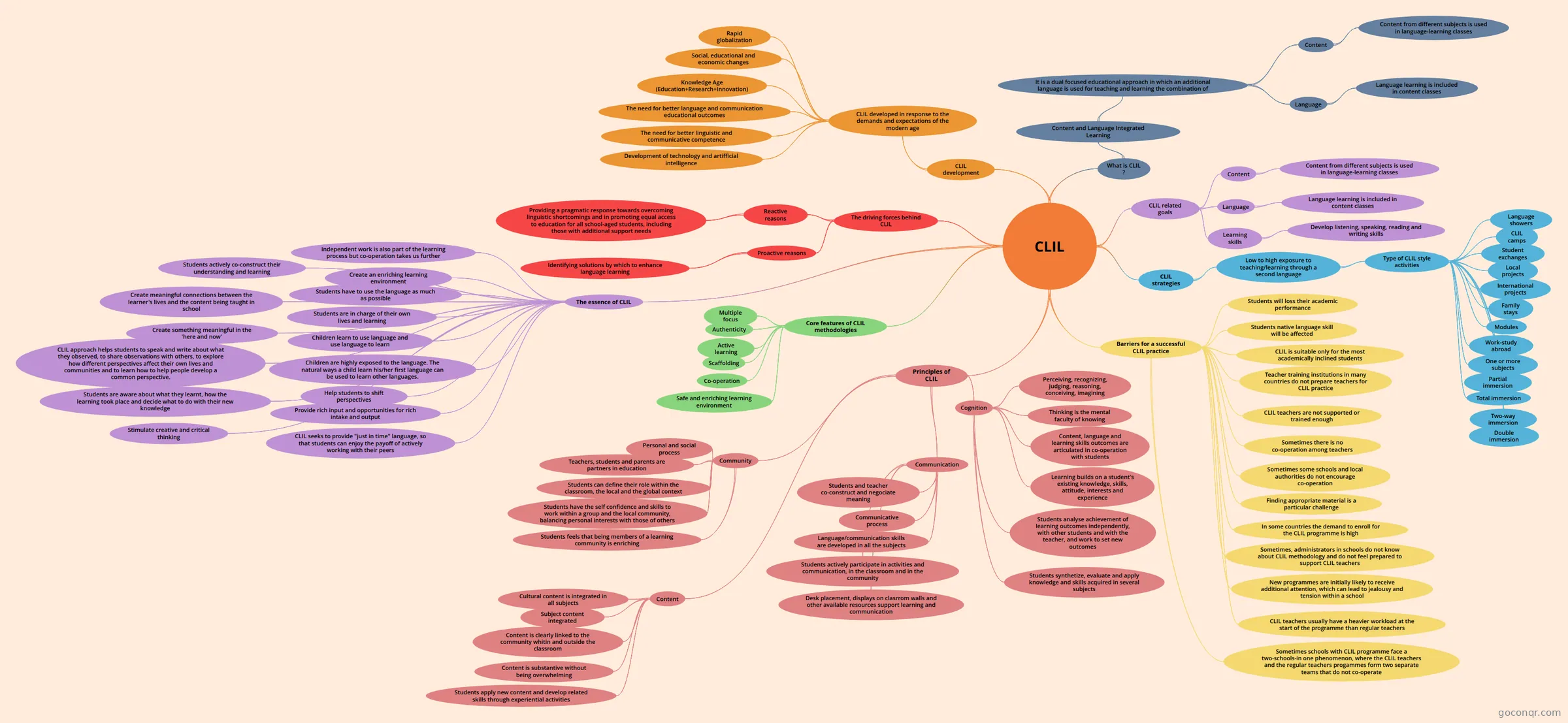
Mind map: CLIL
Contenido del mapa
CLIL
The essence of CLIL
- Independent work is also part of the learning process but co-operation takes us further
- Create an enriching learning environment
- Students are in charge of their own lives and learning
- Children are highly exposed to the language. The natural ways a child learn his/her first language can be used to learn other languages.
- Help students to shift perspectives
- Provide rich input and opportunities for rich intake and output
- Students have to use the language as much as possible
- Children learn to use language and use language to learn
- CLIL seeks to provide "just in time" language, so that students can enjoy the payoff of actively working with their peers
- Students actively co-construct their understanding and learning
- Create meaningful connections between the learner's lives and the content being taught in school
- Create something meaningful in the 'here and now'
- CLIL approach helps students to speak and write about what they observed, to share observations with others, to explore how different perspectives affect their own lives and communities and to learn how to help people develop a common perspective.
- Students are aware about what they learnt, how the learning took place and decide what to do with their new knowledge
- Stimulate creative and critical thinking
Barriers for a successful CLIL practice
- Students will loss their academic performance
- Students native language skill will be affected
- CLIL is suitable only for the most academically inclined students
- Sometimes there is no co-operation among teachers
- CLIL teachers are not supported or trained enough
- Teacher training institutions in many countries do not prepare teachers for CLIL practice
- Finding appropriate material is a particular challenge
- Sometimes some schools and local authorities do not encourage co-operation
- In some countries the demand to enroll for the CLIL programme is high
- Sometimes, administrators in schools do not know about CLIL methodology and do not feel prepared to support CLIL teachers
- New programmes are initially likely to receive additional attention, which can lead to jealousy and tension within a school
- CLIL teachers usually have a heavier workload at the start of the programme than regular teachers
- Sometimes schools with CLIL programme face a two-schools-in one phenomenon, where the CLIL teachers and the regular teachers progammes form two separate teams that do not co-operate
CLIL related goals
- Content
- Content from different subjects is used in language-learning classes
- Language
- Language learning is included in content classes
- Learning skills
- Develop listening, speaking, reading and writing skills
- Content
What is CLIL ?
- Content and Language Integrated Learning
- It is a dual focused educational approach in which an additional language is used for teaching and learning the combination of
- Content
- Content from different subjects is used in language-learning classes
- Language
- Language learning is included in content classes
- Content
- It is a dual focused educational approach in which an additional language is used for teaching and learning the combination of
- Content and Language Integrated Learning
CLIL development
- CLIL developed in response to the demands and expectations of the modern age
- Rapid globalization
- Social, educational and economic changes
- Knowledge Age (Education+Research+Innovation)
- The need for better language and communication educational outcomes
- The need for better linguistic and communicative competence
- Development of technology and artifficial intelligence
- CLIL developed in response to the demands and expectations of the modern age
Principles of CLIL
- Community
- Personal and social process
- Teachers, students and parents are partners in education
- Students can define their role within the classroom, the local and the global context
- Students have the self confidence and skills to work within a group and the local community, balancing personal interests with those of others
- Students feels that being members of a learning community is enriching
- Content
- Cultural content is integrated in all subjects
- Subject content integrated
- Content is clearly linked to the community whitin and outside the classroom
- Students apply new content and develop related skills through experiential activities
- Content is substantive without being overwhelming
- Cognition
- Perceiving, recognizing, judging, reasoning, conceiving, imagining
- Thinking is the mental faculty of knowing
- Learning builds on a student's existing knowledge, skills, attitude, interests and experience
- Students analyse achievement of learning outcomes independently, with other students and with the teacher, and work to set new outcomes
- Content, language and learning skills outcomes are articulated in co-operation with students
- Students synthetize, evaluate and apply knowledge and skills acquired in several subjects
- Communication
- Communicative process
- Students actively participate in activities and communication, in the classroom and in the community
- Desk placement, displays on clasrrom walls and other available resources support learning and communication
- Language/communication skills are developed in all the subjects
- Students and teacher co-construct and negociate meaning
- Community
CLIL strategies
- Low to high exposure to teaching/learning through a second language
- Type of CLIL style activities
- Language showers
- CLIL camps
- Student exchanges
- Local projects
- International projects
- Family stays
- Modules
- Work-study abroad
- One or more subjects
- Partial immersion
- Total immersion
- Two-way immersion
- Double immersion
- Type of CLIL style activities
- Low to high exposure to teaching/learning through a second language
The driving forces behind CLIL
- Reactive reasons
- Providing a pragmatic response towards overcoming linguistic shortcomings and in promoting equal access to education for all school-aged students, including those with additional support needs
- Proactive reasons
- Identifying solutions by which to enhance language learning
- Reactive reasons
Core features of CLIL methodologies
- Multiple focus
- Authenticity
- Active learning
- Scaffolding
- Co-operation
- Safe and enriching learning environment
Información
- Descripción
- Mapa Mental sobre CLIL, creado por Rosario Iborra el 26/09/2020.
- Creado por
- Rosario Iborra
- Visitas
- 4
- Valoración
Más sobre Content-Based Instruction and CLIL