
Mapa mental
Positivism
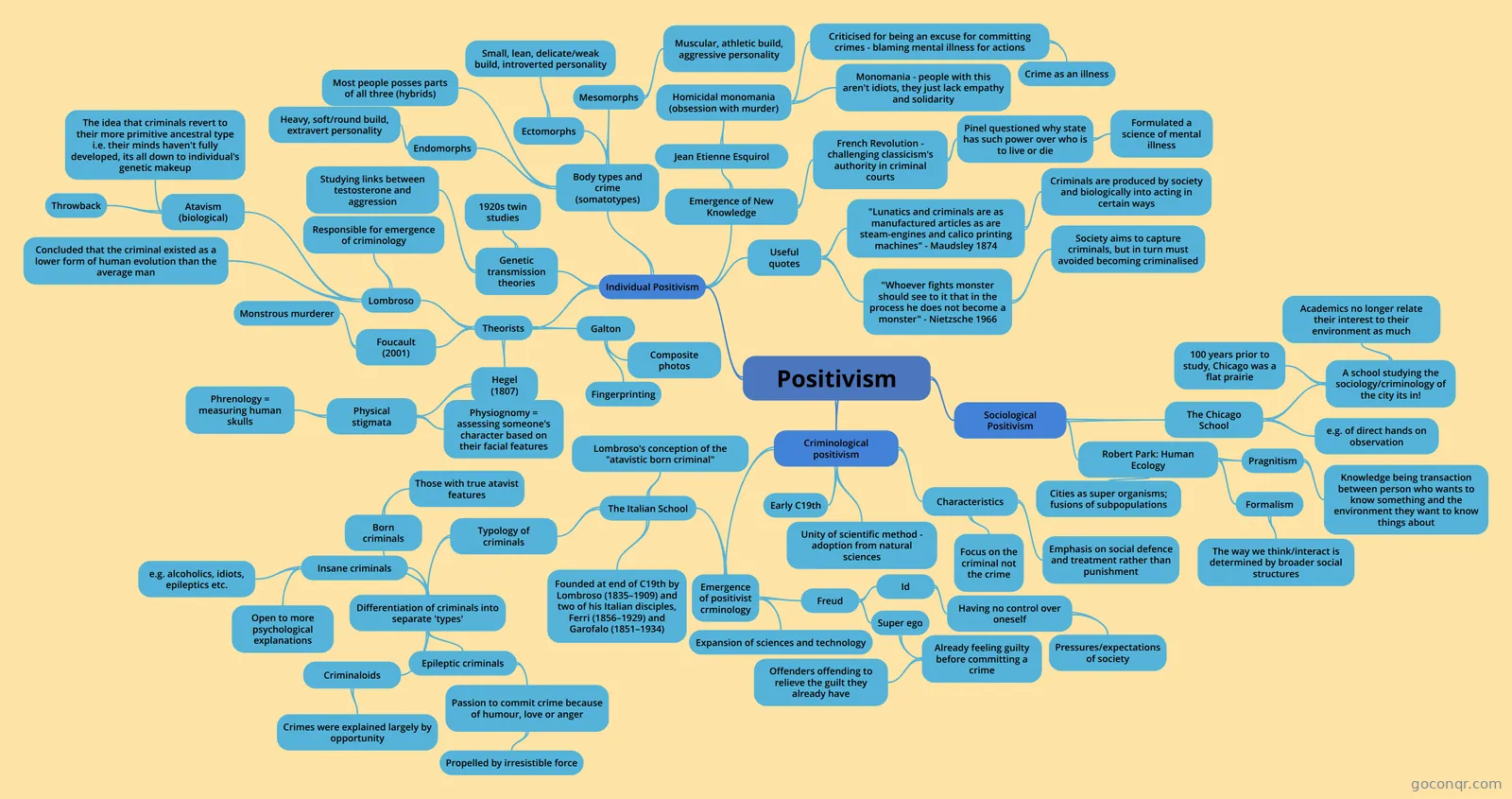
Mind map: Positivism criminology
Contenido del mapa
Positivism
Individual Positivism
- Emergence of New Knowledge
- Jean Etienne Esquirol
- Homicidal monomania (obsession with murder)
- Monomania - people with this aren't idiots, they just lack empathy and solidarity
- Criticised for being an excuse for committing crimes - blaming mental illness for actions
- Crime as an illness
- Homicidal monomania (obsession with murder)
- French Revolution - challenging classicism's authority in criminal courts
- Pinel questioned why state has such power over who is to live or die
- Formulated a science of mental illness
- Pinel questioned why state has such power over who is to live or die
- Jean Etienne Esquirol
- Theorists
- Lombroso
- Responsible for emergence of criminology
- Atavism (biological)
- The idea that criminals revert to their more primitive ancestral type i.e. their minds haven't fully developed, its all down to individual's genetic makeup
- Throwback
- Concluded that the criminal existed as a lower form of human evolution than the average man
- Galton
- Fingerprinting
- Composite photos
- Hegel (1807)
- Physical stigmata
- Physiognomy = assessing someone's character based on their facial features
- Phrenology = measuring human skulls
- Physical stigmata
- Foucault (2001)
- Monstrous murderer
- Lombroso
- Body types and crime (somatotypes)
- Endomorphs
- Heavy, soft/round build, extravert personality
- Mesomorphs
- Muscular, athletic build, aggressive personality
- Ectomorphs
- Small, lean, delicate/weak build, introverted personality
- Most people posses parts of all three (hybrids)
- Endomorphs
- Genetic transmission theories
- 1920s twin studies
- Studying links between testosterone and aggression
- Useful quotes
- "Lunatics and criminals are as manufactured articles as are steam-engines and calico printing machines" - Maudsley 1874
- Criminals are produced by society and biologically into acting in certain ways
- "Whoever fights monster should see to it that in the process he does not become a monster" - Nietzsche 1966
- Society aims to capture criminals, but in turn must avoided becoming criminalised
- "Lunatics and criminals are as manufactured articles as are steam-engines and calico printing machines" - Maudsley 1874
- Emergence of New Knowledge
Sociological Positivism
- The Chicago School
- e.g. of direct hands on observation
- A school studying the sociology/criminology of the city its in!
- 100 years prior to study, Chicago was a flat prairie
- Academics no longer relate their interest to their environment as much
- Robert Park: Human Ecology
- Pragnitism
- Knowledge being transaction between person who wants to know something and the environment they want to know things about
- Formalism
- The way we think/interact is determined by broader social structures
- Cities as super organisms; fusions of subpopulations
- Pragnitism
- The Chicago School
Criminological positivism
- Early C19th
- Unity of scientific method - adoption from natural sciences
- Characteristics
- Focus on the criminal not the crime
- Emphasis on social defence and treatment rather than punishment
- Emergence of positivist crminology
- Expansion of sciences and technology
- Freud
- Id
- Having no control over oneself
- Pressures/expectations of society
- Having no control over oneself
- Super ego
- Already feeling guilty before committing a crime
- Offenders offending to relieve the guilt they already have
- Already feeling guilty before committing a crime
- Id
- The Italian School
- Founded at end of C19th by Lombroso (1835–1909) and two of his Italian disciples, Ferri (1856–1929) and Garofalo (1851–1934)
- Lombroso's conception of the "atavistic born criminal"
- Typology of criminals
- Differentiation of criminals into separate 'types'
- Born criminals
- Those with true atavist features
- Insane criminals
- e.g. alcoholics, idiots, epileptics etc.
- Open to more psychological explanations
- Criminaloids
- Crimes were explained largely by opportunity
- Epileptic criminals
- Passion to commit crime because of humour, love or anger
- Propelled by irresistible force
- Passion to commit crime because of humour, love or anger
- Born criminals
- Differentiation of criminals into separate 'types'
Información
- Descripción
- Undergraduate (Crime and Criminal Justice) Sociology Mapa Mental sobre Positivism, creado por Grace Feakes el 30/04/2015.
- Creado por
- Grace Feakes
- Visitas
- 347
- Etiquetas
- Valoración