
Mapa mental
Police Powers
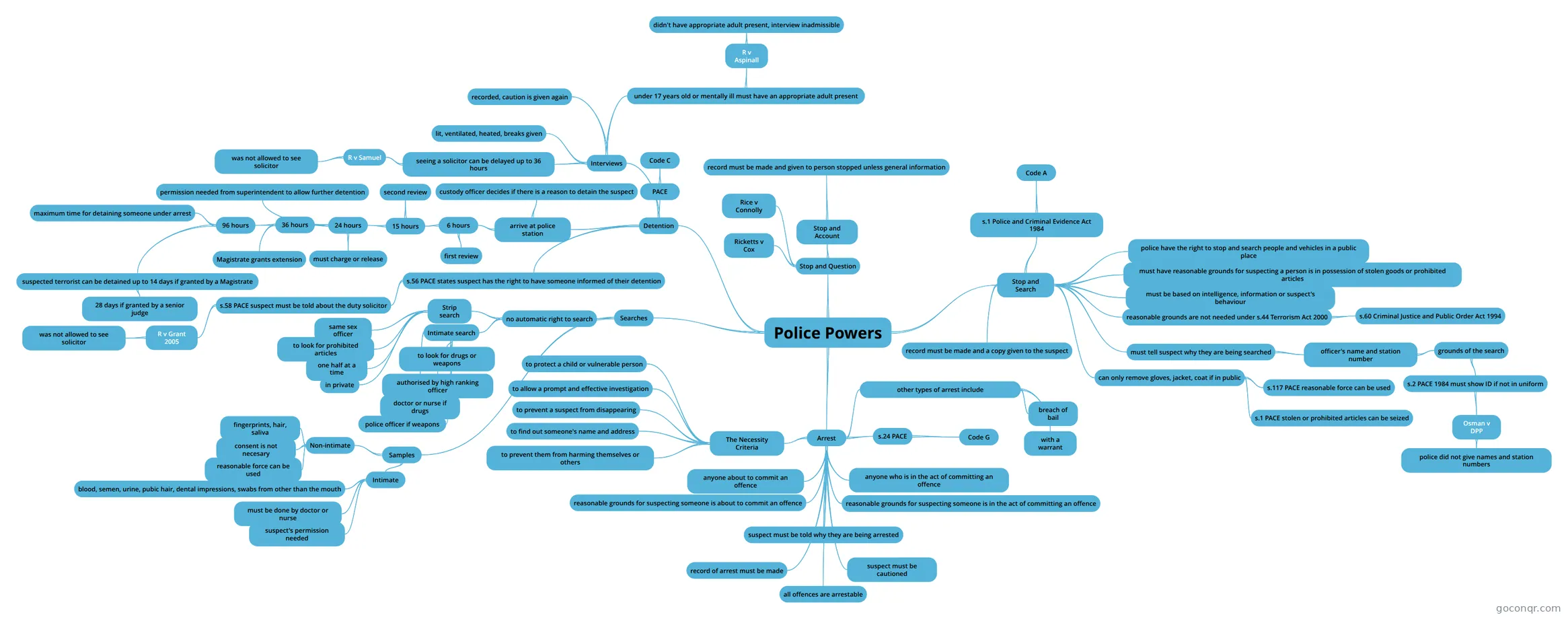
Mind map: Police powers
Contenido del mapa
Police Powers
Stop and Question
- Stop and Account
- record must be made and given to person stopped unless general information
- Rice v Connolly
- Ricketts v Cox
- Stop and Account
Stop and Search
- s.1 Police and Criminal Evidence Act 1984
- Code A
- police have the right to stop and search people and vehicles in a public place
- must have reasonable grounds for suspecting a person is in possession of stolen goods or prohibited articles
- reasonable grounds are not needed under s.44 Terrorism Act 2000
- s.60 Criminal Justice and Public Order Act 1994
- must be based on intelligence, information or suspect's behaviour
- must tell suspect why they are being searched
- officer's name and station number
- grounds of the search
- s.2 PACE 1984 must show ID if not in uniform
- Osman v DPP
- police did not give names and station numbers
- Osman v DPP
- s.2 PACE 1984 must show ID if not in uniform
- grounds of the search
- officer's name and station number
- can only remove gloves, jacket, coat if in public
- s.117 PACE reasonable force can be used
- s.1 PACE stolen or prohibited articles can be seized
- record must be made and a copy given to the suspect
- s.1 Police and Criminal Evidence Act 1984
Arrest
- s.24 PACE
- Code G
- anyone about to commit an offence
- anyone who is in the act of committing an offence
- reasonable grounds for suspecting someone is in the act of committing an offence
- reasonable grounds for suspecting someone is about to commit an offence
- The Necessity Criteria
- to prevent a suspect from disappearing
- to find out someone's name and address
- to prevent them from harming themselves or others
- to protect a child or vulnerable person
- to allow a prompt and effective investigation
- suspect must be told why they are being arrested
- suspect must be cautioned
- record of arrest must be made
- other types of arrest include
- with a warrant
- breach of bail
- all offences are arrestable
- s.24 PACE
Detention
- PACE
- Code C
- arrive at police station
- custody officer decides if there is a reason to detain the suspect
- 6 hours
- first review
- 15 hours
- second review
- 24 hours
- must charge or release
- permission needed from superintendent to allow further detention
- 36 hours
- Magistrate grants extension
- 96 hours
- maximum time for detaining someone under arrest
- suspected terrorist can be detained up to 14 days if granted by a Magistrate
- 28 days if granted by a senior judge
- s.56 PACE states suspect has the right to have someone informed of their detention
- s.58 PACE suspect must be told about the duty solicitor
- R v Grant 2005
- was not allowed to see solicitor
- R v Grant 2005
- s.58 PACE suspect must be told about the duty solicitor
- Interviews
- recorded, caution is given again
- lit, ventilated, heated, breaks given
- seeing a solicitor can be delayed up to 36 hours
- R v Samuel
- was not allowed to see solicitor
- R v Samuel
- under 17 years old or mentally ill must have an appropriate adult present
- R v Aspinall
- didn't have appropriate adult present, interview inadmissible
- R v Aspinall
- PACE
Searches
- no automatic right to search
- Strip search
- in private
- same sex officer
- one half at a time
- to look for prohibited articles
- Intimate search
- to look for drugs or weapons
- doctor or nurse if drugs
- police officer if weapons
- authorised by high ranking officer
- Strip search
- Samples
- Non-intimate
- fingerprints, hair, saliva
- consent is not necesary
- reasonable force can be used
- Intimate
- blood, semen, urine, pubic hair, dental impressions, swabs from other than the mouth
- must be done by doctor or nurse
- suspect's permission needed
- Non-intimate
- no automatic right to search
Información
- Descripción
- AS level Law Mapa Mental sobre Police Powers, creado por ellenrose5 el 02/05/2015.
- Creado por
- ellenrose5
- Visitas
- 2
- Valoración