
Mapa mental
Health
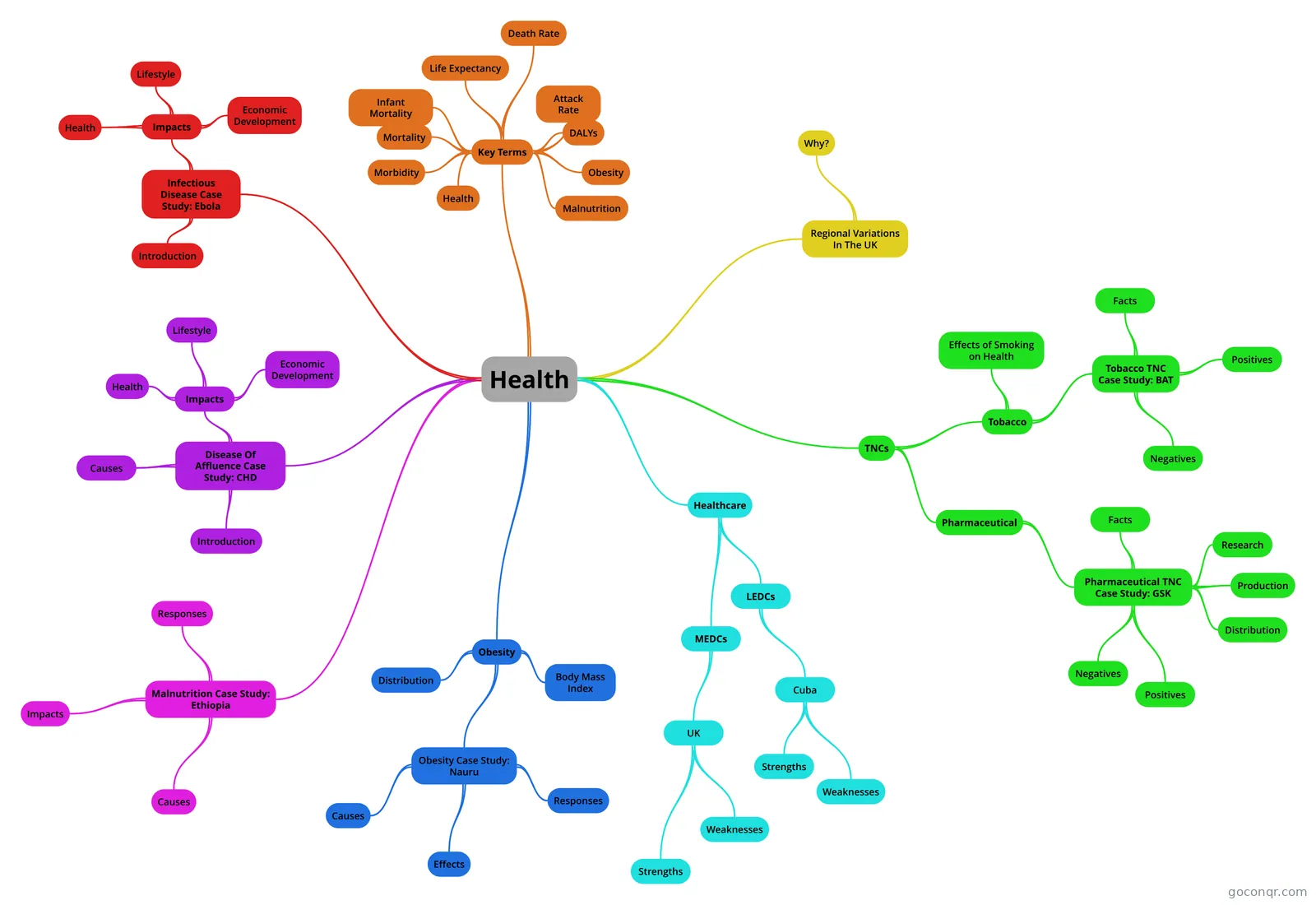
Mind map: health geography
Contenido del mapa
Health
Key Terms
- Morbidity
- Illness or any diseased state
- Mortality
- Deaths
- Infant Mortality
- The number of deaths of children before the age of 1 per 1000 population
- Life Expectancy
- The average period that a person may expect to live
- Death Rate
- The number of deaths per 1000 people each year
- DALYs
- Disability Adjusted Life Years - the number of years lost because of premature death or disability
- Attack Rate
- The number of cases of diseases diagnosed in an area, divided by the total population, over the period of an epidemic
- Health
- A state of complete physical, mental and social well-being and not merely the absence of diseases and infirmity
- Obesity
- Having abnormal or excessive amounts of fat accumulates that may impair health
- Malnutrition
- A lack of the right amount of nutrients that the body requires
- Morbidity
Infectious Disease Case Study: Ebola
- Introduction
- - Ebola is a communicable disease (contagious) - The first Ebola outbreak took place in 1976, near the Ebola River, Democratic Republic of Congo - Originated in fruit bats - The three main countries impacted are Guinea, Liberia and Sierra Leone - The disease is spread through animal and human contact through the mouth, nose, open skin, bodily fluids, blood, vomit, urine, faeces and semen and also through contaminated surfaces such as walls and beds. - Ebola has become such a bad issue because the countries impacted by the disease have recently emerged from long periods of conflict and instability
- Impacts
- Health
- - By 18th Jan 2015, death toll had reached 8,641: 3,605 deaths in Liberia, 3,145 deaths in Sierra Leone, 1,876 deaths in Guinea and 8 deaths in Nigeria - Initial symptoms involve typical fevers, severe headaches, joint and muscle pains and aches, chills and weakness. Over time symptoms deteriorate and include effects such as nausea and vomiting, potentially bloody diarrhoea, red eyes, raised rash, coughs, chest and stomach pains, bruising, external bleeding from eyes, internal bleeding and death.
- Lifestyle
- - Caused parents to either die or abandon their children resulting in over 500 orphans that have to fend for themselves. Some of these orphans were sent to live with other families away from the affected areas, however most refused to take new children - 60% of deaths from Ebola have been women, 75% in Liberia. Women are the primary caregivers in Sierra Leone's patriarchal society. With more women being impacted than men, there aren't as many homes for orphaned children to live - Due to border closures to prevent the disease from spreading, people can not visit their friends and family living in other areas
- Economic Development
- - The damage caused by Ebola in the affected areas could cost as much as £20billion - Many foods and other products cannot be imported due to border closures - Fear of contamination is keeping tourists away from affected and surrounding areas, even those such as Ghana who haven't been effected by the disease are losing business from lack of tourists. Busiest hotel in Ghana seeing a 20% increase in room vacancies - Food prices are increasing, due to panic buying and shortages -Agriculture accounts for 57% of Sierra Leone's, 39% of Liberia's and 22% of Guinea's GDP which has been affected due to disruption by the outbreak during the planting seasons in early 2014 -!4% of Liberia's and 17% of Sierra Leone's economy is fuelled by mining which is decreasing due to restrictions on non-essential personal travel
- Health
- Introduction
Disease Of Affluence Case Study: CHD
- Introduction
- - Approximately 1 in 5 men and 1 in 8 women die from heart disease - In the UK, 82,000 people die every year from heart disease - More than 2.7 million people with heart disease in the UK - Heart attacks cause 124,000 deaths per year in the UK alone
- Causes
- - CHD refers to blockage of the hearts blood supply or interruption due to a build up of fatty, unhealthy substances in the coronary arteries - Unhealthy lifestyle habits and various conditions such as excessive smoking, high blood pressure, high cholesterol and diabetes can lead to to CHD
- Impacts
- Health
- - Swelling of the feet, ankles, legs and abdomen. Those with the condition may also experience pain in their chest, shoulders, arms or neck - If an artery becomes completely blocked, cells, tissues and organs cannot receive adequate amounts of nutrients and oxygen in the blood in order to help survive, causing cells and tissues to die (necrosis). When this process takes place in the coronary arteries, a section of the heart dies potentially leading to heart attacks - Patients may suffer from psychological effects as a result of heart attacks and near death experiences, leading to potential anxiety or depression. These effects increase the likely hood of having a heart attack - Patients may develop irregular heartbeat patterns, indicating that the body is not receiving enough blood
- Lifestyle
- - Those with the condition must undertake dramatic life changes. This can involve regular physical exercise, Cutting down on smoking and drinking alcohol, eating healthily, and maintaining a well balanced diet - Medication will be prescribed to help reduce the impacts of the condition - Regular visits to the doctor will be necessary to measure the patients blood sugar and cholesterol levels and overall blood pressure - If patient is suffering from psychological effects, regular visits with therapists will help calm these effects
- Economic Development
- - £32billion pounds are spent each year on heart disease in the UK alone - Over a fifth of all healthcare expenditures of the NHS went towards heart disease in 2004, this was a total of roughly £16billion - In 2004, as a result of 69 million work days being lost due to the disease, resulted in a cost of approximately £3billion - The total annual cost of all coronary heart disease related burdens was £7.06billion
- Health
- Introduction
Healthcare
- MEDCs
- UK
- NHS - state supported - states role in health care is central and direct - facilities mainly publicly owned
- Strengths
- - Provides high quality health care - Free of charge for most UK residents - Strictly paid for by taxes; every tax payer makes the same contribution- Under constant observation to ensure that the system runs smoothly
- Weaknesses
- - Hundreds of thousands of patients visit their GP each day, requiring individual attention, causing high demand - Resources used are often strained, therefore if someone is looking for an operation, they may have to wait
- UK
- LEDCs
- Cuba
- Socialised - state provided public service - facilities are wholly publicly owned - states role in healthcare is total
- Strengths
- Weaknesses
- Cuba
- MEDCs
TNCs
- Pharmaceutical
- Pharmaceutical TNC Case Study: GSK
- Positives
- - Provided 206 million tablets at special prices to poorer countries, including 120 million of these generically made - Tackling HIV/AIDS and TB - Top selling drug at $7billion is Advair used for asthma and chronic obstructive pulmonary disorder treatment
- Negatives
- Facts
- - 4th largest pharmaceutical company in 2013 with sales of $45.83billion - UK based
- Research
- Responsible for finding drugs that act as cures/offset symptoms of diseases. Most research is into diseases of affluence, such as CHD and cancer
- Production
- Drugs are manufactured either by major companies directly which are more expensive or by copied versions which perform the same function but are cheaper
- Distribution
- Many companies target doctors when selling their drugs rather than patients directly
- Positives
- Pharmaceutical TNC Case Study: GSK
- Tobacco
- Tobacco TNC Case Study: BAT
- Positives
- - A landmark restoration project is being developed which will benefit the whole rural community. - In 2007, the partnership developed a tool to identify, assess and address risks posed by BAT's leaf growing operations
- Negatives
- - Tobacco leaf farming causing deforestation and decline in water supply - In 2014, nine month revenues had fallen 9.6% - Total number of cigarettes fell by 1%, which increased taxes intended to discourage smoking hitting demand
- Facts
- - Main brands: Dunhill and Kent - Profits: £4billion in 2009 - Cigarette factories in 44 countries
- Positives
- Effects of Smoking on Health
- - Greater cause of death than any single disease - 5 times more likely to have a heart attack - Increased risk of stroke - Men are 22 times more likely to get lung cancer
- Tobacco TNC Case Study: BAT
- Pharmaceutical
Regional Variations In The UK
- Why?
- A greater abundance of fast food chains Processed food is becoming more common because it is easy and cheap to package and produce The elderly are cumulating in various areas which puts a stress on the local health care system People of different ages and sexes have different views on exercise Different ethnicity has an impact on the food you eat, affecting ones diet Urban and rural split. Greater pollution in urban access, reduced access to supermarkets in rural areas encourage healthier eating and crowing your own food Ratio of doctors to the local population. Depending on where you live has an impact on the health care you get Local facilities such as leisure centres and gyms Areas of hot, sunny weather can increase rates of skin cancer, likewise areas of colder weather can lead to an increase in common influenza The amount of money that you have can have an impact on the quality of food you are able to buy
- Why?
Obesity
- Distribution
- - Levels of obesity at <10.0 are generally LEDCs or countries with heavy primary industry and agriculture, such as Afghanistan, Pakistan and China - Levels of obesity at >30.0 are generally MEDCs or countries with heavy tertiary industry, such as USA, Mexico and Saudi Arabia
- Body Mass Index
- Body Mass Index (BMI) is a simple measure of whether someone is a healthy weight for their hight. BMI = weight (kg) divided by height squared (m) - overweight = BMI of 25 or over - obese = BMI of 30 or over
- Obesity Case Study: Nauru
- Causes
- - The increasing use of modern technology and the shift from agriculture based occupations to civil servant office work has resulted in a sharp decrease in the day-to-day physical activity of many islanders - With the introduction of a modern way of life, the islanders have traded their canoes for motorised boats and have become accustomed to using cars rather than walking. - Culturally, large physical size is considered a mark of beauty and social status in many Pacific Island countries, making it difficult for these populations to recognise that they have a health problem
- Effects
- - Rates of overweight and obese persons have been reported to be as high as 75% - Purchasing imported food has become a social status in the community and traditional foods have decreased in importance - The island of Nauru has the highest levels of obesity. The island is only 8.5 sq. miles, making it the world’s smallest republic - Many Pacific islanders have come to depend upon food imported from abroad which is more energy dense and higher in fat
- Responses
- - The WHO states that obesity must be addressed through public health policies that promote the availability and accessibility of a variety of healthier foods and places and opportunities for physical activity - The WHO believe that comprehensive and effective clinical programmes and education are essential in tackling the problem - A movement to substitute local foods for imports is needed. To not only benefit the health of people, but also the economy
- Causes
- Distribution
Malnutrition Case Study: Ethiopia
- Causes
- - Drought due to lack of rainfall and water in general led to failure in crops and farming for several years. Soil and groundwater sources declined and were unable to meet the needs to grow crops. - Desertification, caused due to a lack of agricultural land. Also due to large total population increase; demand for food and land to grow crops is high. Overgrazing is also a cause of desertification. - Increase in population due to lack of contraception and family planning, greater demand for food. Parents having 8-10 children, in hope that just two would survive; Ethiopian population now 80million.
- Impacts
- - 8million people left starving - Hundreds of thousands of people were claimed to have died - Lack of nutrients causes the immune system to function inadequately, increasing chance for disease such as AIDS/HIV - Harvesting began to fail and the total income that people were earning was reducing because of this. Food prices then increased due to high demand. - People become increasingly dependant on food aid, with 5.8million people relying solely on charities to keep them feed - Farmers caught in never ending cycle of debt, unable to grow crops, cattle dying.
- Responses
- - Better health care - Systems were improved to ensure food gets distributed evenly - Projects set up to make water more accessible, e.g. wells - Temporary food distributions, such as Oxfam - Live Aid and Band Aid raised money, however not all of it was allocated correctly - 600,000 people were relocated from the north to the south in order to move them out of areas of famine
- Causes
Información
- Descripción
- Mapa Mental sobre Health, creado por anthonygt98 el 04/05/2015.
- Creado por
- anthonygt98
- Visitas
- 4
- Valoración