
Mapa mental
Linguistics
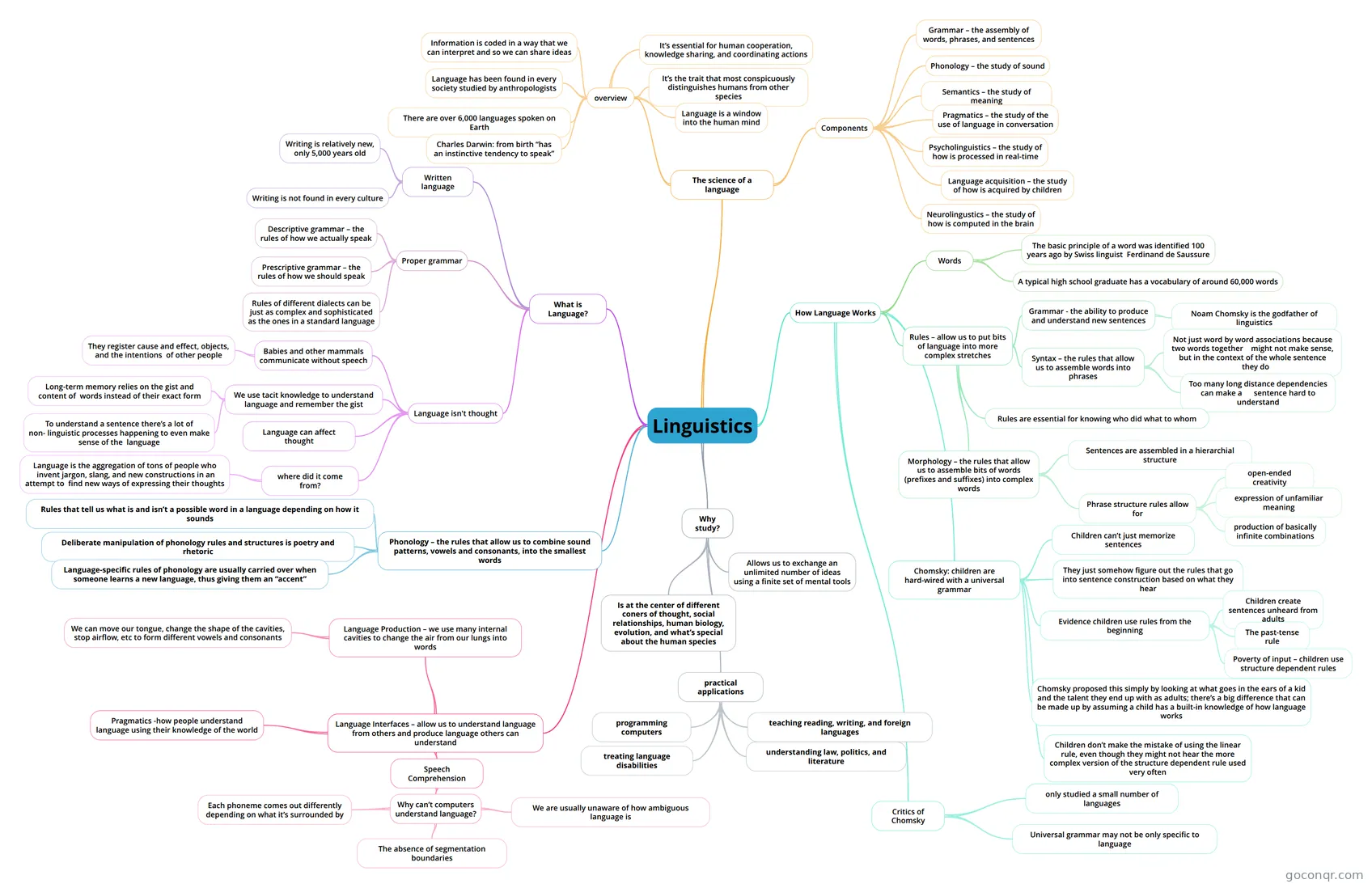
Mind map: Linguistics
Contenido del mapa
Linguistics
The science of a language
- overview
- Information is coded in a way that we can interpret and so we can share ideas
- It’s essential for human cooperation, knowledge sharing, and coordinating actions
- It’s the trait that most conspicuously distinguishes humans from other species
- Language is a window into the human mind
- Language has been found in every society studied by anthropologists
- There are over 6,000 languages spoken on Earth
- Charles Darwin: from birth “has an instinctive tendency to speak”
- Components
- Grammar – the assembly of words, phrases, and sentences
- Phonology – the study of sound
- Semantics – the study of meaning
- Pragmatics – the study of the use of language in conversation
- Psycholinguistics – the study of how is processed in real-time
- Language acquisition – the study of how is acquired by children
- Neurolingustics – the study of how is computed in the brain
- overview
What is Language?
- Written language
- Writing is not found in every culture
- Writing is relatively new, only 5,000 years old
- Proper grammar
- Descriptive grammar – the rules of how we actually speak
- Prescriptive grammar – the rules of how we should speak
- Rules of different dialects can be just as complex and sophisticated as the ones in a standard language
- Language isn't thought
- Babies and other mammals communicate without speech
- They register cause and effect, objects, and the intentions of other people
- where did it come from?
- Language is the aggregation of tons of people who invent jargon, slang, and new constructions in an attempt to find new ways of expressing their thoughts
- Language can affect thought
- We use tacit knowledge to understand language and remember the gist
- Long-term memory relies on the gist and content of words instead of their exact form
- To understand a sentence there’s a lot of non- linguistic processes happening to even make sense of the language
- Babies and other mammals communicate without speech
- Written language
How Language Works
- Words
- The basic principle of a word was identified 100 years ago by Swiss linguist Ferdinand de Saussure
- A typical high school graduate has a vocabulary of around 60,000 words
- Rules – allow us to put bits of language into more complex stretches
- Grammar - the ability to produce and understand new sentences
- Noam Chomsky is the godfather of linguistics
- Syntax – the rules that allow us to assemble words into phrases
- Not just word by word associations because two words together might not make sense, but in the context of the whole sentence they do
- Too many long distance dependencies can make a sentence hard to understand
- Morphology – the rules that allow us to assemble bits of words (prefixes and suffixes) into complex words
- Sentences are assembled in a hierarchial structure
- Phrase structure rules allow for
- open-ended creativity
- expression of unfamiliar meaning
- production of basically infinite combinations
- Rules are essential for knowing who did what to whom
- Grammar - the ability to produce and understand new sentences
- Chomsky: children are hard-wired with a universal grammar
- Children can’t just memorize sentences
- They just somehow figure out the rules that go into sentence construction based on what they hear
- Evidence children use rules from the beginning
- Children create sentences unheard from adults
- The past-tense rule
- Poverty of input – children use structure dependent rules
- Chomsky proposed this simply by looking at what goes in the ears of a kid and the talent they end up with as adults; there’s a big difference that can be made up by assuming a child has a built-in knowledge of how language works
- Children don’t make the mistake of using the linear rule, even though they might not hear the more complex version of the structure dependent rule used very often
- Critics of Chomsky
- only studied a small number of languages
- Universal grammar may not be only specific to language
- Words
Phonology – the rules that allow us to combine sound patterns, vowels and consonants, into the smallest words
- Rules that tell us what is and isn’t a possible word in a language depending on how it sounds
- Deliberate manipulation of phonology rules and structures is poetry and rhetoric
- Language-specific rules of phonology are usually carried over when someone learns a new language, thus giving them an “accent”
Language Interfaces – allow us to understand language from others and produce language others can understand
- Language Production – we use many internal cavities to change the air from our lungs into words
- We can move our tongue, change the shape of the cavities, stop airflow, etc to form different vowels and consonants
- Speech Comprehension
- Why can’t computers understand language?
- Each phoneme comes out differently depending on what it’s surrounded by
- The absence of segmentation boundaries
- We are usually unaware of how ambiguous language is
- Why can’t computers understand language?
- Pragmatics -how people understand language using their knowledge of the world
- Language Production – we use many internal cavities to change the air from our lungs into words
Why study?
- Allows us to exchange an unlimited number of ideas using a finite set of mental tools
- Is at the center of different coners of thought, social relationships, human biology, evolution, and what’s special about the human species
- practical applications
- programming computers
- treating language disabilities
- teaching reading, writing, and foreign languages
- understanding law, politics, and literature
Información
- Descripción
- Mapa Mental sobre Linguistics, creado por maitita_19 el 12/05/2015.
- Creado por
- maitita_19
- Visitas
- 0
- Valoración
Más sobre Nature and Properties of Language