
Mapa mental
Solid State & Flash Memory
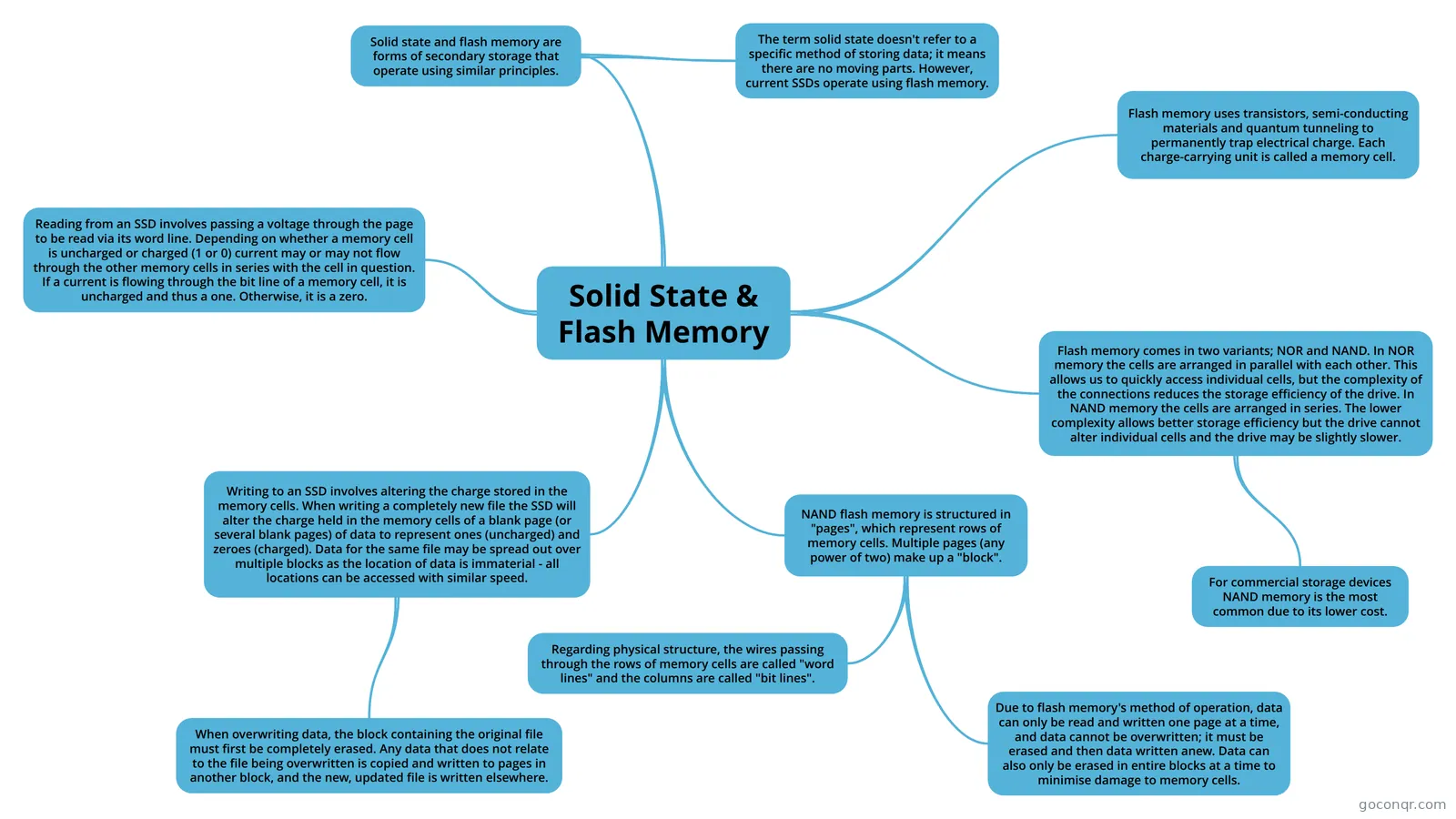
Mind map: Solid state and flash memory
Contenido del mapa
Solid State & Flash Memory
Solid state and flash memory are forms of secondary storage that operate using similar principles.
- The term solid state doesn't refer to a specific method of storing data; it means there are no moving parts. However, current SSDs operate using flash memory.
Flash memory uses transistors, semi-conducting materials and quantum tunneling to permanently trap electrical charge. Each charge-carrying unit is called a memory cell.
Flash memory comes in two variants; NOR and NAND. In NOR memory the cells are arranged in parallel with each other. This allows us to quickly access individual cells, but the complexity of the connections reduces the storage efficiency of the drive. In NAND memory the cells are arranged in series. The lower complexity allows better storage efficiency but the drive cannot alter individual cells and the drive may be slightly slower.
- For commercial storage devices NAND memory is the most common due to its lower cost.
NAND flash memory is structured in "pages", which represent rows of memory cells. Multiple pages (any power of two) make up a "block".
- Due to flash memory's method of operation, data can only be read and written one page at a time, and data cannot be overwritten; it must be erased and then data written anew. Data can also only be erased in entire blocks at a time to minimise damage to memory cells.
- Regarding physical structure, the wires passing through the rows of memory cells are called "word lines" and the columns are called "bit lines".
Writing to an SSD involves altering the charge stored in the memory cells. When writing a completely new file the SSD will alter the charge held in the memory cells of a blank page (or several blank pages) of data to represent ones (uncharged) and zeroes (charged). Data for the same file may be spread out over multiple blocks as the location of data is immaterial - all locations can be accessed with similar speed.
- When overwriting data, the block containing the original file must first be completely erased. Any data that does not relate to the file being overwritten is copied and written to pages in another block, and the new, updated file is written elsewhere.
Reading from an SSD involves passing a voltage through the page to be read via its word line. Depending on whether a memory cell is uncharged or charged (1 or 0) current may or may not flow through the other memory cells in series with the cell in question. If a current is flowing through the bit line of a memory cell, it is uncharged and thus a one. Otherwise, it is a zero.
Información
- Descripción
- A-Level Computing Mapa Mental sobre Solid State & Flash Memory, creado por Lewis Anderso el 24/05/2015.
- Creado por
- Lewis Anderso
- Visitas
- 2
- Valoración