
Mapa mental
Acids, bases and salts
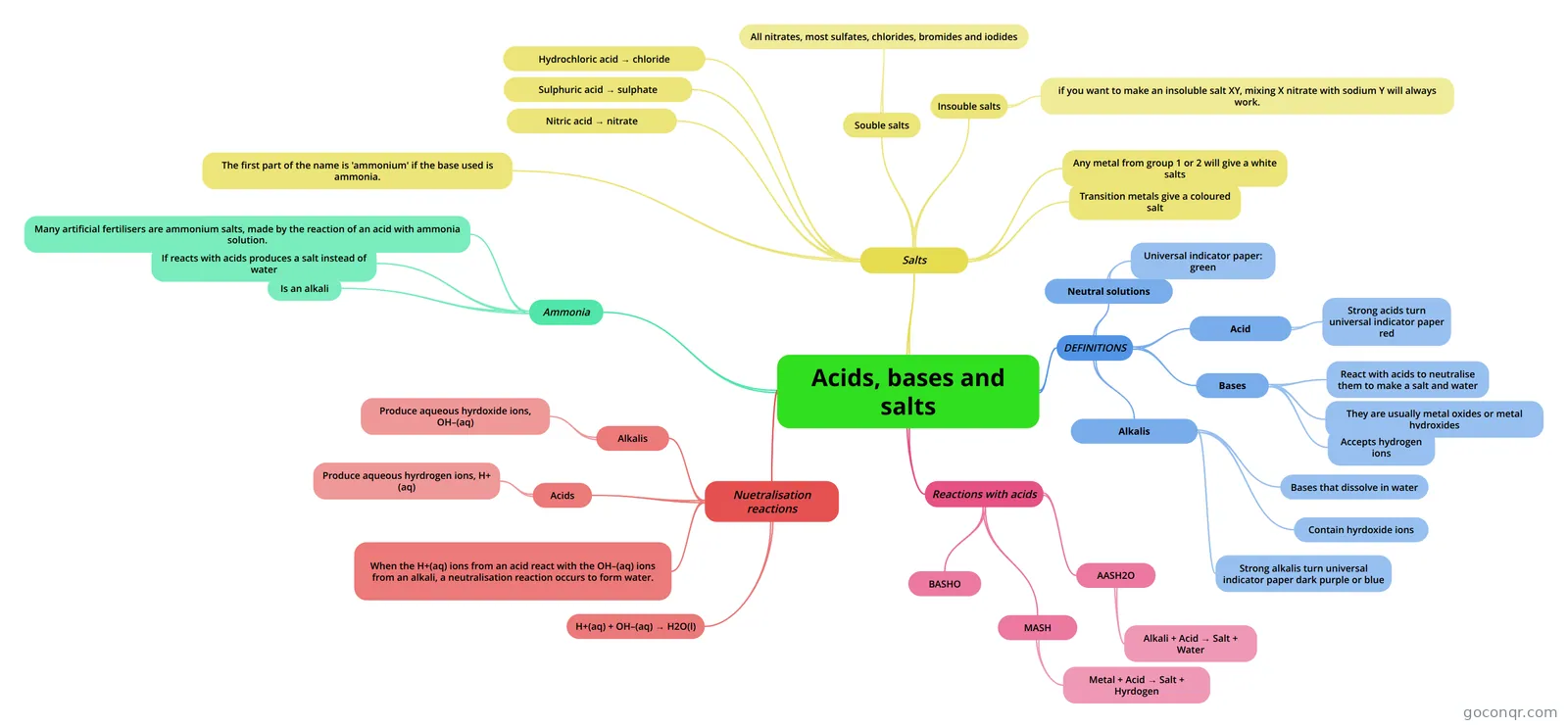
Mind map: Acids, bases and salts
Contenido del mapa
Acids, bases and salts
DEFINITIONS
- Acid
- Strong acids turn universal indicator paper red
- Bases
- React with acids to neutralise them to make a salt and water
- They are usually metal oxides or metal hydroxides
- Accepts hydrogen ions
- Alkalis
- Bases that dissolve in water
- Strong alkalis turn universal indicator paper dark purple or blue
- Contain hyrdoxide ions
- Neutral solutions
- Universal indicator paper: green
- Acid
Nuetralisation reactions
- Alkalis
- Produce aqueous hyrdoxide ions, OH–(aq)
- Acids
- Produce aqueous hyrdrogen ions, H+ (aq)
- When the H+(aq) ions from an acid react with the OH–(aq) ions from an alkali, a neutralisation reaction occurs to form water.
- H+(aq) + OH–(aq) → H2O(l)
- Alkalis
Salts
- Hydrochloric acid → chloride
- Sulphuric acid → sulphate
- Nitric acid → nitrate
- The first part of the name is 'ammonium' if the base used is ammonia.
- Any metal from group 1 or 2 will give a white salts
- Transition metals give a coloured salt
- Souble salts
- All nitrates, most sulfates, chlorides, bromides and iodides
- Insouble salts
- if you want to make an insoluble salt XY, mixing X nitrate with sodium Y will always work.
Ammonia
- Is an alkali
- If reacts with acids produces a salt instead of water
- Many artificial fertilisers are ammonium salts, made by the reaction of an acid with ammonia solution.
Reactions with acids
- MASH
- Metal + Acid → Salt + Hyrdogen
- AASH2O
- Alkali + Acid → Salt + Water
- BASHO
- MASH
Información
- Descripción
- AS Level GCSE Stuff Mapa Mental sobre Acids, bases and salts, creado por hollyweber el 18/10/2013.
- Creado por
- hollyweber
- Visitas
- 162
- Etiquetas
- Valoración