
Mapa mental
Teaching Grammar
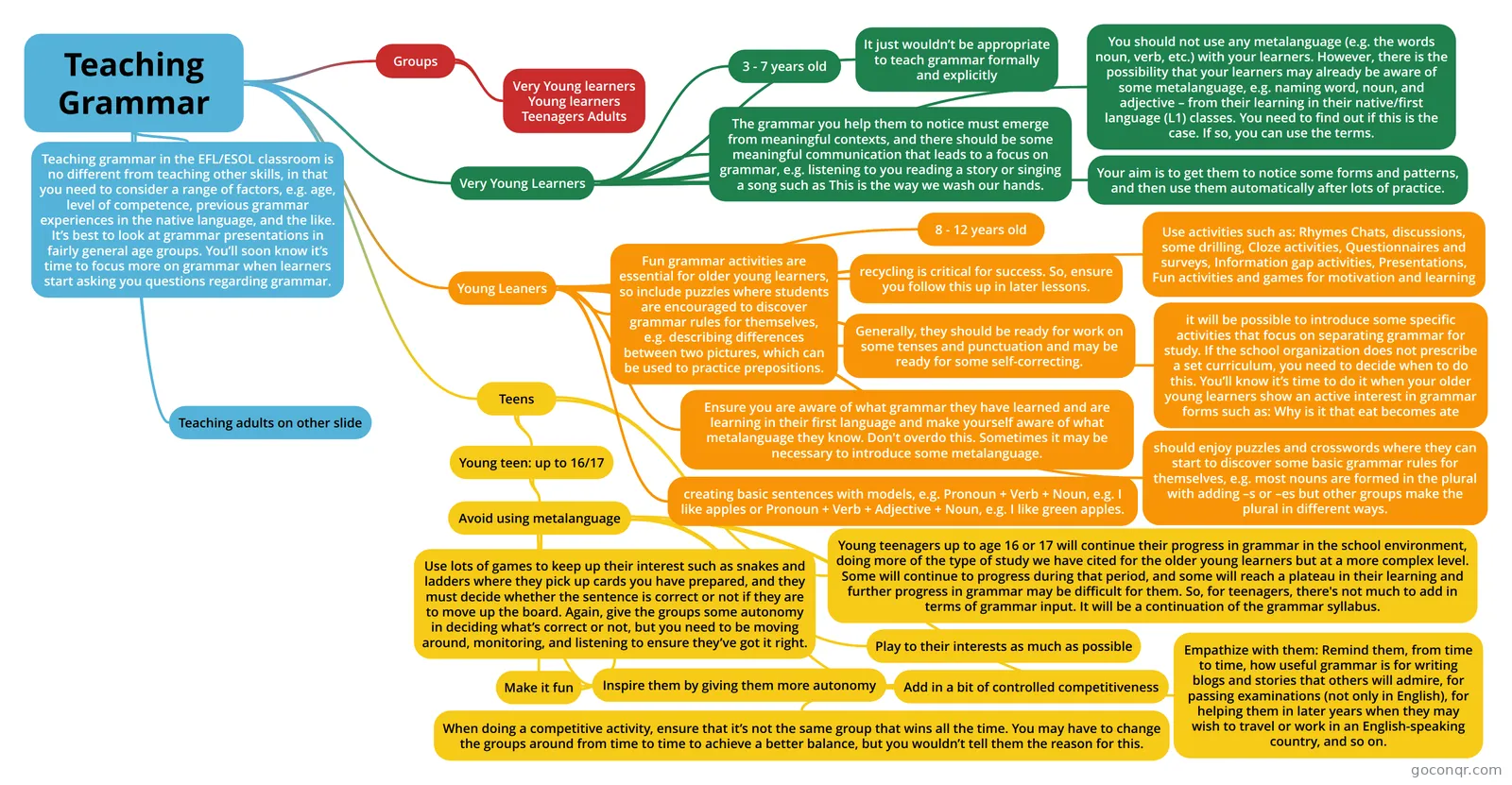
Mind map: teaching grammar
Contenido del mapa
Teaching Grammar
Teaching grammar in the EFL/ESOL classroom is no different from teaching other skills, in that you need to consider a range of factors, e.g. age, level of competence, previous grammar experiences in the native language, and the like. It’s best to look at grammar presentations in fairly general age groups. You’ll soon know it’s time to focus more on grammar when learners start asking you questions regarding grammar.
Groups
- Very Young learners Young learners Teenagers Adults
Very Young Learners
- 3 - 7 years old
- It just wouldn’t be appropriate to teach grammar formally and explicitly
- You should not use any metalanguage (e.g. the words noun, verb, etc.) with your learners. However, there is the possibility that your learners may already be aware of some metalanguage, e.g. naming word, noun, and adjective – from their learning in their native/first language (L1) classes. You need to find out if this is the case. If so, you can use the terms.
- Your aim is to get them to notice some forms and patterns, and then use them automatically after lots of practice.
- The grammar you help them to notice must emerge from meaningful contexts, and there should be some meaningful communication that leads to a focus on grammar, e.g. listening to you reading a story or singing a song such as This is the way we wash our hands.
Young Leaners
- 8 - 12 years old
- Use activities such as: Rhymes Chats, discussions, some drilling, Cloze activities, Questionnaires and surveys, Information gap activities, Presentations, Fun activities and games for motivation and learning
- it will be possible to introduce some specific activities that focus on separating grammar for study. If the school organization does not prescribe a set curriculum, you need to decide when to do this. You’ll know it’s time to do it when your older young learners show an active interest in grammar forms such as: Why is it that eat becomes ate
- Ensure you are aware of what grammar they have learned and are learning in their first language and make yourself aware of what metalanguage they know. Don't overdo this. Sometimes it may be necessary to introduce some metalanguage.
- Generally, they should be ready for work on some tenses and punctuation and may be ready for some self-correcting.
- should enjoy puzzles and crosswords where they can start to discover some basic grammar rules for themselves, e.g. most nouns are formed in the plural with adding –s or –es but other groups make the plural in different ways.
- creating basic sentences with models, e.g. Pronoun + Verb + Noun, e.g. I like apples or Pronoun + Verb + Adjective + Noun, e.g. I like green apples.
- Fun grammar activities are essential for older young learners, so include puzzles where students are encouraged to discover grammar rules for themselves, e.g. describing differences between two pictures, which can be used to practice prepositions.
- recycling is critical for success. So, ensure you follow this up in later lessons.
Teens
- Young teenagers up to age 16 or 17 will continue their progress in grammar in the school environment, doing more of the type of study we have cited for the older young learners but at a more complex level. Some will continue to progress during that period, and some will reach a plateau in their learning and further progress in grammar may be difficult for them. So, for teenagers, there's not much to add in terms of grammar input. It will be a continuation of the grammar syllabus.
- Young teen: up to 16/17
- Avoid using metalanguage
- Empathize with them: Remind them, from time to time, how useful grammar is for writing blogs and stories that others will admire, for passing examinations (not only in English), for helping them in later years when they may wish to travel or work in an English-speaking country, and so on.
- Play to their interests as much as possible
- Add in a bit of controlled competitiveness
- When doing a competitive activity, ensure that it’s not the same group that wins all the time. You may have to change the groups around from time to time to achieve a better balance, but you wouldn’t tell them the reason for this.
- Inspire them by giving them more autonomy
- Make it fun
- Use lots of games to keep up their interest such as snakes and ladders where they pick up cards you have prepared, and they must decide whether the sentence is correct or not if they are to move up the board. Again, give the groups some autonomy in deciding what’s correct or not, but you need to be moving around, monitoring, and listening to ensure they’ve got it right.
- Avoid using metalanguage
Teaching adults on other slide
Información
- Descripción
- TESOL Grammar Mapa Mental sobre Teaching Grammar, creado por Shannon McCall el 19/02/2021.
- Creado por
- Shannon McCall
- Visitas
- 2
- Valoración