
Mapa mental
Writing Skills
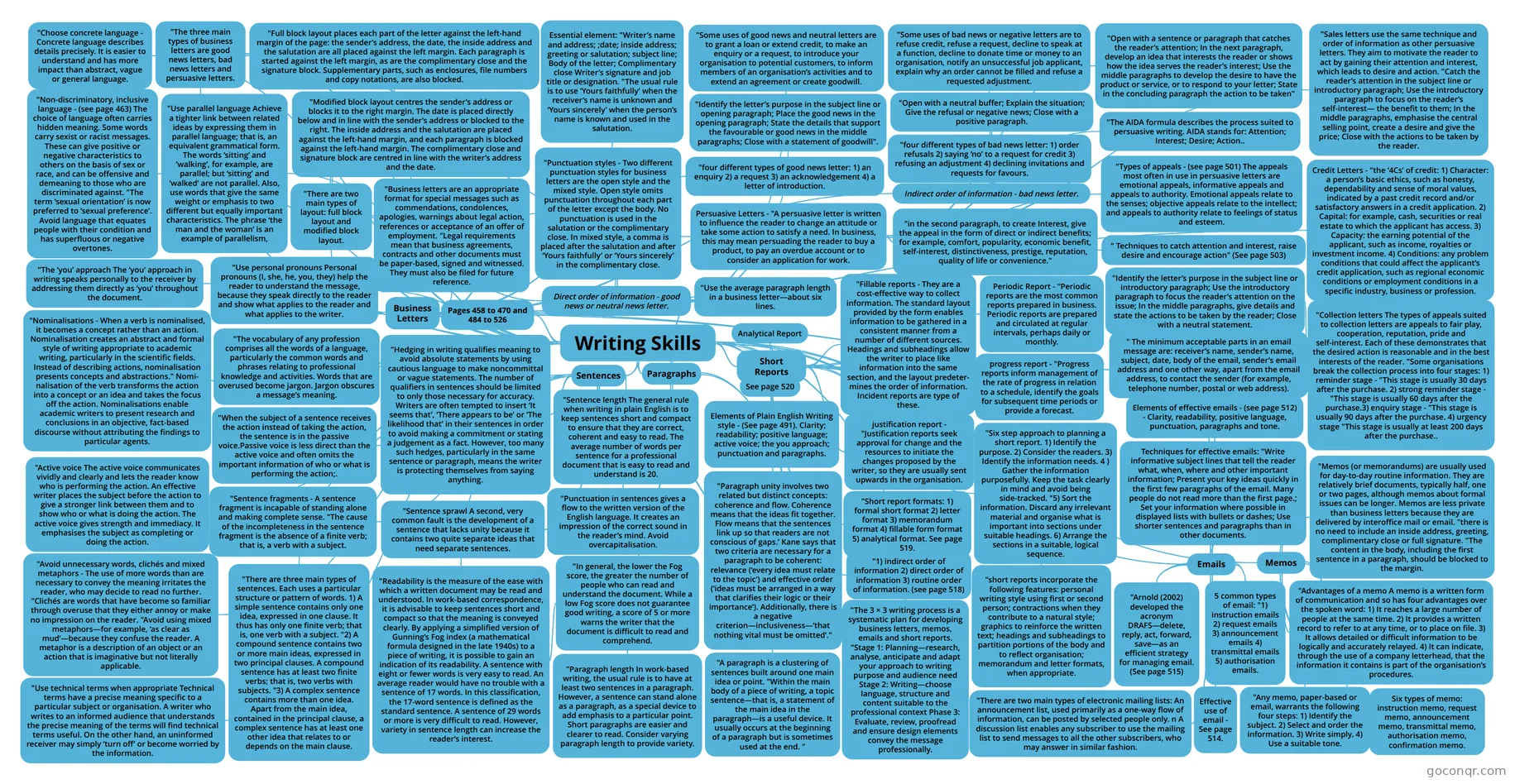
Mind map: Writing skills
Contenido del mapa
Writing Skills
Pages 458 to 470 and 484 to 526
Short Reports
- justification report - "Justification reports seek approval for change and the resources to initiate the changes proposed by the writer, so they are usually sent upwards in the organisation.
- progress report - "Progress reports inform management of the rate of progress in relation to a schedule, identify the goals for subsequent time periods or provide a forecast.
- Periodic Report - "Periodic reports are the most common reports prepared in business. Periodic reports are prepared and circulated at regular intervals, perhaps daily or monthly.
- Analytical Report
- "short reports incorporate the following features: personal writing style using first or second person; contractions when they contribute to a natural style; graphics to reinforce the written text; headings and subheadings to partition portions of the body and to reflect organisation; memorandum and letter formats, when appropriate.
- "Six step approach to planning a short report. 1) Identify the purpose. 2) Consider the readers. 3) Identify the information needs. 4 ) Gather the information purposefully. Keep the task clearly in mind and avoid being side-tracked. "5) Sort the information. Discard any irrelevant material and organise what is important into sections under suitable headings. 6) Arrange the sections in a suitable, logical sequence.
- "1) indirect order of information 2) direct order of information 3) routine order of information. (see page 518)
- "Short report formats: 1) formal short format 2) letter format 3) memorandum format 4) fillable form format 5) analytical format. See page 519.
- "Fillable reports - They are a cost-effective way to collect information. The standard layout provided by the form enables information to be gathered in a consistent manner from a number of different sources. Headings and subheadings allow the writer to place like information into the same section, and the layout predeter- mines the order of information. Incident reports are type of these.
- See page 520
Sentences
- "There are three main types of sentences. Each uses a particular structure or pattern of words. 1) A simple sentence contains only one idea, expressed in one clause. It thus has only one finite verb; that is, one verb with a subject. "2) A compound sentence contains two or more main ideas, expressed in two principal clauses. A compound sentence has at least two finite verbs; that is, two verbs with subjects. "3) A complex sentence contains more than one idea. Apart from the main idea, contained in the principal clause, a complex sentence has at least one other idea that relates to or depends on the main clause.
- "Sentence fragments - A sentence fragment is incapable of standing alone and making complete sense. "The cause of the incompleteness in the sentence fragment is the absence of a finite verb; that is, a verb with a subject.
- "Sentence sprawl A second, very common fault is the development of a sentence that lacks unity because it contains two quite separate ideas that need separate sentences.
- "Sentence length The general rule when writing in plain English is to keep sentences short and compact to ensure that they are correct, coherent and easy to read. The average number of words per sentence for a professional document that is easy to read and understand is 20.
- "Hedging in writing qualifies meaning to avoid absolute statements by using cautious language to make noncommittal or vague statements. The number of qualifiers in sentences should be limited to only those necessary for accuracy. Writers are often tempted to insert ‘It seems that’, ‘There appears to be’ or ‘The likelihood that’ in their sentences in order to avoid making a commitment or stating a judgement as a fact. However, too many such hedges, particularly in the same sentence or paragraph, means the writer is protecting themselves from saying anything.
- "Readability is the measure of the ease with which a written document may be read and understood. In work-based correspondence, it is advisable to keep sentences short and compact so that the meaning is conveyed clearly. By applying a simplified version of Gunning’s Fog index (a mathematical formula designed in the late 1940s) to a piece of writing, it is possible to gain an indication of its readability. A sentence with eight or fewer words is very easy to read. An average reader would have no trouble with a sentence of 17 words. In this classification, the 17-word sentence is defined as the standard sentence. A sentence of 29 words or more is very difficult to read. However, variety in sentence length can increase the reader’s interest.
- "In general, the lower the Fog score, the greater the number of people who can read and understand the document. While a low Fog score does not guarantee good writing, a score of 5 or more warns the writer that the document is difficult to read and comprehend.
- "Punctuation in sentences gives a flow to the written version of the English language. It creates an impression of the correct sound in the reader’s mind. Avoid overcapitalisation.
Paragraphs
- "A paragraph is a clustering of sentences built around one main idea or point. "Within the main body of a piece of writing, a topic sentence—that is, a statement of the main idea in the paragraph—is a useful device. It usually occurs at the beginning of a paragraph but is sometimes used at the end. "
- "Paragraph length In work-based writing, the usual rule is to have at least two sentences in a paragraph. However, a sentence can stand alone as a paragraph, as a special device to add emphasis to a particular point. Short paragraphs are easier and clearer to read. Consider varying paragraph length to provide variety.
- "Paragraph unity involves two related but distinct concepts: coherence and flow. Coherence means that the ideas fit together. Flow means that the sentences link up so that readers are not conscious of gaps.’ Kane says that two criteria are necessary for a paragraph to be coherent: relevance (‘every idea must relate to the topic’) and effective order (‘ideas must be arranged in a way that clarifies their logic or their importance’). Additionally, there is a negative criterion—inclusiveness—‘that nothing vital must be omitted’."
- "Use the average paragraph length in a business letter—about six lines.
"The vocabulary of any profession comprises all the words of a language, particularly the common words and phrases relating to professional knowledge and activities. Words that are overused become jargon. Jargon obscures a message’s meaning.
"Avoid unnecessary words, clichés and mixed metaphors - The use of more words than are necessary to convey the meaning irritates the reader, who may decide to read no further. "Clichés are words that have become so familiar through overuse that they either annoy or make no impression on the reader. "Avoid using mixed metaphors—for example, ‘as clear as mud’—because they confuse the reader. A metaphor is a description of an object or an action that is imaginative but not literally applicable.
"Choose concrete language - Concrete language describes details precisely. It is easier to understand and has more impact than abstract, vague or general language.
"Use technical terms when appropriate Technical terms have a precise meaning specific to a particular subject or organisation. A writer who writes to an informed audience that understands the precise meaning of the terms will find technical terms useful. On the other hand, an uninformed receiver may simply ‘turn off’ or become worried by the information.
"Active voice The active voice communicates vividly and clearly and lets the reader know who is performing the action. An effective writer places the subject before the action to give a stronger link between them and to show who or what is doing the action. The active voice gives strength and immediacy. It emphasises the subject as completing or doing the action.
"When the subject of a sentence receives the action instead of taking the action, the sentence is in the passive voice.Passive voice is less direct than the active voice and often omits the important information of who or what is performing the action;.
"Nominalisations - When a verb is nominalised, it becomes a concept rather than an action. Nominalisation creates an abstract and formal style of writing appropriate to academic writing, particularly in the scientific fields. Instead of describing actions, nominalisation presents concepts and abstractions." Nomi- nalisation of the verb transforms the action into a concept or an idea and takes the focus off the action. Nominalisations enable academic writers to present research and conclusions in an objective, fact-based discourse without attributing the findings to particular agents.
"Use personal pronouns Personal pronouns (I, she, he, you, they) help the reader to understand the message, because they speak directly to the reader and show what applies to the reader and what applies to the writer.
"The ‘you’ approach The ‘you’ approach in writing speaks personally to the receiver by addressing them directly as ‘you’ throughout the document.
"Non-discriminatory, inclusive language - (see page 463) The choice of language often carries hidden meaning. Some words carry sexist or racist messages. These can give positive or negative characteristics to others on the basis of sex or race, and can be offensive and demeaning to those who are discriminated against. "The term ‘sexual orientation’ is now preferred to ‘sexual preference’. Avoid language that equates people with their condition and has superfluous or negative overtones.
"Use parallel language Achieve a tighter link between related ideas by expressing them in parallel language; that is, an equivalent grammatical form. The words ‘sitting’ and ‘walking’, for example, are parallel; but ‘sitting’ and ‘walked’ are not parallel. Also, use words that give the same weight or emphasis to two different but equally important characteristics. The phrase ‘the man and the woman’ is an example of parallelism,
Business Letters
- "The three main types of business letters are good news letters, bad news letters and persuasive letters.
- Direct order of information - good news or neutral news letter.
- "Some uses of good news and neutral letters are to grant a loan or extend credit, to make an enquiry or a request, to introduce your organisation to potential customers, to inform members of an organisation’s activities and to extend an agreement or create goodwill.
- "Identify the letter’s purpose in the subject line or opening paragraph; Place the good news in the opening paragraph; State the details that support the favourable or good news in the middle paragraphs; Close with a statement of goodwill".
- "four different types of good news letter: 1) an enquiry 2) a request 3) an acknowledgement 4) a letter of introduction.
- Persuasive Letters - "A persuasive letter is written to influence the reader to change an attitude or take some action to satisfy a need. In business, this may mean persuading the reader to buy a product, to pay an overdue account or to consider an application for work.
- "The AIDA formula describes the process suited to persuasive writing. AIDA stands for: Attention; Interest; Desire; Action..
- "Open with a sentence or paragraph that catches the reader’s attention; In the next paragraph, develop an idea that interests the reader or shows how the idea serves the reader’s interest; Use the middle paragraphs to develop the desire to have the product or service, or to respond to your letter; State in the concluding paragraph the action to be taken"
- "in the second paragraph, to create Interest, give the appeal in the form of direct or indirect benefits; for example, comfort, popularity, economic benefit, self-interest, distinctiveness, prestige, reputation, quality of life or convenience."
- "Types of appeals - (see page 501) The appeals most often in use in persuasive letters are emotional appeals, informative appeals and appeals to authority. Emotional appeals relate to the senses; objective appeals relate to the intellect; and appeals to authority relate to feelings of status and esteem.
- " Techniques to catch attention and interest, raise desire and encourage action" (See page 503)
- "Sales letters use the same technique and order of information as other persuasive letters. They aim to motivate the reader to act by gaining their attention and interest, which leads to desire and action. "Catch the reader’s attention in the subject line or introductory paragraph; Use the introductory paragraph to focus on the reader’s self-interest— the benefit to them; In the middle paragraphs, emphasise the central selling point, create a desire and give the price; Close with the actions to be taken by the reader.
- Direct order of information - good news or neutral news letter.
- "Business letters are an appropriate format for special messages such as commendations, condolences, apologies, warnings about legal action, references or acceptance of an offer of employment. "Legal requirements mean that business agreements, contracts and other documents must be paper-based, signed and witnessed. They must also be filed for future reference.
- Essential element: "Writer’s name and address; ;date; inside address; greeting or salutation; subject line; Body of the letter; Complimentary close Writer’s signature and job title or designation. "The usual rule is to use ‘Yours faithfully’ when the receiver’s name is unknown and ‘Yours sincerely’ when the person’s name is known and used in the salutation.
- "There are two main types of layout: full block layout and modified block layout.
- "Full block layout places each part of the letter against the left-hand margin of the page: the sender’s address, the date, the inside address and the salutation are all placed against the left margin. Each paragraph is started against the left margin, as are the complimentary close and the signature block. Supplementary parts, such as enclosures, file numbers and copy notations, are also blocked.
- "Modified block layout centres the sender’s address or blocks it to the right margin. The date is placed directly below and in line with the sender’s address or blocked to the right. The inside address and the salutation are placed against the left-hand margin, and each paragraph is blocked against the left-hand margin. The complimentary close and signature block are centred in line with the writer’s address and the date.
- "Punctuation styles - Two different punctuation styles for business letters are the open style and the mixed style. Open style omits punctuation throughout each part of the letter except the body. No punctuation is used in the salutation or the complimentary close. In mixed style, a comma is placed after the salutation and after ‘Yours faithfully’ or ‘Yours sincerely’ in the complimentary close.
- Indirect order of information - bad news letter.
- "Some uses of bad news or negative letters are to refuse credit, refuse a request, decline to speak at a function, decline to donate time or money to an organisation, notify an unsuccessful job applicant, explain why an order cannot be filled and refuse a requested adjustment.
- "Open with a neutral buffer; Explain the situation; Give the refusal or negative news; Close with a positive paragraph.
- "four different types of bad news letter: 1) order refusals 2) saying ‘no’ to a request for credit 3) refusing an adjustment 4) declining invitations and requests for favours.
- Credit Letters - "the ‘4Cs’ of credit: 1) Character: a person’s basic ethics, such as honesty, dependability and sense of moral values, indicated by a past credit record and/or satisfactory answers in a credit application. 2) Capital: for example, cash, securities or real estate to which the applicant has access. 3) Capacity: the earning potential of the applicant, such as income, royalties or investment income. 4) Conditions: any problem conditions that could affect the applicant’s credit application, such as regional economic conditions or employment conditions in a specific industry, business or profession.
- "Collection letters The types of appeals suited to collection letters are appeals to fair play, cooperation, reputation, pride and self-interest. Each of these demonstrates that the desired action is reasonable and in the best interests of the reader. "Some organisations break the collection process into four stages: 1) reminder stage - "This stage is usually 30 days after the purchase. 2) strong reminder stage - "This stage is usually 60 days after the purchase.3) enquiry stage - "This stage is usually 90 days after the purchase. 4) urgency stage "This stage is usually at least 200 days after the purchase..
- "Identify the letter’s purpose in the subject line or introductory paragraph; Use the introductory paragraph to focus the reader’s attention on the issue; In the middle paragraphs, give details and state the actions to be taken by the reader; Close with a neutral statement.
- "The three main types of business letters are good news letters, bad news letters and persuasive letters.
"The 3 × 3 writing process is a systematic plan for developing business letters, memos, emails and short reports. "Stage 1: Planning—research, analyse, anticipate and adapt your approach to writing purpose and audience need Stage 2: Writing—choose language, structure and content suitable to the professional context Phase 3: Evaluate, review, proofread and ensure design elements convey the message professionally.
Elements of Plain English Writing style - (See page 491). Clarity; readability; positive language; active voice; the you approach; punctuation and paragraphs.
Memos
- "Memos (or memorandums) are usually used for day-to-day routine information. They are relatively brief documents, typically half, one or two pages, although memos about formal issues can be longer. Memos are less private than business letters because they are delivered by interoffice mail or email. "there is no need to include an inside address, greeting, complimentary close or full signature. "The content in the body, including the first sentence in a paragraph, should be blocked to the margin.
- "Advantages of a memo A memo is a written form of communication and so has four advantages over the spoken word: 1) It reaches a large number of people at the same time. 2) It provides a written record to refer to at any time, or to place on file. 3) It allows detailed or difficult information to be logically and accurately relayed. 4) It can indicate, through the use of a company letterhead, that the information it contains is part of the organisation’s procedures.
- "Any memo, paper-based or email, warrants the following four steps: 1) Identify the subject. 2) Select and order the information. 3) Write simply. 4) Use a suitable tone.
- Six types of memo: instruction memo, request memo, announcement memo, transmittal memo, authorisation memo, confirmation memo.
Emails
- Techniques for effective emails: "Write informative subject lines that tell the reader what, when, where and other important information; Present your key ideas quickly in the first few paragraphs of the email. Many people do not read more than the first page.; Set your information where possible in displayed lists with bullets or dashes; Use shorter sentences and paragraphs than in other documents.
- Elements of effective emails - (see page 512) - Clarity, readability, positive language, punctuation, paragraphs and tone.
- " The minimum acceptable parts in an email message are: receiver’s name, sender’s name, subject, date, body of the email, sender’s email address and one other way, apart from the email address, to contact the sender (for example, telephone number, postal or web address).
- 5 common types of email: "1) instruction emails 2) request emails 3) announcement emails 4) transmittal emails 5) authorisation emails.
- Effective use of email - See page 514.
- "There are two main types of electronic mailing lists: An announcement list, used primarily as a one-way flow of information, can be posted by selected people only. n A discussion list enables any subscriber to use the mailing list to send messages to all the other subscribers, who may answer in similar fashion.
- "Arnold (2002) developed the acronym DRAFS—delete, reply, act, forward, save—as an efficient strategy for managing email. (See page 515)
Información
- Descripción
- Bachelor Professional Communications Mapa Mental sobre Writing Skills, creado por caramelcarl el 07/06/2015.
- Creado por
- caramelcarl
- Visitas
- 8
- Valoración