
Mapa mental
Speciation
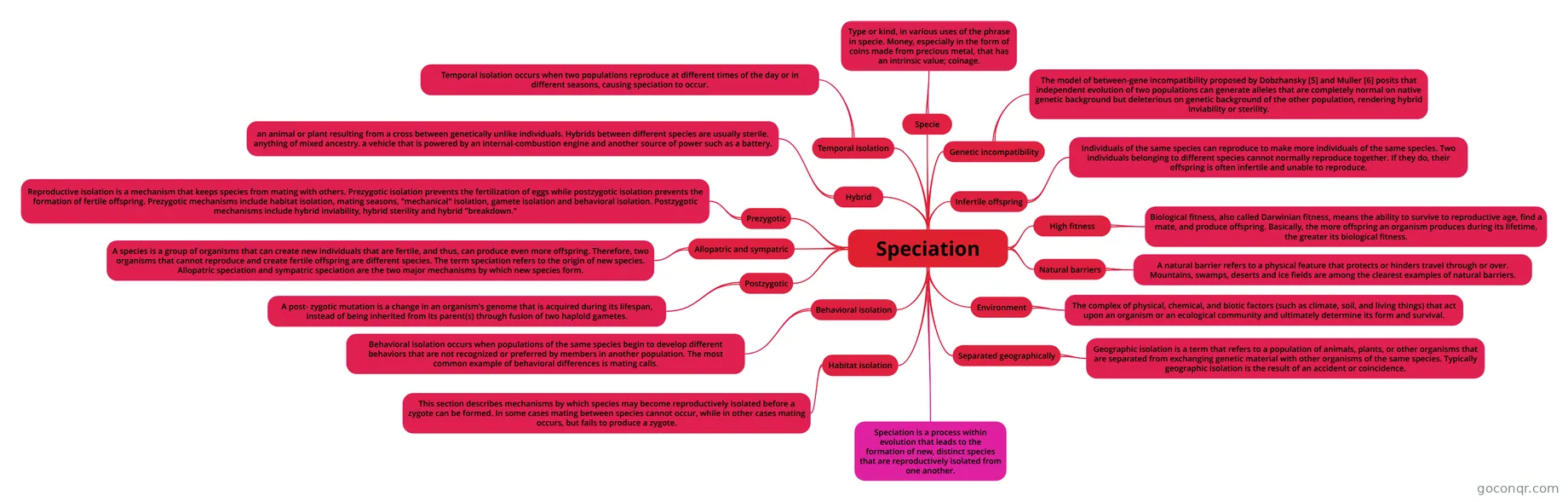
Mind map: Speciation
Contenido del mapa
Speciation
Speciation is a process within evolution that leads to the formation of new, distinct species that are reproductively isolated from one another.
Specie
- Type or kind, in various uses of the phrase in specie. Money, especially in the form of coins made from precious metal, that has an intrinsic value; coinage.
Hybrid
- an animal or plant resulting from a cross between genetically unlike individuals. Hybrids between different species are usually sterile. anything of mixed ancestry. a vehicle that is powered by an internal-combustion engine and another source of power such as a battery.
Prezygotic
- Reproductive isolation is a mechanism that keeps species from mating with others. Prezygotic isolation prevents the fertilization of eggs while postzygotic isolation prevents the formation of fertile offspring. Prezygotic mechanisms include habitat isolation, mating seasons, "mechanical" isolation, gamete isolation and behavioral isolation. Postzygotic mechanisms include hybrid inviability, hybrid sterility and hybrid "breakdown."
Allopatric and sympatric
- A species is a group of organisms that can create new individuals that are fertile, and thus, can produce even more offspring. Therefore, two organisms that cannot reproduce and create fertile offspring are different species. The term speciation refers to the origin of new species. Allopatric speciation and sympatric speciation are the two major mechanisms by which new species form.
Postzygotic
- A post- zygotic mutation is a change in an organism's genome that is acquired during its lifespan, instead of being inherited from its parent(s) through fusion of two haploid gametes.
Behavioral isolation
- Behavioral isolation occurs when populations of the same species begin to develop different behaviors that are not recognized or preferred by members in another population. The most common example of behavioral differences is mating calls.
Temporal isolation
- Temporal isolation occurs when two populations reproduce at different times of the day or in different seasons, causing speciation to occur.
Habitat isolation
- This section describes mechanisms by which species may become reproductively isolated before a zygote can be formed. In some cases mating between species cannot occur, while in other cases mating occurs, but fails to produce a zygote.
Genetic incompatibility
- The model of between-gene incompatibility proposed by Dobzhansky [5] and Muller [6] posits that independent evolution of two populations can generate alleles that are completely normal on native genetic background but deleterious on genetic background of the other population, rendering hybrid inviability or sterility.
Infertile offspring
- Individuals of the same species can reproduce to make more individuals of the same species. Two individuals belonging to different species cannot normally reproduce together. If they do, their offspring is often infertile and unable to reproduce.
High fitness
- Biological fitness, also called Darwinian fitness, means the ability to survive to reproductive age, find a mate, and produce offspring. Basically, the more offspring an organism produces during its lifetime, the greater its biological fitness.
Natural barriers
- A natural barrier refers to a physical feature that protects or hinders travel through or over. Mountains, swamps, deserts and ice fields are among the clearest examples of natural barriers.
Environment
- The complex of physical, chemical, and biotic factors (such as climate, soil, and living things) that act upon an organism or an ecological community and ultimately determine its form and survival.
Separated geographically
- Geographic isolation is a term that refers to a population of animals, plants, or other organisms that are separated from exchanging genetic material with other organisms of the same species. Typically geographic isolation is the result of an accident or coincidence.
Información
- Descripción
- Mapa Mental sobre Speciation, creado por Samuel Pabon Valderrama el 23/03/2021.
- Creado por
- Samuel Pabon Valderrama
- Visitas
- 0
- Valoración