
Mapa mental
EWT
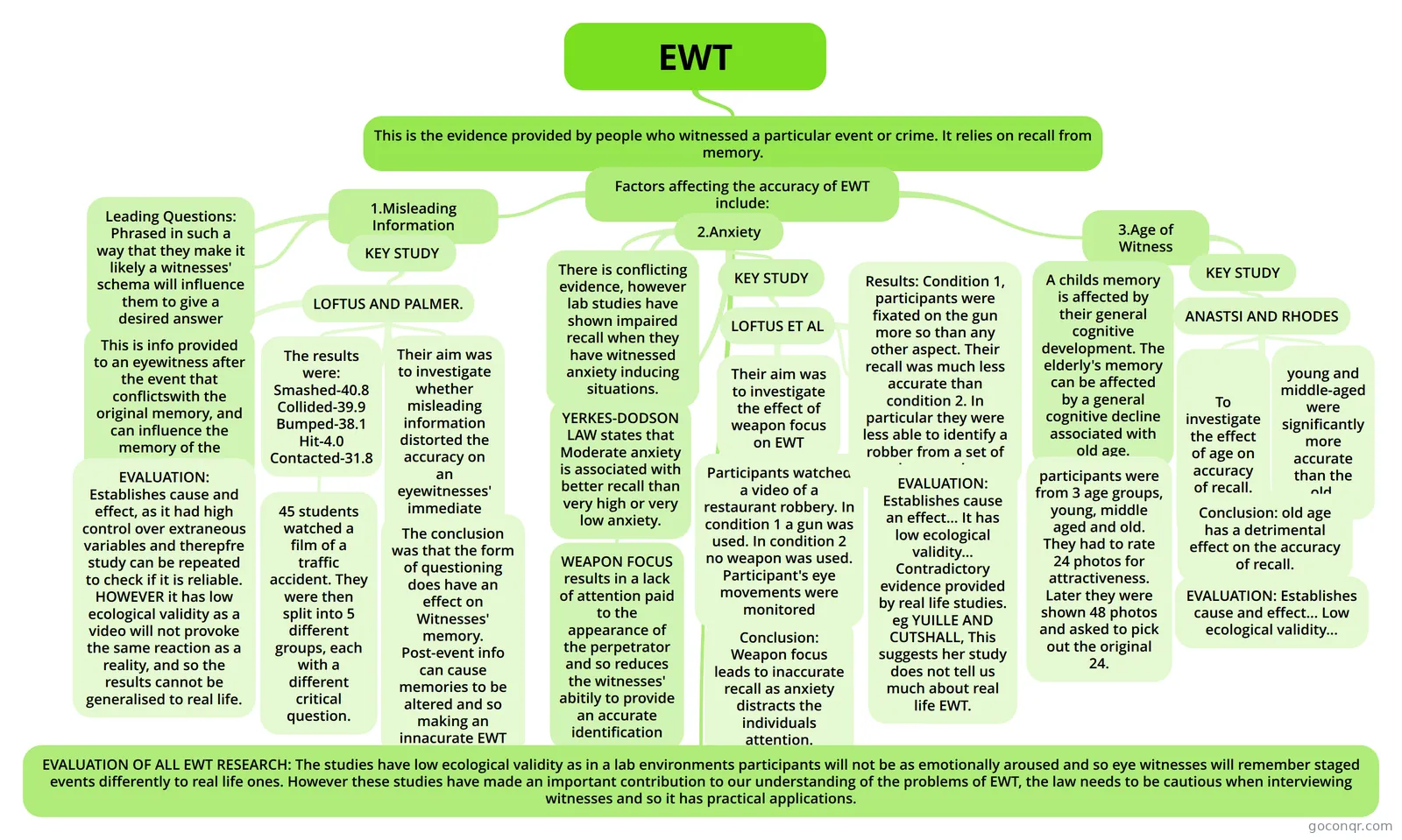
Mind map: EWT psychology
Contenido del mapa
EWT
This is the evidence provided by people who witnessed a particular event or crime. It relies on recall from memory.
- Factors affecting the accuracy of EWT include:
- 1.Misleading Information
- This is info provided to an eyewitness after the event that conflictswith the original memory, and can influence the memory of the witness.
- Leading Questions: Phrased in such a way that they make it likely a witnesses' schema will influence them to give a desired answer
- KEY STUDY
- LOFTUS AND PALMER.
- Their aim was to investigate whether misleading information distorted the accuracy on an eyewitnesses' immediate recall
- 45 students watched a film of a traffic accident. They were then split into 5 different groups, each with a different critical question.
- The results were: Smashed-40.8 Collided-39.9 Bumped-38.1 Hit-4.0 Contacted-31.8
- The conclusion was that the form of questioning does have an effect on Witnesses' memory. Post-event info can cause memories to be altered and so making an innacurate EWT
- EVALUATION: Establishes cause and effect, as it had high control over extraneous variables and therepfre study can be repeated to check if it is reliable. HOWEVER it has low ecological validity as a video will not provoke the same reaction as a reality, and so the results cannot be generalised to real life.
- LOFTUS AND PALMER.
- 2.Anxiety
- There is conflicting evidence, however lab studies have shown impaired recall when they have witnessed anxiety inducing situations.
- YERKES-DODSON LAW states that Moderate anxiety is associated with better recall than very high or very low anxiety.
- WEAPON FOCUS results in a lack of attention paid to the appearance of the perpetrator and so reduces the witnesses' abitily to provide an accurate identification
- KEY STUDY
- LOFTUS ET AL
- Their aim was to investigate the effect of weapon focus on EWT
- Participants watched a video of a restaurant robbery. In condition 1 a gun was used. In condition 2 no weapon was used. Participant's eye movements were monitored
- Results: Condition 1, participants were fixated on the gun more so than any other aspect. Their recall was much less accurate than condition 2. In particular they were less able to identify a robber from a set of photographs.
- Conclusion: Weapon focus leads to inaccurate recall as anxiety distracts the individuals attention.
- EVALUATION: Establishes cause an effect... It has low ecological validity... Contradictory evidence provided by real life studies. eg YUILLE AND CUTSHALL, This suggests her study does not tell us much about real life EWT.
- LOFTUS ET AL
- 3.Age of Witness
- A childs memory is affected by their general cognitive development. The elderly's memory can be affected by a general cognitive decline associated with old age.
- KEY STUDY
- ANASTSI AND RHODES
- To investigate the effect of age on accuracy of recall.
- participants were from 3 age groups, young, middle aged and old. They had to rate 24 photos for attractiveness. Later they were shown 48 photos and asked to pick out the original 24.
- young and middle-aged were significantly more accurate than the old.
- Conclusion: old age has a detrimental effect on the accuracy of recall.
- EVALUATION: Establishes cause and effect... Low ecological validity...
- ANASTSI AND RHODES
- 1.Misleading Information
- EVALUATION OF ALL EWT RESEARCH: The studies have low ecological validity as in a lab environments participants will not be as emotionally aroused and so eye witnesses will remember staged events differently to real life ones. However these studies have made an important contribution to our understanding of the problems of EWT, the law needs to be cautious when interviewing witnesses and so it has practical applications.
- Factors affecting the accuracy of EWT include:
Información
- Descripción
- Mapa Mental sobre EWT, creado por charlottewestby el 06/11/2013.
- Creado por
- charlottewestby
- Visitas
- 24
- Valoración