
Mapa mental
Natural Hazards
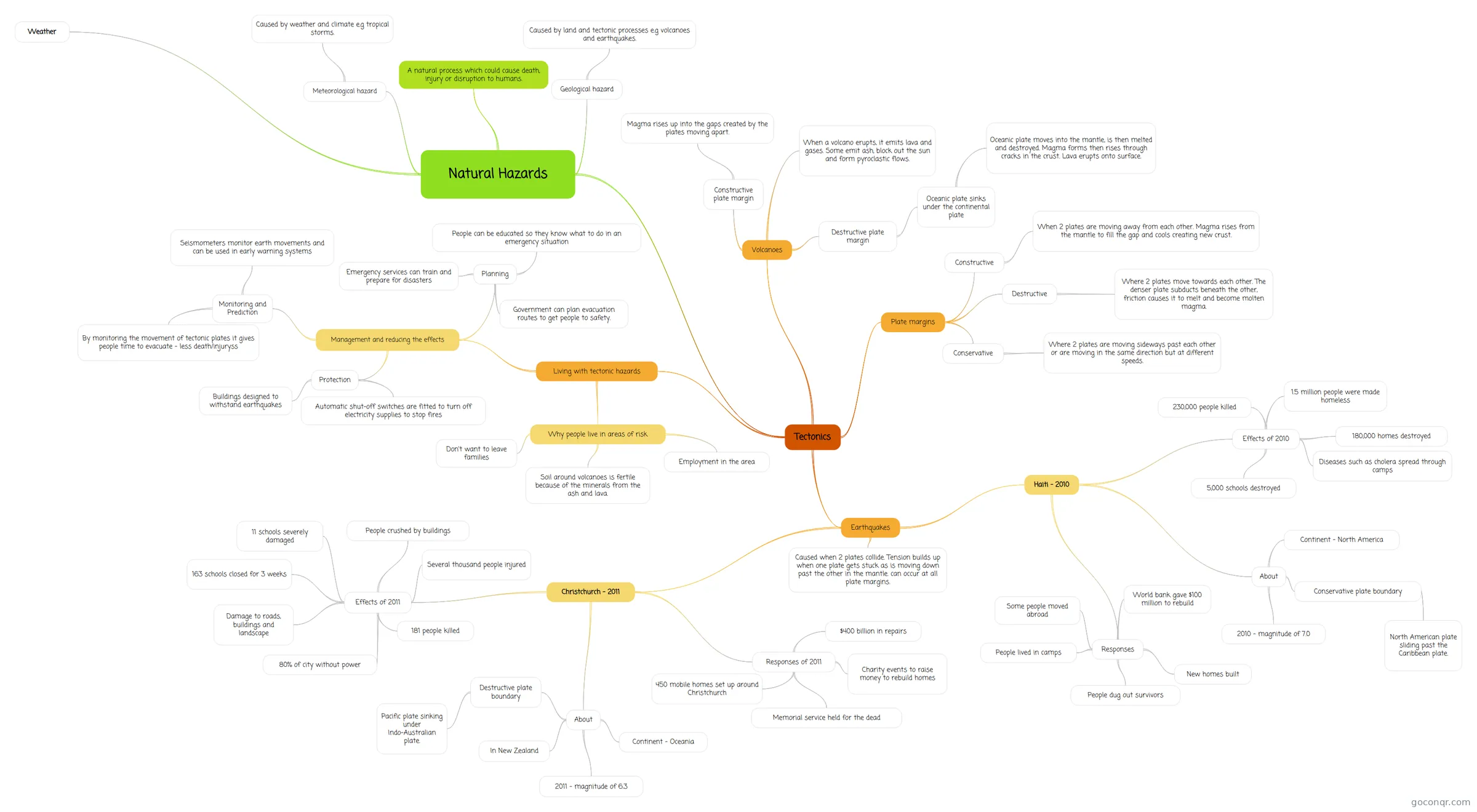
Mind map: Natural Hazards
Contenido del mapa
Natural Hazards
Tectonics
- Volcanoes
- Destructive plate margin
- Oceanic plate sinks under the continental plate
- Oceanic plate moves into the mantle, is then melted and destroyed. Magma forms then rises through cracks in the crust. Lava erupts onto surface.
- Oceanic plate sinks under the continental plate
- Constructive plate margin
- Magma rises up into the gaps created by the plates moving apart.
- When a volcano erupts, it emits lava and gases. Some emit ash, block out the sun and form pyroclastic flows.
- Destructive plate margin
- Living with tectonic hazards
- Why people live in areas of risk
- Employment in the area
- Don't want to leave families
- Soil around volcanoes is fertile because of the minerals from the ash and lava.
- Management and reducing the effects
- Planning
- Government can plan evacuation routes to get people to safety.
- People can be educated so they know what to do in an emergency situation
- Emergency services can train and prepare for disasters
- Protection
- Buildings designed to withstand earthquakes
- Automatic shut-off switches are fitted to turn off electricity supplies to stop fires
- Monitoring and Prediction
- Seismometers monitor earth movements and can be used in early warning systems
- By monitoring the movement of tectonic plates it gives people time to evacuate - less death/injuryss
- Planning
- Why people live in areas of risk
- Earthquakes
- Christchurch - 2011
- About
- Destructive plate boundary
- Pacific plate sinking under Indo-Australian plate.
- In New Zealand
- 2011 - magnitude of 6.3
- Continent - Oceania
- Destructive plate boundary
- Effects of 2011
- 181 people killed
- 80% of city without power
- 163 schools closed for 3 weeks
- 11 schools severely damaged
- People crushed by buildings
- Damage to roads, buildings and landscape
- Several thousand people injured
- Responses of 2011
- $400 billion in repairs
- Charity events to raise money to rebuild homes
- Memorial service held for the dead
- 450 mobile homes set up around Christchurch
- About
- Haiti - 2010
- Responses
- People lived in camps
- Some people moved abroad
- World bank gave $100 million to rebuild
- New homes built
- People dug out survivors
- About
- Conservative plate boundary
- North American plate sliding past the Caribbean plate.
- 2010 - magnitude of 7.0
- Continent - North America
- Conservative plate boundary
- Effects of 2010
- 230,000 people killed
- 180,000 homes destroyed
- 1.5 million people were made homeless
- 5,000 schools destroyed
- Diseases such as cholera spread through camps
- Responses
- Caused when 2 plates collide. Tension builds up when one plate gets stuck as is moving down past the other in the mantle. can occur at all plate margins.
- Christchurch - 2011
- Plate margins
- Constructive
- When 2 plates are moving away from each other. Magma rises from the mantle to fill the gap and cools creating new crust.
- Destructive
- Where 2 plates move towards each other. The denser plate subducts beneath the other, friction causes it to melt and become molten magma.
- Conservative
- Where 2 plates are moving sideways past each other or are moving in the same direction but at different speeds.
- Constructive
- Volcanoes
Weather
Geological hazard
- Caused by land and tectonic processes e.g volcanoes and earthquakes.
Meteorological hazard
- Caused by weather and climate e.g tropical storms.
A natural process which could cause death, injury or disruption to humans.
Información
- Descripción
- GCSE (Natural Hazards) Geography Mapa Mental sobre Natural Hazards, creado por Caitlin Russell el 29/05/2023.
- Creado por
- Caitlin Russell
- Visitas
- 2
- Valoración