
Mapa mental
PLATE BOUNDARIES:
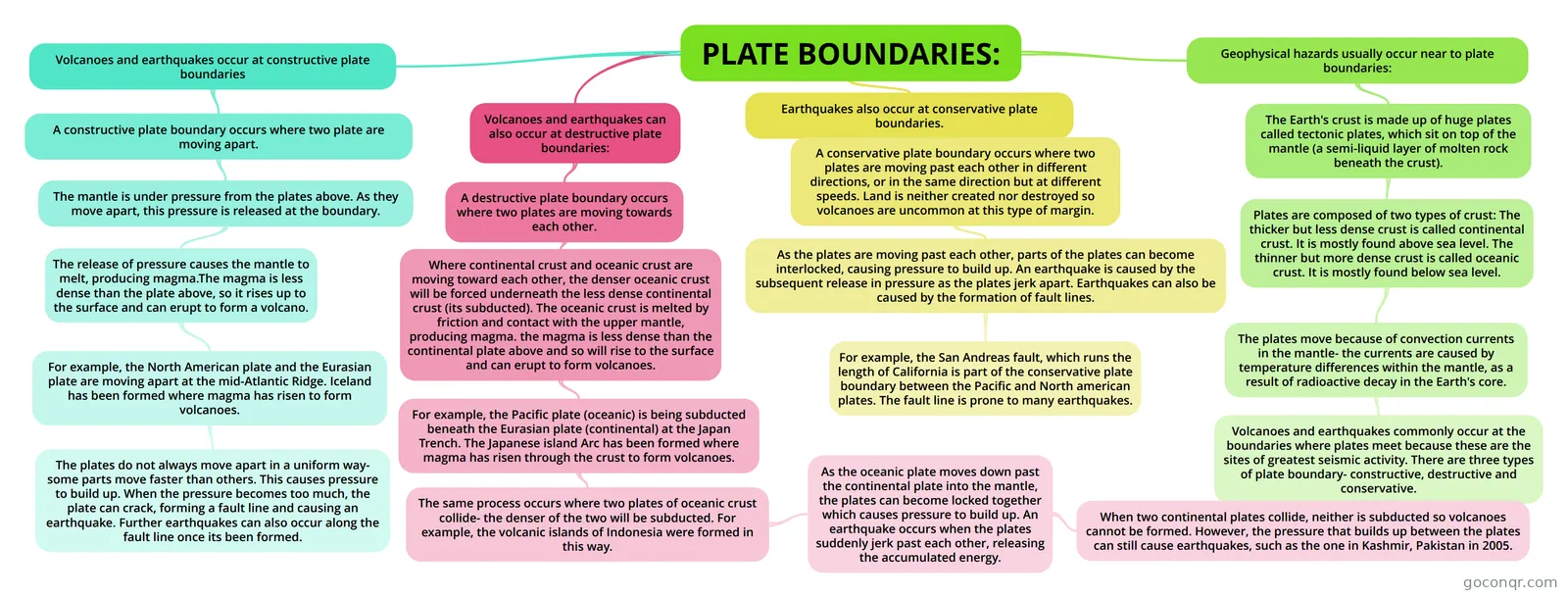
Mind map: plate boundaries
Contenido del mapa
PLATE BOUNDARIES:
Geophysical hazards usually occur near to plate boundaries:
- The Earth's crust is made up of huge plates called tectonic plates, which sit on top of the mantle (a semi-liquid layer of molten rock beneath the crust).
- Plates are composed of two types of crust: The thicker but less dense crust is called continental crust. It is mostly found above sea level. The thinner but more dense crust is called oceanic crust. It is mostly found below sea level.
- The plates move because of convection currents in the mantle- the currents are caused by temperature differences within the mantle, as a result of radioactive decay in the Earth's core.
- Volcanoes and earthquakes commonly occur at the boundaries where plates meet because these are the sites of greatest seismic activity. There are three types of plate boundary- constructive, destructive and conservative.
- The plates move because of convection currents in the mantle- the currents are caused by temperature differences within the mantle, as a result of radioactive decay in the Earth's core.
- Plates are composed of two types of crust: The thicker but less dense crust is called continental crust. It is mostly found above sea level. The thinner but more dense crust is called oceanic crust. It is mostly found below sea level.
- The Earth's crust is made up of huge plates called tectonic plates, which sit on top of the mantle (a semi-liquid layer of molten rock beneath the crust).
Volcanoes and earthquakes occur at constructive plate boundaries
- A constructive plate boundary occurs where two plate are moving apart.
- The mantle is under pressure from the plates above. As they move apart, this pressure is released at the boundary.
- The release of pressure causes the mantle to melt, producing magma.The magma is less dense than the plate above, so it rises up to the surface and can erupt to form a volcano.
- For example, the North American plate and the Eurasian plate are moving apart at the mid-Atlantic Ridge. Iceland has been formed where magma has risen to form volcanoes.
- The plates do not always move apart in a uniform way- some parts move faster than others. This causes pressure to build up. When the pressure becomes too much, the plate can crack, forming a fault line and causing an earthquake. Further earthquakes can also occur along the fault line once its been formed.
- For example, the North American plate and the Eurasian plate are moving apart at the mid-Atlantic Ridge. Iceland has been formed where magma has risen to form volcanoes.
- The release of pressure causes the mantle to melt, producing magma.The magma is less dense than the plate above, so it rises up to the surface and can erupt to form a volcano.
- The mantle is under pressure from the plates above. As they move apart, this pressure is released at the boundary.
- A constructive plate boundary occurs where two plate are moving apart.
Volcanoes and earthquakes can also occur at destructive plate boundaries:
- A destructive plate boundary occurs where two plates are moving towards each other.
- Where continental crust and oceanic crust are moving toward each other, the denser oceanic crust will be forced underneath the less dense continental crust (its subducted). The oceanic crust is melted by friction and contact with the upper mantle, producing magma. the magma is less dense than the continental plate above and so will rise to the surface and can erupt to form volcanoes.
- For example, the Pacific plate (oceanic) is being subducted beneath the Eurasian plate (continental) at the Japan Trench. The Japanese island Arc has been formed where magma has risen through the crust to form volcanoes.
- The same process occurs where two plates of oceanic crust collide- the denser of the two will be subducted. For example, the volcanic islands of Indonesia were formed in this way.
- As the oceanic plate moves down past the continental plate into the mantle, the plates can become locked together which causes pressure to build up. An earthquake occurs when the plates suddenly jerk past each other, releasing the accumulated energy.
- When two continental plates collide, neither is subducted so volcanoes cannot be formed. However, the pressure that builds up between the plates can still cause earthquakes, such as the one in Kashmir, Pakistan in 2005.
- As the oceanic plate moves down past the continental plate into the mantle, the plates can become locked together which causes pressure to build up. An earthquake occurs when the plates suddenly jerk past each other, releasing the accumulated energy.
- The same process occurs where two plates of oceanic crust collide- the denser of the two will be subducted. For example, the volcanic islands of Indonesia were formed in this way.
- For example, the Pacific plate (oceanic) is being subducted beneath the Eurasian plate (continental) at the Japan Trench. The Japanese island Arc has been formed where magma has risen through the crust to form volcanoes.
- Where continental crust and oceanic crust are moving toward each other, the denser oceanic crust will be forced underneath the less dense continental crust (its subducted). The oceanic crust is melted by friction and contact with the upper mantle, producing magma. the magma is less dense than the continental plate above and so will rise to the surface and can erupt to form volcanoes.
- A destructive plate boundary occurs where two plates are moving towards each other.
Earthquakes also occur at conservative plate boundaries.
- A conservative plate boundary occurs where two plates are moving past each other in different directions, or in the same direction but at different speeds. Land is neither created nor destroyed so volcanoes are uncommon at this type of margin.
- As the plates are moving past each other, parts of the plates can become interlocked, causing pressure to build up. An earthquake is caused by the subsequent release in pressure as the plates jerk apart. Earthquakes can also be caused by the formation of fault lines.
- For example, the San Andreas fault, which runs the length of California is part of the conservative plate boundary between the Pacific and North american plates. The fault line is prone to many earthquakes.
- As the plates are moving past each other, parts of the plates can become interlocked, causing pressure to build up. An earthquake is caused by the subsequent release in pressure as the plates jerk apart. Earthquakes can also be caused by the formation of fault lines.
- A conservative plate boundary occurs where two plates are moving past each other in different directions, or in the same direction but at different speeds. Land is neither created nor destroyed so volcanoes are uncommon at this type of margin.
Información
- Descripción
- A Levels Geography Mapa Mental sobre PLATE BOUNDARIES:, creado por caryyon el 14/02/2014.
- Creado por
- caryyon
- Visitas
- 47
- Etiquetas
- Valoración