
Mapa mental
C3 Topic 1,2,3
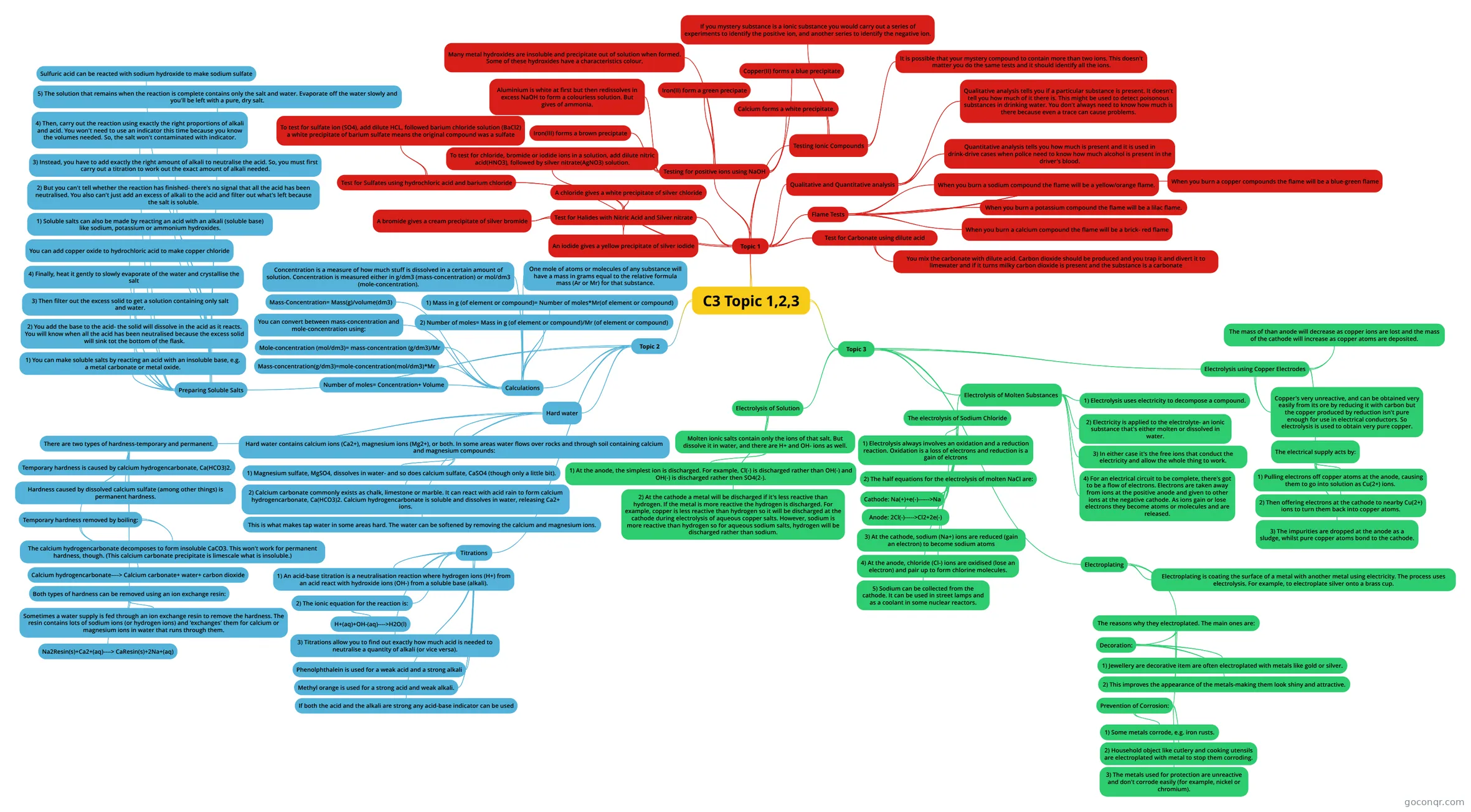
Mind map: C3 chemistry tests and electrolysis
Contenido del mapa
C3 Topic 1,2,3
Topic 1
- Qualitative and Quantitative analysis
- Qualitative analysis tells you if a particular substance is present. It doesn't tell you how much of it there is. This might be used to detect poisonous substances in drinking water. You don't always need to know how much is there because even a trace can cause problems.
- Quantitative analysis tells you how much is present and it is used in drink-drive cases when police need to know how much alcohol is present in the driver's blood.
- Testing Ionic Compounds
- If you mystery substance is a ionic substance you would carry out a series of experiments to identify the positive ion, and another series to identify the negative ion.
- It is possible that your mystery compound to contain more than two ions. This doesn't matter you do the same tests and it should identify all the ions.
- Testing for positive ions using NaOH
- Many metal hydroxides are insoluble and precipitate out of solution when formed. Some of these hydroxides have a characteristics colour.
- Calcium forms a white precipitate.
- Copper(II) forms a blue precipitate
- Iron(III) forms a brown preciptate
- Iron(II) form a green precipate
- Aluminium is white at first but then redissolves in excess NaOH to form a colourless solution. But gives of ammonia.
- Test for Halides with Nitric Acid and Silver nitrate
- To test for chloride, bromide or iodide ions in a solution, add dilute nitric acid(HNO3), followed by silver nitrate(AgNO3) solution.
- A chloride gives a white precipitate of silver chloride
- A bromide gives a cream precipitate of silver bromide
- An iodide gives a yellow precipitate of silver iodide
- Flame Tests
- When you burn a sodium compound the flame will be a yellow/orange flame.
- When you burn a potassium compound the flame will be a lilac flame.
- When you burn a calcium compound the flame will be a brick- red flame
- When you burn a copper compounds the flame will be a blue-green flame
- Test for Carbonate using dilute acid
- You mix the carbonate with dilute acid. Carbon dioxide should be produced and you trap it and divert it to limewater and if it turns milky carbon dioxide is present and the substance is a carbonate
- Test for Sulfates using hydrochloric acid and barium chloride
- To test for sulfate ion (SO4), add dilute HCL, followed barium chloride solution (BaCl2) a white precipitate of barium sulfate means the original compound was a sulfate
- Qualitative and Quantitative analysis
Topic 3
- Electrolysis of Molten Substances
- 1) Electrolysis uses electricity to decompose a compound.
- 2) Electricity is applied to the electrolyte- an ionic substance that's either molten or dissolved in water.
- 3) In either case it's the free ions that conduct the electricity and allow the whole thing to work.
- 4) For an electrical circuit to be complete, there's got to be a flow of electrons. Electrons are taken away from ions at the positive anode and given to other ions at the negative cathode. As ions gain or lose electrons they become atoms or molecules and are released.
- The electrolysis of Sodium Chloride
- 1) Electrolysis always involves an oxidation and a reduction reaction. Oxidation is a loss of electrons and reduction is a gain of elctrons
- 2) The half equations for the electrolysis of molten NaCl are:
- Cathode: Na(+)+e(-)------>Na
- Anode: 2Cl(-)----->Cl2+2e(-)
- 3) At the cathode, sodium (Na+) ions are reduced (gain an electron) to become sodium atoms
- 4) At the anode, chloride (Cl-) ions are oxidised (lose an electron) and pair up to form chlorine molecules.
- 5) Sodium can be collected from the cathode. It can be used in street lamps and as a coolant in some nuclear reactors.
- Electrolysis of Solution
- Molten ionic salts contain only the ions of that salt. But dissolve it in water, and there are H+ and OH- ions as well.
- 1) At the anode, the simplest ion is discharged. For example, Cl(-) is discharged rather than OH(-) and OH(-) is discharged rather then SO4(2-).
- 2) At the cathode a metal will be discharged if it's less reactive than hydrogen. If the metal is more reactive the hydrogen is discharged. For example, copper is less reactive than hydrogen so it will be discharged at the cathode during electrolysis of aqueous copper salts. However, sodium is more reactive than hydrogen so for aqueous sodium salts, hydrogen will be discharged rather than sodium.
- Molten ionic salts contain only the ions of that salt. But dissolve it in water, and there are H+ and OH- ions as well.
- Electrolysis using Copper Electrodes
- Copper's very unreactive, and can be obtained very easily from its ore by reducing it with carbon but the copper produced by reduction isn't pure enough for use in electrical conductors. So electrolysis is used to obtain very pure copper.
- The electrical supply acts by:
- 1) Pulling electrons off copper atoms at the anode, causing them to go into solution as Cu(2+) ions.
- 2) Then offering electrons at the cathode to nearby Cu(2+) ions to turn them back into copper atoms.
- 3) The impurities are dropped at the anode as a sludge, whilst pure copper atoms bond to the cathode.
- The mass of than anode will decrease as copper ions are lost and the mass of the cathode will increase as copper atoms are deposited.
- Electroplating
- Electroplating is coating the surface of a metal with another metal using electricity. The process uses electrolysis. For example, to electroplate silver onto a brass cup.
- The reasons why they electroplated. The main ones are:
- Decoration:
- 1) Jewellery are decorative item are often electroplated with metals like gold or silver.
- 2) This improves the appearance of the metals-making them look shiny and attractive.
- Prevention of Corrosion:
- 1) Some metals corrode, e.g. iron rusts.
- 2) Household object like cutlery and cooking utensils are electroplated with metal to stop them corroding.
- 3) The metals used for protection are unreactive and don't corrode easily (for example, nickel or chromium).
- Decoration:
- Electrolysis of Molten Substances
Topic 2
- Calculations
- One mole of atoms or molecules of any substance will have a mass in grams equal to the relative formula mass (Ar or Mr) for that substance.
- 1) Mass in g (of element or compound)= Number of moles*Mr(of element or compound)
- 2) Number of moles= Mass in g (of element or compound)/Mr (of element or compound)
- Concentration is a measure of how much stuff is dissolved in a certain amount of solution. Concentration is measured either in g/dm3 (mass-concentration) or mol/dm3 (mole-concentration).
- Mass-Concentration= Mass(g)/volume(dm3)
- You can convert between mass-concentration and mole-concentration using:
- Mole-concentration (mol/dm3)= mass-concentration (g/dm3)/Mr
- Mass-concentration(g/dm3)=mole-concentration(mol/dm3)*Mr
- Number of moles= Concentration+ Volume
- Hard water
- Hard water contains calcium ions (Ca2+), magnesium ions (Mg2+), or both. In some areas water flows over rocks and through soil containing calcium and magnesium compounds:
- 1) Magnesium sulfate, MgSO4, dissolves in water- and so does calcium sulfate, CaSO4 (though only a little bit).
- 2) Calcium carbonate commonly exists as chalk, limestone or marble. It can react with acid rain to form calcium hydrogencarbonate, Ca(HCO3)2. Calcium hydrogencarbonate is soluble and dissolves in water, releasing Ca2+ ions.
- This is what makes tap water in some areas hard. The water can be softened by removing the calcium and magnesium ions.
- There are two types of hardness-temporary and permanent.
- Temporary hardness is caused by calcium hydrogencarbonate, Ca(HCO3)2.
- Hardness caused by dissolved calcium sulfate (among other things) is permanent hardness.
- Temporary hardness removed by boiling:
- The calcium hydrogencarbonate decomposes to form insoluble CaCO3. This won't work for permanent hardness, though. (This calcium carbonate precipitate is limescale what is insoluble.)
- Calcium hydrogencarbonate----> Calcium carbonate+ water+ carbon dioxide
- Both types of hardness can be removed using an ion exchange resin:
- Sometimes a water supply is fed through an ion exchange resin to remove the hardness. The resin contains lots of sodium ions (or hydrogen ions) and 'exchanges' them for calcium or magnesium ions in water that runs through them.
- Na2Resin(s)+Ca2+(aq)----> CaResin(s)+2Na+(aq)
- Hard water contains calcium ions (Ca2+), magnesium ions (Mg2+), or both. In some areas water flows over rocks and through soil containing calcium and magnesium compounds:
- Titrations
- 1) An acid-base titration is a neutralisation reaction where hydrogen ions (H+) from an acid react with hydroxide ions (OH-) from a soluble base (alkali).
- 2) The ionic equation for the reaction is:
- H+(aq)+OH-(aq)---->H2O(l)
- 3) Titrations allow you to find out exactly how much acid is needed to neutralise a quantity of alkali (or vice versa).
- Phenolphthalein is used for a weak acid and a strong alkali
- Methyl orange is used for a strong acid and weak alkali.
- If both the acid and the alkali are strong any acid-base indicator can be used
- Preparing Soluble Salts
- 1) You can make soluble salts by reacting an acid with an insoluble base, e.g. a metal carbonate or metal oxide.
- 2) You add the base to the acid- the solid will dissolve in the acid as it reacts. You will know when all the acid has been neutralised because the excess solid will sink tot the bottom of the flask.
- 3) Then filter out the excess solid to get a solution containing only salt and water.
- 4) Finally, heat it gently to slowly evaporate of the water and crystallise the salt
- You can add copper oxide to hydrochloric acid to make copper chloride
- 1) Soluble salts can also be made by reacting an acid with an alkali (soluble base) like sodium, potassium or ammonium hydroxides.
- 2) But you can't tell whether the reaction has finished- there's no signal that all the acid has been neutralised. You also can't just add an excess of alkali to the acid and filter out what's left because the salt is soluble.
- 3) Instead, you have to add exactly the right amount of alkali to neutralise the acid. So, you must first carry out a titration to work out the exact amount of alkali needed.
- 4) Then, carry out the reaction using exactly the right proportions of alkali and acid. You won't need to use an indicator this time because you know the volumes needed. So, the salt won't contaminated with indicator.
- 5) The solution that remains when the reaction is complete contains only the salt and water. Evaporate off the water slowly and you'll be left with a pure, dry salt.
- Sulfuric acid can be reacted with sodium hydroxide to make sodium sulfate
- Calculations
Información
- Descripción
- GSCE (C3) Chemistry Mapa Mental sobre C3 Topic 1,2,3, creado por Rhys Evans el 15/02/2017.
- Creado por
- Rhys Evans
- Visitas
- 1
- Valoración